A Painting of the First Jubilee

Wandering the back rooms of Thrubworth, Alfred Tolland identified some of the found objects: “That oil painting on its side’s the First Jubilee. Very old fashioned in style. Nobody paints like that now.” [BDFR 74/ ]

Golden Jubilee Service Westminster Abbey William Ewart Lockhart, 1887 oil on canvas, 92 x 121 in Royal Collection, United Kingdom photo in public domain from Wikimedia Commons

Golden Jubilee Service Westminster Abbey
William Ewart Lockhart, 1887-1890
oil on canvas, 92 x 121 in
Royal Collection, United Kingdom
photo in public domain from Wikimedia Commons

The first jubilee, of course, was Queen Victoria’s Golden Jubilee in 1887, as opposed to her Diamond Jubilee in 1897. The jubilees were commemorated with innumerable paintings, busts, coins, plates and other curios, which became so commonplace that even today most have little value as antiques. No wonder that the painting was not on display at Thrubworth in 1946.
We show a painting of the first jubilee by William Ewart Lockhart, 1846-1900, a fellow of the Royal Scottish Academy, who spent 3 years completing the painting. Lockhart’s  work has been described as”marked by considerable bravura of execution and much brilliance of colour, but are rather wanting in refinement and subtlety, (Caw in Dictionary of National Biography, 1901). ” The painting cast aside at Thrubworth may have been even less distinguished than Lockhart’s, but we suspect that Alfred Tolland’s comment, “very old fashioned in style,” referred not to the refinement or subtlety of the work but rather to the realistic representation that was predominant at the time but was being replaced by  the evolving styles of the late nineteenth and early twentieth centuries.

(c) Wallingford Town Council; Supplied by The Public Catalogue Foundation

Queen Victoria
George Dunlop Leslie and James Hayllar, 1883
oil on canvas, 53 x 42 in. Wallingford Town Hall, Britain photo (c) Wallingford Town Council via BBC Your Paintings

Queen Victoria Alexander Bassano,1882 half-plate glass negative The National Porttrait Gallery, © National Portrait Gallery, London

Queen Victoria
Alexander Bassano,1882
half-plate glass negative
The National Porttrait Gallery,
© National Portrait Gallery, London

Realistic painting was being eclipsed by photographs. In homes less prosperous than Thrubworth, a photographic portrait of Victoria, like those of Alexander Bassano (1829-1913), was one of the common mementos of the Queen’s Jubilee.

Posted in Uncategorized | Leave a comment

Church Memorials

We have already noted Jenkins’ interest in public monuments like those in St. Paul’s and the tension between his devotion to Modernism and his nostalgia for the unapologetic patriotism of earlier generations.  Now we will turn to more personal memorials. Within a few months, Jenkins attended the funerals first for George Tolland and later for Erridge at the family church, where the family’s memorials went back to the mid eighteenth century, starting with “a tomb in white marble, ornate but elegant, surrounded by sepulchral urns and trophies of arms” for the 1st Earl of Warminster and including a “portrait medallion, like gray marble against an alabaster background, of the so-called ‘chemist-Earl,’ depicted in bas relief with side whiskers and a high collar…” [BDFR 48-49/42-43].

by Frank Bowcher, Wedgwood medallion, 1897

Sir J.D. Hooker
Frank Bowcher, 1897
Wedgwood medallion
photo by Stephen Craven via the Victorian Web

These monuments are, of course, fictictious. We show, at right, a Victorian portrait medallion memorializing another scientist, the botantist Sir Joseph Dalton Hooker. The medallion that we show is Wedgewood and served as the model for a marble medallion of Hooker in Westminster Abbey.

In TKBR Powell gives a more detailed example of the cultural and historical significance of the memorials in a local church and reveals that he, like Jenkins, sees these monuments as both a manifestation of the evolution of modern visual art and an evocative expression of strong emotions. Powell recounts that a family, the Horners, had been resident for years in a Manor House at Mells, England, near Powell’s country house, and buried their dead at St. Andrew’s Church in Mells [TKBR 342-344].

Laura Lyttelton memorial Edward Burne-Jones, 1886 gesso on wood, height 8-9 feet Mells Church photo from Britainexpress.com

Laura Lyttelton memorial
Edward Burne-Jones, 1886
gesso on wood, height 8-9 feet
Mells Church
photo from Britainexpress.com

In the first three centuries, they built few monuments in the church; however, between the late nineteenth century and the aftermath of the first war, they built three memorials in which Powell saw a “haunting sense of their time;”  he sees an 1886 mural tablet to Laura Lyttelton, by Edward Burne-Jones, as an example of the way that late nineteenth century work was “heralding the explosion” of Modernism and contrasts the Lyttelton memorial with the more traditional memorial to Edward Horner and the simpler memorial to Raymond Asquith, who both lost their lives in the First World War, as examples of changing styles of artistic patriotic expression. The Asquith memorial has been despoiled by looters, so we cannot show what moved Powell:

“Something about the whole conception of the memorial — which would have been different a few years earlier or a few years later, one could almost say a few months in each case — bring back with a force comparable to no other monument I can thing of an overwhelming sense of the first war, its idealisms, its agonies, its tragedies. [TKBR 344] “

Memorial to Edward Horner
Sir Alfred Munnings, base by Sir Edwin Lutyens, 1917
St. Andrews Church, Mells, England
Photo by Tom Oates. Original uploader was Nabokov at en.wikipedia (a.k.a. Tom Oates)

After George died, Erridge took up George’s project of commissioning a memorial stained glass window to their grandfather [BDFR  95/89].  Perhaps the Tolland brothers envisioned a window like that shown behind the Horner equestrian statue. That window was designed  by William Nicholson (1872-1949) as part of the Horner memorial

Posted in Uncategorized | Leave a comment

Simian Appearances

Jenkins describes Sillery:

Perhaps illusorily, his body and face had shrunk, physical contraction giving him a more simian look than formerly, though of no ordinary monkey; Brueghel’s Antwerp apes (admired by Pennistone) rather than the Douanier’s homely denizens of Tropiques, which Soper, the Division Catering officer, had resembled. [BDFR 11/7]

Jenkins has previously mentioned Pennistone’s admiration of Pieter Brueghel the Elder’s Two Monkeys, which he had seen in Berlin. Here Jenkins refers to another Brueghel singerie, this one by Jan Brueghel the Elder, Pieter Brueghel the Elder’s son.  Jan Brueghel’s painting anthromorphizes the monkeys, satirizing human folly.

Jan_Breughel_I-Singerie

Singerie
Jan Brueghel the Elder, 1620s
oil on copper ,11 x 14 in
Rubenhuis, Antwerp on loan from a private collection

The picture is currently in the Rubens Museum (Rubenshuis) in Antwerp, the city where Peter Paul Rubens and Jan Brueghel lived and collaborated (Woollet and  Suchtellen  Rubens and Brueghel: A Working Friendship). Barely discernible at the upper right, just above the door, is a copy of Rubens and Frans Snyders’  Ceres and Pan (1620), which is currently in the Prado. The contrast between the cultivating goddess Ceres and the passionate god Pan is a comment on the tension between human culture and the wild monkeys; however, we perceive the always wily Sillery as now wizened rather than wild.

The Douanier is the nickname of the French painter Henri Rousseau (1844-1910).  A douanier is a toll or tax collector, which was Rousseau’s occupation from 1871 until about 1893. He started painting seriously about the mid 1880s, in an unschooled manner that seemed primitive to his contemporaries but sophisticated to today’s eyes.  He never left France, observing the foliage for his tropical paintings chiefly in Paris’ botanical garden, the Jardin des Plantes.

Picasso introduced Rousseau to many rising artists of the School of Paris, who were influenced by his distinctive style.  When he died, Appolinaire wrote his epitaph, which was chiseled into the grave stone by Brancusi: “We salute you Gentle Rousseau. You can hear us, Delaunay, his wife, Monsieur Queval, and myself. Let our luggage pass duty free through the gates of heaven. We will bring you brushes, paints, and canvas that you may spend your sacred leisure in the light of truth painting, as you once did, my portrait facing the stars.”

Tropiques Henri Rousseau, 2007 private collection photo from HenriRousseau.org

Tropiques
Henri Rousseau, 1907
oil on canvas, 44 x 64 in
private collection
photo from HenriRousseau.org

Perhaps Powell saw Tropiques (The Tropics, also known as Apes in the Orange Grove) on a trip to New York. Adelaide Milton de Groot owned it in France and first lent it to the Metropolitan Museum in about 1936.  Incidentally, shortly after BDFR was published (1971), Tropiques made news when the Met sold it back into private hands. Another Rousseau simian scene, Tropical Forest with Monkeys (2010), is owned by the National Gallery, Washington. Rousseau’s monkeys have flat, deadpan, perhaps sad, faces, nothing like the varied distinct personalities shown by Brueghel.


Posted in Uncategorized | 1 Comment

The Anatomy of Melancholy

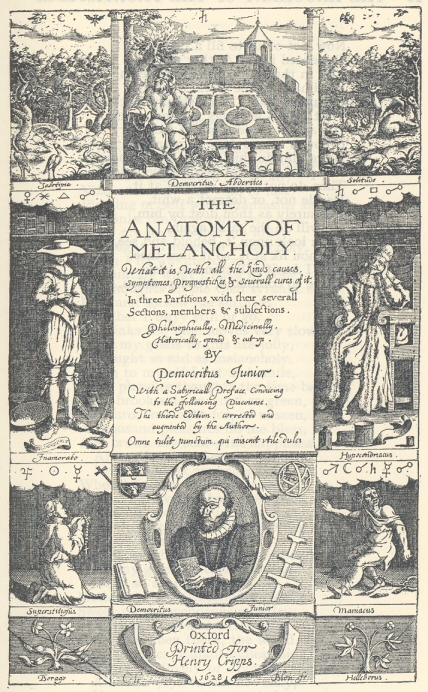
In describing his own state of irresolute depression after the war, Nick invokes Robert Burton’s seventeenth century treatise on the condition, The Anatomy of Melancholy.  Nick cites Burton’s own copious descriptors of the magnum opus itself, and then describes its famous frontispiece:

“The title page showed not only Burton’s own portrait in ruff and skullcap, but also figures illustrative of his theme; love-madness; hypocondriasis, religious melancholy.  The emblems of jealously and solitude were there too, together with those sovereign cures for melancholy and madness, borage [bottom left] and hellebore [bottom right].  Burton had long been a favorite of mine.” [BDFR 6-7/2]

frontispiece The Anatomy of Melancholy Robert Burton original edition, 1621 book in public domain page from ebooks.adelaide.edu

frontispiece
The Anatomy of Melancholy
Robert Burton
original edition, 1621
frontispiece, added to third edition, 1628 engraver Christian Le Blon book in public domain
page from ebooks.adelaide.edu

Burton first published The Anatomy of Melancholy in 1621, but no original manuscript now exists.  The text was reprinted five times in Burton’s own lifetime and in numerous versions and revisions since. The title page Nick refers to dates from the third edition (1628) and is attributed to one Christian Le Blon, about whose work we found no examples but this.  It appears to be a wood engraving that would have served to furnish sufficient copies for a limited edition of the Anatomy.  For the 1632 edition, Burton added an “Argument of the Frontispiece,” in verse to explain the meaning of each of the 10 “Squares.”  Le Blon’s technical execution is quite refined, but his drawing style is somewhat rustic, even a bit loopy or jokey, which might have suited Burton’s opus well, alternating as it does between scientific text and parody of the exhaustive and exhausting tone of such texts.

Posted in Uncategorized | 1 Comment

Trajan’s Column

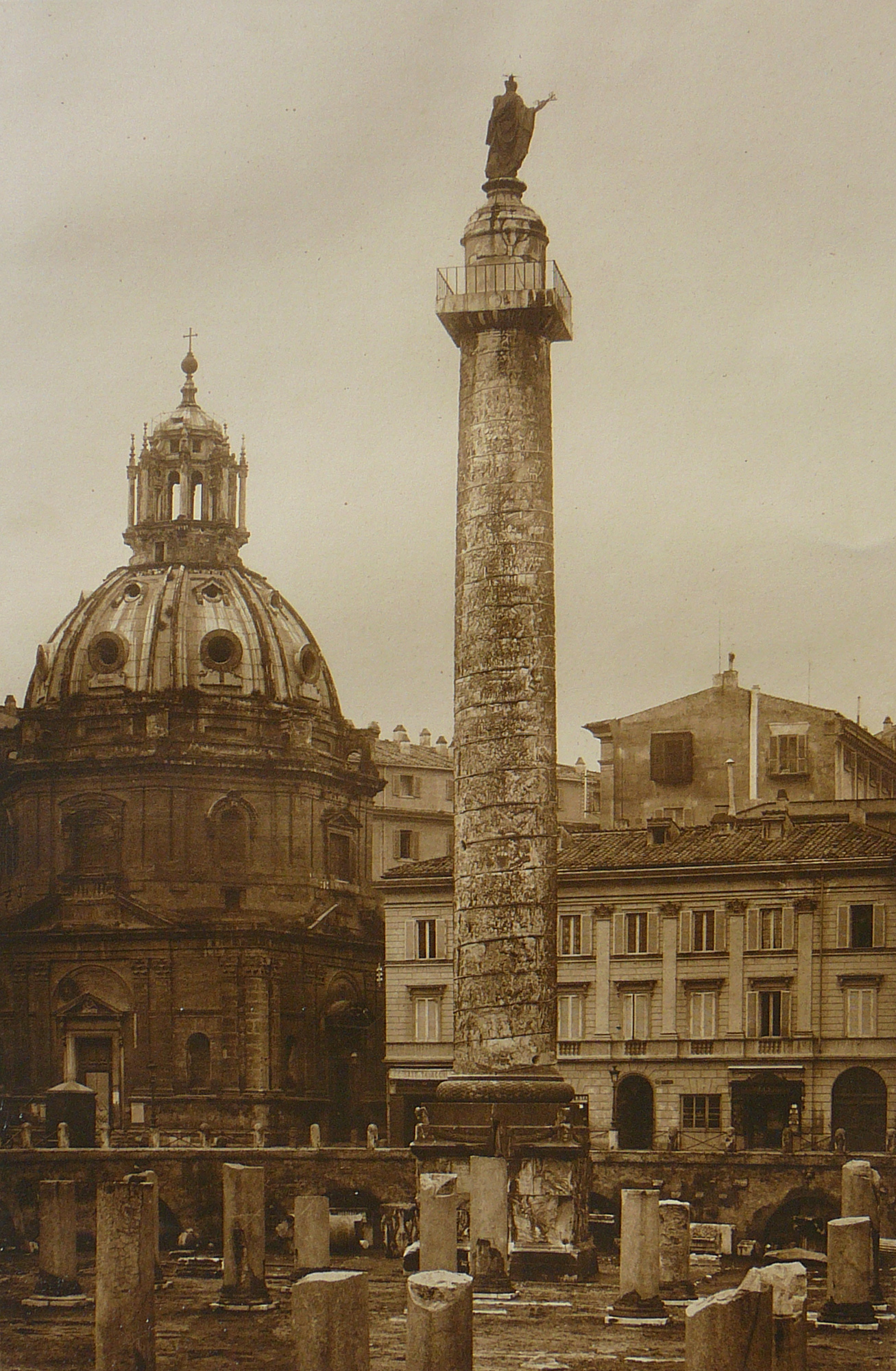
After the war, Nick returns to university to write a book about Robert Burton, but finds the return of his memories of undergraduate years oddly depressing.  “The odd thing was how distant the recent past had also become, the army now as stylized in the mind—to compare another triumphal frieze—as the legionaries of Trajan’s Column, exercising, sacrificing, sweating at their antique fatigues, silent files on eternal parade to soundless military music.” [BDFR 1].

Nick is comparing his memory of military service during the war to war’s representation on Trajan’s Column, erected in AD 113 in the Trajan Forum in Rome. It was built to commemorate and glorify the Emporer Trajan’s two victorious campagns against the Dacians, a people living in what is now Moldova, Romania, and parts of neighboring Ukraine, Bulgaria, Serbia, and Hungary .

Trajan’s Column Sculptor: possibly Apollodorus of Damascus, 113 AD Rome photo in public domain by Conrad Cichorius: “Die Reliefs der Traianssäule”, Erster Tafelband: “Die Reliefs des Ersten Dakischen Krieges”, Tafeln 1-57, Verlag von Georg Reimer, Berlin 1896 via Wikimedia Commons

The monument stands 35 meters high, a column of Cararra marble carved in an upward-winding spiral with a continuous, elegant freize depicting episodes from the campaigns in bas relief. The labors of war are depicted in exquisite detail, but the chaos and heartache of war are replaced by stylized order and rhythmic beauty. Originally, a bronze statue of Trajan stood at the top of column; it was replaced in the sixteenth century by a bronze Saint Peter.


Trajan's Column detail plaster cast, 1864 Victoria and Albert Museum, London copyright Victoria and Albert Museum, photo displayed with permission

Trajan’s Column detail
plaster cast, 1864
Victoria and Albert Museum, London
copyright Victoria and Albert Museum, photo displayed with permission

Nick has not told us about any travel to Rome. Perhaps, he knew Trajan’s column from the full size plaster cast, made in 1864, that is displayed in London at the Victoria and Albert Museum. Because of effects of time and pollution on the original column, the detail is better studied on the plaster cast reproduction.

The incised script at the base of the column is as stylized as the bas relief army.  This inscription is the preeminent example of the elegant Roman capital alphabet.

Inscription, base of Trajan's Column 169 A..D. Rome photo by Aulldemolins from Wikimedia Commons by Creative Commons licence

Inscription, base of Trajan’s Column
113 A..D.
Rome
photo by Aulldemolins from Wikimedia Commons by Creative Commons licence

Trajan™ Adobe type face Carol Twombly, 1989 image from GearedBull at English Wikipedia in Wikimedia Commons

Trajan™ Adobe type face
Carol Twombly, 1989
image from GearedBull at English Wikipedia in Wikimedia Commons

In the later twentieth century, this Roman capital script has been adapted into one of the more popular digital fonts, shown at left.

Trajan’s glorification of victory has many descendants: Trajan type face in the titles of epic movies, plaster cast bas reliefs in museums, imitative columns all over the world. Our last post from MP left Nick depressed at the memorial service in Saint Paul’s; at the beginning of BDFR, his post-war depression continues, and he fears that actual painful memories of war will be distorted or obscured in the idealized images of memorial art. We suspect that Nick’s anxiety is that memory itself is the art that necessarily stylizes our most painful experiences into stories that we can bear to tell ourselves.

Posted in Uncategorized | 1 Comment

Monuments in St Paul’s

On a Sunday in August, 1945, Jenkins accompanied the Allied military attachés to a service of General Thanksgiving at St. Paul’s Cathedral. Seated in the south transcept, he surveyed the surrounding “huge marble monuments in pseudo-classical style.” [MP 219/214 ] Recalling that some of the monuments had been described in The Ingoldsby Legends, a book that his mother read to him in childhood, he remembered: [MP 221/216 ]

… Sir Ralph Abercrombie going to tumble

With a thump that alone were enough to dispatch him

If the Scotchman in front shouldn’t happen to catch him.

The Ingoldsby Legends are stories and poems published between 1837 and 1847 by Richard Harris Barnham.  Jenkins is quoting from the one of the poems, The Cynotaph, which begins:

Oh! where shall I bury my poor dog Tray,

Now his fleeting breath has pass’d away?

 A ‘cynotaph’ or ‘dog’s tomb’ is not to be confused with a ‘cenotaph.’ In the poem Barnham proceeds to exclude St. Paul’s as a burial place after reviewing memorials such as those of Abercrombie and Sir John Moore.

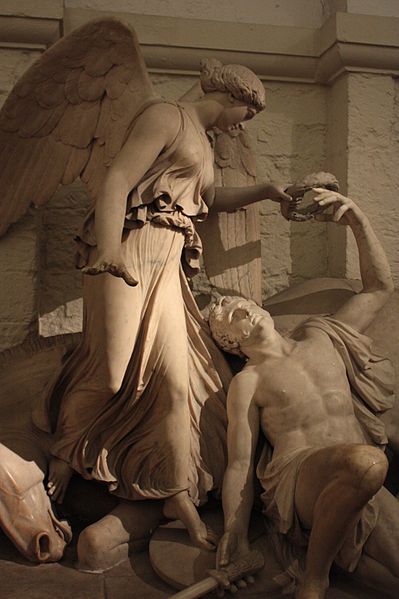
Memorial for Lieutenant General Sir Ralph Abercrombie, K. B. Sir Richard Westmacott, RA, 1801 Marble St. Paul's Cathedral, London photo courtesy of Geogre P. Landow and the Victorian Web

Memorial for Lieutenant General Sir Ralph Abercrombie, K. B.
Sir Richard Westmacott, RA, 1801
Marble
St. Paul’s Cathedral, London
photo courtesy of Geogre P. Landow and the Victorian Web

Sir Ralph Abercrombie or Abercromby (1734-1801) was in the British Army from 1756 until his death. He served in the Seven Years War, in the French Revolutionary Wars, including important commands in the Caribbean, and in Ireland during the Irish rebellion. He was a  Lieutenant-General when he died while leading troops in battles to regain Egypt from France.  After his death, the House of Commons voted that a monument be built in his honor in St. Paul’s. Sir Richard Westmacott (1775-1856) did this momument early in his productive career, during which he produced the Achilles statue honoring the Duke of Wellington and many others still visible in the squares of London and elsewhere in the Commonwealth.

Coincidentally, the French writer Stendhal also knew these monuments. Powell admired the diaries of Stendhal more than he enjoyed the pioneering realistic novels The Red and The Black (1830) and The Charterhouse of Parma (1839) [TKBR p.181]. When Stendhal visited St. Paul’s in August, 1817,  he ridiculed the heavy style of the Abercrombie monument; Jenkins seems to accept this criticism but reflects:

Nevertheless, one felt glad it remained there. It put on record what was then officially felt about death in battle, begging all that large question of why the depiction of action in the graphic arts had fallen in our own day almost entirely into the hands of the Surrealists. [MP 221/216 ]
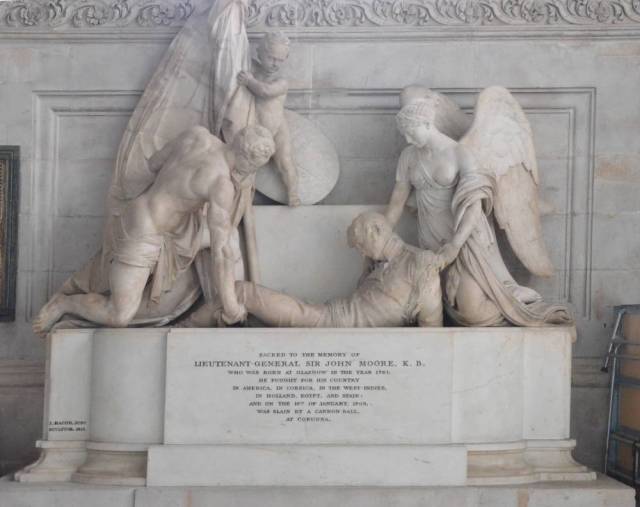
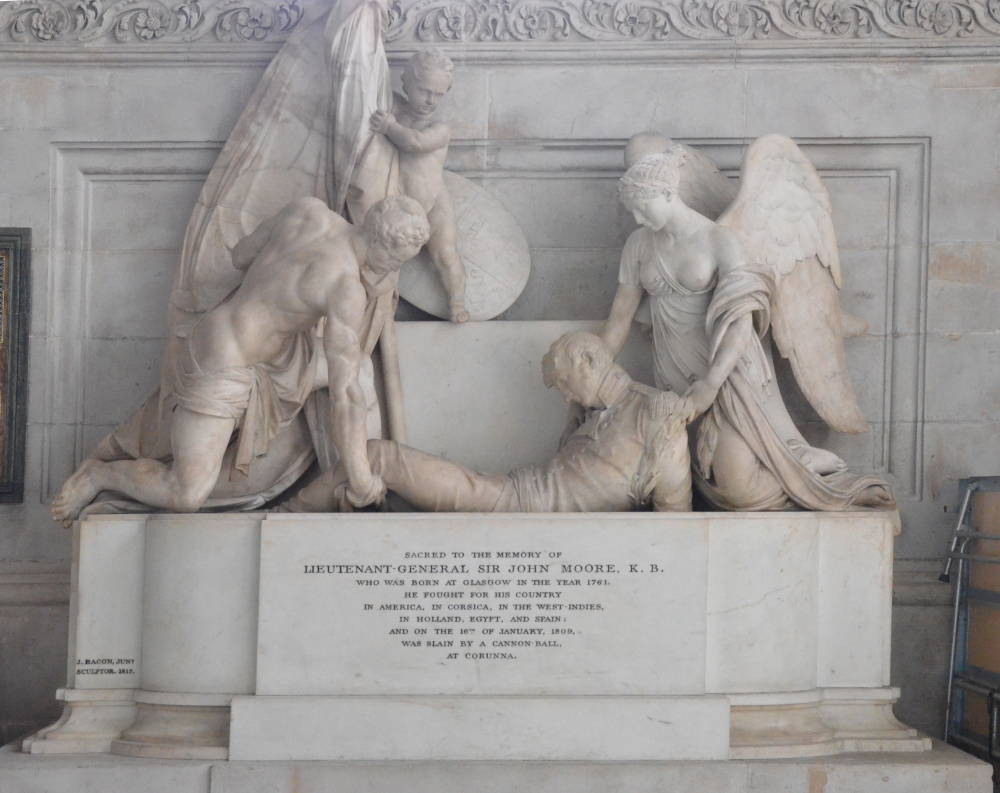
Monument to Lieutenant-General Sir John Moore, K.B. John Bacon, Jr, St. Paul's Cathedral, London photo courtesy of George P. Landow and the Victorian Web

Monument to Lieutenant-General Sir John Moore, K.B.
John Bacon, Jr,
St. Paul’s Cathedral, London
photo courtesy of George P. Landow and the Victorian Web

Stendahl preferred the tomb of Sir John Moore (1761-1809), another Lieutenant-General honored with a memorial in St. Paul’s. His service included the American War of Independence, the French Revolutionary Wars, the Irish Rebellion, the Anglo-Russian invasion of Holland, and the war against France in Egypt and Syria,  ending with his death at the battle of Corunna during the Penisular War in Iberia. John Bacon, Jr. (1877-1859) sculpted Moore’s monument, five other monuments in St. Pauls, and many others in Westminster Abbey and other British sites. Jenkins gives Barnham’s desciption of the scene:

Where the Man and the Angel have got Sir John Moore,
And are quietly letting him down through the floor,

Monument to Major General Ponsonby designed by R. Theed, RA; executed by E. H. Bailey, RA, 1815 marble St. Paul's Cathedral, London photo by Stephencdickson via Wikimedia Commons

Monument to Major General Ponsonby
designed by R. Theed, RA; executed by E. H. Bailey, RA, 1815
marble
St. Paul’s Cathedral, London
photo by Stephencdickson via Wikimedia Commons

Jenkins looked around for what Barnham called “that Queer-looking horse that is rolling on Ponsonby,” but did not see it because Ponsonby’s monument is at the north end of the cathedral. [MP 222/217].

The service seemed cold and depressing to Jenkins; however, the monuments recalled warmer days of his childhood before World War I. The music of time seems to echo off the monuments, which patriotically commemorate the protracted hostilities with the French in the late eighteenth and early nineteenth centuries. Barnham’s poem,The Cynotaph, reveals a Victorian sense of humor regarding the bombastic character of the sculptures in St. Paul’s.  But the arch-Modernist Jenkins, exhausted by the unremitting sorrows of the war, is touched by a faint nostalgia for a pre-Modern moment when artists could celebrate patriotic valor without a hint of self-consciousness or embarrassment.

Posted in Uncategorized | 4 Comments

Art Nouveau wallpaper

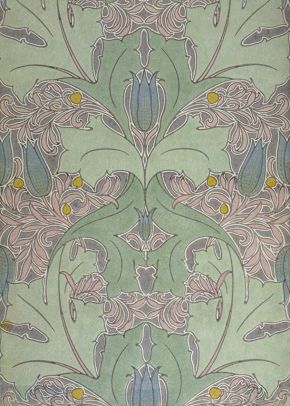
Jenkins attends an Indian embassy party. “The huge saloons, built at the turn of the century, were done up in sage green, the style of decoration displaying a nostalgic leaning toward Art Nouveau, a period always sympathetic to Asian taste.” [MP 204-205/199]

Wallpaper C.F.A. Voysey ~1899 England Victoria and Albert Museum, London

Wallpaper
C.F.A. Voysey ~1899
England
© Victoria and Albert Museum, London

The term Art Nouveau was introduced in the 1890s in a Belgian journal, L’Art Moderne.  The style prospered in France, propelled in part by a gallery, L’Art Nouveau, owned by Siegfried Bing. The movement championed flowing designs based on shapes derived from plants and vines.  Think of the iron-work entries of the Paris Metro and the graphics used to advertise that subway system. The French vogue for japonisme is seen in many of the works. William Morris and the Arts and Crafts Movement influenced British Art Nouveau.

We can imagine the wallpaper shown at left in the embassy rooms.  C.F.A. Voysey (1857-1941) was an English architect and designer who was particularly well known for his wallpaper. The Victoria and Albert Museum has a fine collection of his work. In 1896 The Studio, a magazine that championed Art Nouveau and Arts and Crafts, proclaimed, “Now a ‘Voysey wall-paper’ sounds almost as familiar as a ‘Morris chintz’ or a ‘Liberty silk’.” ( Studio International, vol. 7, p. 209 ) Exactly which works qualify as Art Nouveau is debated; some critics dismiss Voysey’s work as too “Art Nouveau artsy” and others separate his pieces from the Art Nouveau movement.

Posted in Uncategorized | 1 Comment

Ensor’s Entry of Christ into Brussels


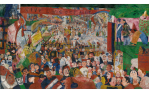
Nick’s cohort of officers makes its way across Belgium into Brussels. “When we drove into the city’s main boulevards, their sedate nineteenth-century self-satisfaction, British troops everywhere, made our cortege somewhat resemble Ensor’s Entry of Christ into Brussels, with soldiers, bands and workers’ delegation.” [MP 174/169-170]

Christ's Entry into Brussels in 1889 James Ensor, 1888 oil on canvas,100 x 170 in. Getty Center, Los Angeles © 2014 Artists Rights Society (ARS), New York / SABAM, Brussels

Christ’s Entry into Brussels in 1889
James Ensor, 1888
oil on canvas,100 x 170 in.
Getty Center, Los Angeles
© 2014 Artists Rights Society (ARS), New York / SABAM, Brussels

Nick is referring to James Ensor’s huge and arresting painting, also known as Christ’s Entry into Brussels in 1889, now in the Getty Museum.  Because of copyright limitations, we show only a thumbnail image; go to the Getty, or at least to the Getty website, to appreciate the energy of this painting or just to search the canvas for the “Colman’s ‘Mustart’ advertisement spelt wrong.” [MP 174/169-170]

Ensor was, before Rene Magritte, perhaps Belgium’s most well-known modernist painter.  He was a controversial figure in art due to his radical expressionist tendencies before the term Expressionist came to describe a recognized movement in the twentieth century.  Christ’s Entry into Brussels was stiff medicine even among the coterie that Ensor formed around him, known as Les XX, and, hence, was not exhibited publicly until 1929, thirty years after its creation.  The painting depicts a Christ almost invisible amidst a throng of workers, clerics, politicians, vagrants, revelers and grotesques, deliberately rendered by Ensor in a rude hand that simultaneously points back toward Pieter Brughel and forward to the likes of George Grosz and Otto Dix.

Nick’s evocation of Ensor’s vision does not, we think, place the emphasis on the Allied officers’ role as saviors of Belgium, but rather suggests the near invisibility of their arrival amidst the churning chaos during the wind-down of the war.


Posted in Uncategorized | Leave a comment

Impressionist Views of Normandy

At the Grand Hotel in Cobourg, Normandy, Nicholas sees:

In the early morning light, the paint on the side walls of the hotel had taken on a pinkish tone, very subtle and delicate, blending gently with that marine vapourness of atmosphere so enthusiastically endorsed by the Impressionists when they painted this luminous northern shore. [MP 170-171/167-168 ]

Boats on the Beach at Etretat Claude Monet, 1883 oil on canvas private collectdion photo in public domain from WikiArt.org

Boats on the Beach at Etretat
Claude Monet, 1883
oil on canvas
private collectdion
photo in public domain from WikiArt.org

Impressionsts, Normandy — Monet immediately springs to mind, but we think that Whistler’s seascapes are more appropriate to this reference.

Harmony in Blue and Silver James McNeill Whistler, oil on canvas, 20 x 30 in Isabella Steward Garner Museum, Boston www.gardnermuseu.org

Harmony in Blue and Silver
James McNeill Whistler,
oil on canvas, 20 x 30 in
Isabella Steward Garner Museum, Boston
http://www.gardnermuseu.org

Proust stayed at the Grand Hotel in Cobourg every summer from 1907 through 1914.  Jenkins recalls the connection:

‘Just spell out the name of that place we stopped over last night, Major Jenkins,’ said Cobb.

‘C-A-B-O-U-R-G, sir.’

As I uttered the last letter, scales fell from my eyes. Everything was transformed. It all came back — like the tea-soaked madeleine itself — in a torrent of memory … Cabourg … We had just driven out of Cabourg … out of Proust’s Balbec. [MP 172/167-168]

Jenkins lists many of Proust’s characters who had visited the Grand Hotel: Albertine, Saint-Loup, Bloch, Charlus. “Here Elstir had painted; Prince Odoacer played golf.” [MP 172/167-168]

We quote Proust without pastiche:

But just as Elstir, when the bay of Balbec, losing its mystery, had become for me simply a portion interchangeable with any other, of the total quantity of salt water distributed over the earth’s surface, had suddenly restored  to its personality of its own by telling me that is was the gulf of opal painted by Whistler in his Harmonies in Blue and Silver … [In Search of Lost Time, Volume III: The Guermantes Way  Enright/Kilmartin/Moncrieff translation]

Whistler was an important figure to Proust; among painters, in his novel, Proust mentions only Vermeer and Rembrandt more than Whistler . They met only once, and Proust came away with a pair of Whistler’s gloves as a souvenir. Whistler actually painted Harmonies in Blue and Silver at Trouville-sur-Mer, a number of miles east of Cabourg, but on the shifting sands of fact and fiction that Proust and Powell sift so elegantly, we can easily join Jenkins in imagining the beach at Balbec

Posted in Uncategorized | 2 Comments

Jan Steen

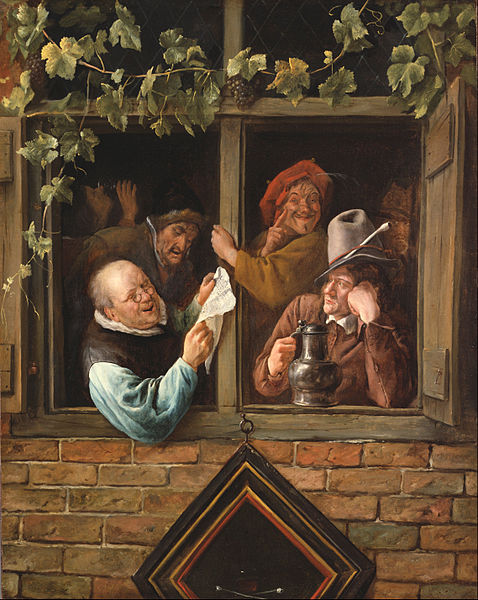
Jenkins writes about the Dutch military attaché Colonel Van der Voort, “whose round florid clean-shaven face looked more that ever as if it peered out of a Jan Steen canvas. Van der Voort was in his most boisterous form, seeming to belong to some anachronistic genre picture, Boors at an Airport or The Airfield Kermesse, executed by one of the lesser Netherlands masters. [MP 159/154]

Rhetoriticians at a Window Jan Steen, 1661-1666 Oil on canvas, 30 x 23 in Philadelphia Museum of Art photo in public domain from Wikimedia.org

Rhetoriticians at a Window
Jan Steen, 1661-1666
Oil on canvas, 30 x 23 in
Philadelphia Museum of Art
photo in public domain from Wikimedia.org

Jan Steen (1626-1679) qualifies as a lesser Dutch master from the Golden Age. He went to the same Latin school attended by his contemporary, Rembrandt van Rijn. He was so well known for his boisterous genre paintings that a “Jan Steen household” became a Dutch phrase for a chaotic scene, “the standard by which all later family dysfunction can be measured” (Heilbrunn Timeline of Art History). The men pictured at the left are members of a rhetoric club, a type of dramatic and literary society popular at the time.

Jenkins has previously compared Colonel Van der Voort’s face to those of clowns by Teniers or Brouwer. The round face of the man at the lower left, reading a paper to his companions, reinforces the image.

 A Kermesse, by the way, is a Dutch or Flemish term for a fair or festival, originating from kerk (church) and mis (mass), and now used in English as “kermis” or “kirmess.”


zs

Posted in Uncategorized | Leave a comment