Polish Portrait Painters

Jenkins served for a time as a liason to the Polish Army in Exile. He describes Michalski, one of the Polish aides-de-camp of his acquaintance: “Of large size, sceptical about most matters, he belonged to the world of industrial design — statuettes for radiator caps and such decorative items–working latterly in Berlin, which had left some mark on him of its bitter individual humor. In fact Pennistone always said talking to Michalski made him feel he was sitting in the Romanisches Café. His father had been a successful portrait painter, and his grandfather before him, stretching back to a long line of itinerant artists wandering over Poland and Saxony.

‘Painting pictures that are now being destroyed as quickly as possible,’ Michalski said.” [MP 31/27]

At times Powell’s artistic references pertain to a specific work, perhaps previously unknown to many of his readers (for example, The Omnipresent); other times, he is referring to an artistic fantasy, rather than to a real painting (for example, The Boyhood of Widmerpool).  Pennistone is modeled on Powell’s friend and commanding officer Alexander Dru; many of the military attachés who appear in MP are modeled closely on officers Powell knew (TKBR 282-283). Was there a real family of artists like the Michalskis or is Powell simply paying homage here to a long tradition of Polish portraiture?
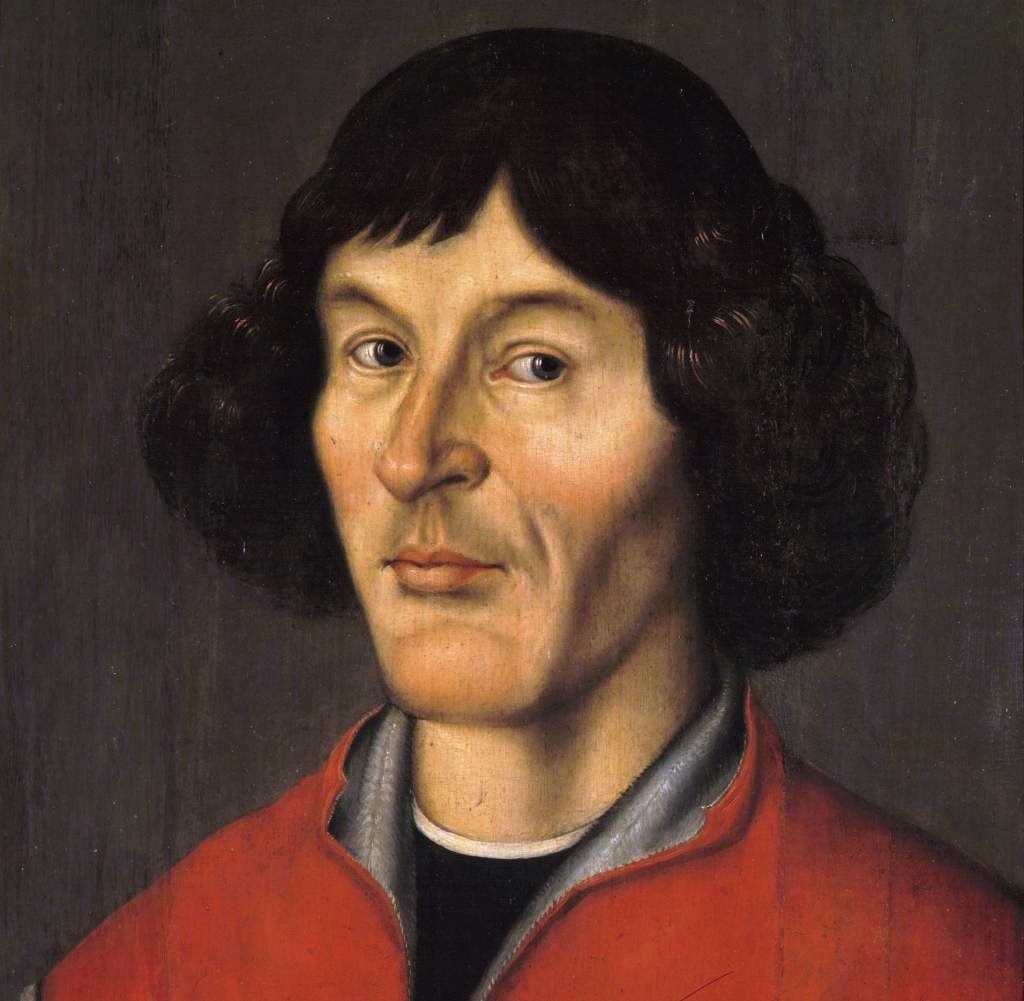
Nicholas Copernicus artist unknown, 1580 tempera and oil on wood Regional Museum, Torun, Poland photo in public domain from Wikimedia Commons, source http://www.frombork.art.pl/Ang10.htm

Nicholas Copernicus
artist unknown, 1580
tempera and oil on wood, 20 x 16 in
Regional Museum, Torun, Poland
photo in public domain from Wikimedia Commons, source http://www.frombork.art.pl/Ang10.htm


Treasures from Poland, an exhibition of Polish art organized by the Art Institute of Chicago, showed Polish portrait painting dating from the Renaissance (as shown above)  to the present. We have found a multigenerational family of Polish painters to illustrate this theme.

Juliusz Fortunat Kossak (1824 – 1899) specialized in historical and battle scenes; his portraits were of the military.

Prince Józef Poniatowski Juliusz Kossak, 1897 oil on canvas photo in public domain from Wikimedia Commons

Prince Józef Poniatowski
Juliusz Kossak, 1897
oil on canvas
photo in public domain from Wikimedia Commons

His son, Wojciech Kossak (1856 – 1942), also painted patriotic scenes; his twin brother was a renown freedom fighter. Wojciech’s portrait of Pilsudski is shown below.  Piłsudski on Horseback Wojciech Kossak, 1928 oil on canvas, 43 x 36 in National Museum, Warsaw photo in public domain from Wikimedia Commons, source http://artyzm.com/e_obraz.php?id=1616

Piłsudski on Horseback
Wojciech Kossak, 1928
oil on canvas, 43 x 36 in
National Museum, Warsaw
photo in public domain from Wikimedia Commons, source http://artyzm.com/e_obraz.php?id=1616

Lancer Watering Horses Jerzy Kossak, 1937 oil on cardboard auctioned by Agra-Art, Warsaw, 2011 All rights to photo reserved by www.artvalue.com

Lancer Watering Horses
Jerzy Kossak, 1937
oil on cardboard
auctioned by Agra-Art, Warsaw, 2011
All rights to photo reserved by http://www.artvalue.com

Jerzy Kossak (1886-1955) , son of Wojciech, followed the family tradition of painting military scenes but was not as revered as his forebears. He served in the Polish army during the First World War, but we are unsure what he did during the Second.

We have no strong evidence that Powell was thinking about the Kossaks, but we  do know that Michalski’s worries about the continued existence of his family’s work reflected what was actually happening in Poland during the war. The Germans occupying Poland were destroying or plundering not only ‘degenerate art‘ and Jewish art, but also any art that might remind the Poles of their national heritage. Some of Wojciech Kossak’s works were among the art that disappeared during the Nazi occupation.


Posted in Uncategorized | 1 Comment

Emotional Colors

Stringham tells Nick about the time Lord Bridgnorth’s butler served macaroni to His Royal Highness the Duke of Connaught but failed to provide a plate on which to eat it. “I shall never forget my ex-father-in-law’s face, richly tinted at the best of times — my late brother-in law, Harrison Wisebit, used to say Lord Bridgnorth’s complexion recalled Our Artist’s Impression of the Hudson in the fall. On that occasion it was more like the Dutch tulip fields in bloom.” [SA 77/ 76]

We are unsure of the identity of “Our Artist,” but perhaps this a reference to The Hudson River School, a group of nineteenth century American painters who presented a dramantic yet realistic vision of American landscape. Thomas Cole (1801-1848) was born in Britain but moved to America, where he founded the movement; Cole wrote: “There is one season when the American forest surpasses all in the world in gorgeousness — that is the autumnal; — then every hill and dale is riant in the luxury of colour — every hue is there, from the liveliest green to the deepest purple from the most golden yellow to the intensest crimson. ” [“Essay on American SceneryThe American Monthly Magazine 1 (January, 1839)] We show a work by Thomas Worthington Whittredge (1820-1910 ), a later member of the Hudson River School, to illustrate how varied those hues can be.

The Artist at His Easel Thomas Worthington Whittedge ,~1891 oil on paper on panel, 12 x 9 in Private collection photo in public domain from  The Anthenaeum

The Artist at His Easel
Thomas Worthington Whittredge ,~1891
oil on paper on panel, 12 x 9 in
Private collection
photo in public domain from The Anthenaeum

Tulip Fields in Hollandi Claude Monet, 1886 oil on canvas, 26 x 32 in Musee d'Orsay photo in public domain from Wikimedia,org and the Yorck Project

Tulip Fields in Holland
Claude Monet, 1886
oil on canvas, 26 x 32 in
Musee d’Orsay
photo in public domain from Wikimedia Commons and the Yorck Project

Speaking of tulips fields, the colors of the bed that dominates the lower left of Monet’s canvas shown here might be compared to a ruddy cheek, but our idea of Lord Bridgnorth’s complexion is actually clearer from reading Powell’s words than from seeing the candidate image. Of course, we do not know exactly where on the hot part of the spectrum Lord Bridgenorth glowered, but Powell rather economically uses the visual allusions to convey this emotional heat.

Thinking about color and emotion prompts us to compare Powell’s style to Proust’s much more extravagant treatment of the emotional power of color, his famous passage on the “little patch of yellow wall” that appears in Vermeer’s View of Delft.  One of characters from In Search of Lost Time, the writer Bergotte, goes to the Jeu de Paume to see this painting. Gazing at the painting, “His dizziness increased; he fixed his gaze, like a child upon a yellow butterfly that it wants to catch, on the precious patch of wall. ‘That’s how I ought to have written,’ he said. ‘My last books are too dry, I ought to have gone over them with a few layers of colour, made my language precious in itself, like this little patch of yellow wall.'” (Proust, The Captive (La Prisonnière), volume 5 of À la recherche du temps perdu, C.K, Scott Moncrieff translator.)

View of Delft Johannes Vermeer, 1660-1 oil on canvas, 38 x 46 in Royal Picture Gallery Mauritshuis, The Hague photo in public domain from Wikimedia Commons

View of Delft
Johannes Vermeer, 1660-1
oil on canvas, 38 x 46 in
Royal Picture Gallery Mauritshuis, The Hague
photo in public domain from Wikimedia Commonson

Overcome by the beautiful color, Bergotte slumps dead in front of the painting. Critics debate exactly which dab of yellow in this painting killed Bergotte and how this passage reflects Proust’s own emotional response to the painting.   In The Military Philosophers, Jenkins reflects on Proust, which will give us a chance to return to the Powell-Proust nexus.

Posted in Uncategorized | 2 Comments

An Engraved Illustration of the Gunpowder Plot

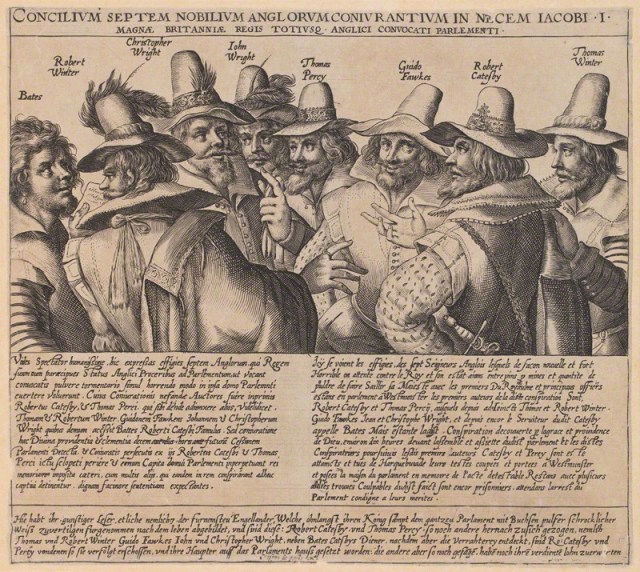
Jenkins describes eating with General Liddament and his  staff: “A single lamp threw a circle of dim light round the dining table of the farm parlour where we ate, leaving the rest of the room in heavy shadow, dramatising by its glow the central figures of the company present. Were they a group of conspirators — something like the Gunpowder Plot — depicted in the cross-hatchings of an old engraved illustration?” [SA 36-7/34 ]

The Gunpowder Plot Crispijn de Passe the Elder, engraving, circa 1605 from the National Portrait Gallery with permission by Creative Commons license

The Gunpowder Plot
Crispijn de Passe the Elder, circa 1605
engraving, 7 7/8 in. x 8 1/8 in
from the National Portrait Gallery with permission by Creative Commons license


The Gunpowder Plot of 1605 was an attempt by Guy Fawkes and others to blow up the Houses of Parliament. The failure of the plot is still celebrated in Britain by bonfires and fireworks as Guy Fawkes Night every November 5. The engraving above includes the only known contemporary portrait of Fawkes. His name appears above the third figure from the right; “Guy” becomes “Guido” in Latin. The artist is Crispijn de Passe the Elder (~1565-1637), a Dutch engraver who worked through a London publisher and bookseller to sell his prints in Britain. Powell might well have been familiar with this engraving because from 1962 to 1976 he was a trustee of the National Portrait Gallery, which has a number of portraits of him.

Posted in Uncategorized | Leave a comment

Barnby’s Murals Destroyed

We have been avoiding writing about Barnby’s frescoes for the Donners Brebner building because we know so little about them. They were commissioned by Sir Magnus Donners, completed about 1928, and received “a great deal of public attention.” [AW 31/24, CCR 14/9] Now that we are reminded that they were destroyed by a direct hit on building in the Blitz, we will provide some historical and geographical background that helps us better imagine Powell’s creations [SA 8/5. MP 118 /113].

Jenkins described the Donners Brebner building, on the south shore of the Thames across from Millbank, as “dominating the far shore like a vast penitentiary” [CCR 120/115] and “this huge shapeless edifice, recently built in a style as wholly without ostensible order as if it were some vast prehistoric cromlech.” [QU 218/225]

Millbank runs along the Thames south of Westminster to Vauxhall bridge; the Albert Embankment runs along the opposite side of the river. Both Millbank and the Albert Embankment sustained multiple bomb hits during the Blitz. After reading about Blitz damage in this part of London, we have reached a dead end in our search for Barnby’s frescoes. For example, the Tate Museum, now called the Tate Britain, was built in Millbank near the Vauxhall bridge late in the nineteenth century on the sight of an infamous penitentiary. The Tate sustained a direct hit, and damage to the building is still visible, yet no art was damaged.

Another approach is through Lord Beaverbrook, who shared some characteristics with Magnus Donners. Lord Beaverbrook was an art collector and did commision murals from contemporary British painters. The building that he built in Fleet Street in 1933 for one of his newpapers, The Daily Express,  survived the Blitz and is today regarded by some as an Art Deco masterpiece, but we can see how others might view it as “without ostensible order.”

The Daily Express Building, London photo by Russ London from Wikimedia.org by Creative Commons license

The former Daily Express Building, London
photo by Russ London from Wikimedia.org by Creative Commons license

The lobby of the former Daily Express Builiding photo from Manchesterhistory.net

The lobby of the former Daily Express Builiding
photo from Manchesterhistory.net


The lobby of the building was designed by Richard Atkinson with bas relief sculptures by Eric Aumonier. Frescoes, by Barnby or others, are absent.

We have no idea if our speculations and digressions have anything to do with Barnby’s frescoes. We welcome insights from our readers.


Posted in Uncategorized | Leave a comment

Egyptian Deities at General Liddament’s Mess

Nick attends the mess of General Liddament, a severe presence who is flanked at table by two colonels: “Here was Pharaoh, carved in the niche of a shrine between two tutelary deities who shielded him from human approach.  All was manifest.  Colonel Hogbourne-Johnson and Colonel Pedlar were animal-headed gods of Ancient Egypt.  Colonel Hogbourne-Johnson was, of course, Horus, one of those sculptured representations in which the Lord of the Morning Sun resembles an owl rather than a falcon; a bad-tempered owl at that.  Colonel Pedlar’s dogs’s muzzle, on the other hand, was a milder than normal version of the Jackal-faced Anubis, whose dominion over Tombs and the Dead did indeed fall within A&Q’s province.” [SA 37/35]

As he did in A Question of Upbringing (see QU 214/221, Le Bas’ Appearance), Powell here evokes impressions of Ancient Egyptian imagery more than references to particular works.  Below is a sculpture of the Pharaoh Ramses II “shielded from human approach” by the gods Ptah (left) and Sekhmet (right).

669px-Ramesses-Ptah-Sekhmet

Reliefs of Ramses II, Ptah and Sekhmet The Egyptian Museum, Cairo photo by Daniel Mayer, cropped by AnnekeBart from Wikimedia Commons by GNU Free Documentation License

Colonel Hogbourne-Johnson as the god Horus was easy to envision, though not as an owl, as Nick has it, but as a falcon, bad-tempered to be sure.  Here is Horus as he is depicted at the Temple at Edfu from the first couple of centuries B.C.

Horus Temple of Horus, Edfu granite, 237 B.C. or earlier photo in public domain from Wikimedia Commons

Horus
Temple of Horus, Edfu
granite, 237 B.C. or earlier
photo in public domain from Wikimedia Commons

The identities of Egyptian deities is not constant over the long evolution of the Egyptian pantheon, but Horus is generally known as the son of Isis and the rival of Set, slayer of Osiris, Horus’ father, or sometimes brother. Horus is also identified with the sun and the moon, and Pharaoh himself came to be identified with Horus while alive, then as Osiris after death.  The Horus at Edfu, judging from his fierce expression, might easily be a colonel who aspires to become a general as soon as possible.


Anubis white marble, height 62" 1st-2nd century AD From Anzio, Villa Pamphili Vatican Museum, Rome photo from Wikimedia Commons by Creative Commons GNU license

Anubis
white marble, height 62″
1st-2nd century AD
From Anzio, Villa Pamphili
Vatican Museum, Rome
photo from Wikimedia Commons by Creative Commons GNU license

Anubis, shown above,  was the jackal-headed god who was associated, as Nick suggests, with mummification of the dead and supervision of souls into the afterlife. Colonel Pedlar as a mild-faced Anubis came readily to mind when we saw this Anubis in the Vatican collection. It is from the Roman period late in Egypt’s history and is actually a blend of Anubis and the Greek god Hermes.   We liked how this more doggy Anubis sports military braids and medals and looks as if he would be right at home at General Liddament’s mess.

Posted in Uncategorized | 1 Comment

Rainy Day at Marrakesh

In At Lady Molly’s Nick was introduced by Chips Lovell to the the bohemian home of Molly and Ted Jeavons.  There, amid priceless art works by Wilson and Greuze hung pastels by an unknown artist of Moroccan subjects.  Now, during the chaos of the blitz, Nick has returned to the nearly-ruined Jeavons home, where Lady Molly has perished and all that remains of the art works are those Moroccan pastels. “The pastels, by some unknown hand, of Moroccan types remained. They were hanging at all angles, the glass splintered of one bearing the caption Rainy Day at Marrakesh.” [SA 164]

In our QA post Wilson and Greuze at the Jeavons’s we offered a pastel of a domestic scene in Marrakesh by Zinaida Serebriakova, from 1928, as a likely example of what the Jeavons’s might have collected.  Continued searching strengthens our hunch that Serebriakova’s work might indeed have turned up in the heterogeneous Jeavons collection.   Zinaida Serebriakova (Russian, 1884-1967) is celebrated as one of the first female painters of the early Modernist period, though her most famous works retain a classical rather than revolutionary nature.  Serebriakova made many pictures of her travels in Morocco, though none, alas, are captioned Rainy Day at Marrakesh.  Indeed, Marrakesh’s scant annual rainfall insures that few rainy views are likely to turn up in any artist’s oeuvre, but a watercolor of Marrakesh by Serebriakova suggests at least a touch of rain might be predicted, judging from that sky.

Morocco. Marrakesh Zinaida Serebriakova, 1932 from WikiArt.org by fair sse priniciples, copyright status unknown

Morocco. Marrakesh
Zinaida Serebriakova, 1932
from WikiArt.org by fair use principles, copyright status unknown

The storage of the Wilson and Greuze in a safe location before the bombing is an example of a more general preservation of art in British collections by removal early in the War from London to protected sites in the country side.

Posted in Uncategorized | Leave a comment

Pieter Bruegel the Elder


On a tiresome train ride to London, Nick takes up conversation with an un-characteristically cultured fellow officer called David Pennistone, destined to become his long-time friend.

“‘Talking of Vienna,’ he said, ‘did you ever have the extraordinary experience of entering that gallery in the Kusthistorisches Museum with the screen across the end of it? On the other side of the screen, quite unexpectedly, you find these four staggering Bruegels.’

‘The Hunters in the Snow is almost my favorite picture.’

‘I am also very fond of the Two Monkeys in the Kaiser Friedrich in Berlin.  I’ve just been sharing a room with a man in the Essex Regiment who looks exactly like the ape on the left, the same shrewd expression.’”

Pieter Bruegel the Elder (Dutch, 1525-1569) is the beloved, enigmatic painter whose scenes of peasant life are the source of much of what we know about rural mores in the Low Countries of the 16th century.  He studied in Antwerp with Pieter Coecke van Aelst and married his daughter. His sons Pieter the Younger and Jan also became painters; Pieter the Elder was born Brueghel but dropped the ‘h’ from his name; his sons restored it to theirs.  Breugel’s Hunters in the Snow of 1565 is one of five surviving paintings depicting the months of the year and their occupations.

Two Hunters in the Snow Pieter Bruegel the Elder 54 x 39 ft  Kunsthistorisches Museum Vienna public domain from Wikimedia.org via the Google Art Project

Hunters in the Snow
Pieter Bruegel the Elder, 1565
54 x 39 ft
Kunsthistorisches Museum, Vienna
public domain from Wikimedia.org via the Google Art Project

Bruegel’s Two Monkeys of 1562 is of more mysterious, probably allegorical, significance.  It was memorably invoked by the Polish poet Wislawa Szymborska (1923-2012) in her poem entitled “Two Monkeys by Brueghel” (translated here by Magnus Krynski):


TwoChained Monkeys Pieter Bruegel the Elder, 1563 oil on oak, 8 x 9 in Gemäldegalerie, Berlin photo in public domain from Wikimedia.org

Two Chained Monkeys
Pieter Bruegel the Elder, 1563
oil on oak, 8 x 9 in
Gemäldegalerie, Berlin
photo in public domain from Wikimedia.org

I keep dreaming of my graduation exam:

in a window sit two chained monkeys,

beyond the window floats the sky,

and the sea splashes.

I am taking an exam on the history of mankind:

I stammer and flounder.

One monkey, eyes fixed upon me, listens ironically,

the other seems to be dozing–

and when silence follows a question,

he prompts me

with a soft jingling of the chain.

Hunters in the Snow remains at the Kunsthistorisches Museum in Vienna.  The Kaiser Friedrich Museum was renamed the Bode Museum after the War, and Two Chained Monkeys has been moved to the Gemäldegalerie, another branch of the Berlin State Museums (Staatliche Museen zu Berlin).

Posted in Uncategorized | 1 Comment

An Ironside in a Victorian Illustration

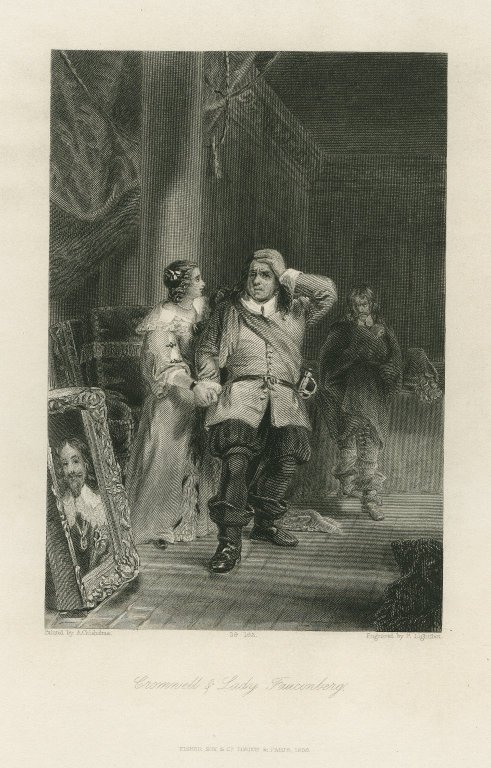
Jenkins describes Company-Sergeant Major Cadwallader as “cleanshaven, with the severely puritanical countenance of an Ironside in a Victorian illustration to a Cavalier-and-Roundhead romance.” [VB 10/6].

Cromwell and Lady Fauconberg P. Lightfoot after a painting by A. Chisholm, 1838 Steel engraving , 8 x 10 in  from Sir Walter Scott Woodstock, chapter 8 from the Walter Scott Image Collection, University of Edinburgh

Cromwell and Lady Fauconberg
P. Lightfoot after a painting by A. Chisholm, 1838
Steel engraving , 8 x 10 in
from Sir Walter Scott Woodstock, chapter 8
from the Walter Scott Image Collection, University of Edinburgh

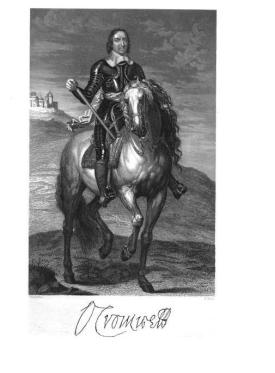
Oliver Cromwell George Cattermole engraving from drawing from Cattermole, Richard Great Civil War or The Times of Charles I. and Cromwell, Henry G. Bohn, London, 1852 via Google Books

Oliver Cromwell
George Cattermole
engraving from drawing
from Cattermole, Richard
Great Civil War or The Times of Charles I. and Cromwell,
Henry G. Bohn, London, 1852
via Google Books

The English Civil Wars (1642-1651) pitted the Cavaliers (followers of King Charles I and King Charles II) against the Roundheads (Parliamentarians or followers of Oliver Cromwell). The Roundheads were named for their bowl-like haircuts; their troops were called Ironsides, because Old Ironsides was one of Cromwell’s nicknames. Many romantic novels have been written about this era. A pre-Victorian example is Sir Walter Scott’s Woodstock, or the Cavalier (1826).  We have not found the illustration that Jenkins recalls, but the image at the left qualifies as Victorian (1837-1901) and shows Cromwell with a portrait of Charles I by Van Dyck.  Another Victorian source of engraved illustrations is the history Great Civil War or The Times of Charles I. and Cromwell, written by Richard Cattermole and illustrated by George Cattermole.

And When Did You Last See Your Father William Frederick Yeames, 1878 oil on canvas, 52 x 99 in The Walker Gallery of Art photo in public domain from Wikimedia.org via the Google Art Project

And When Did You Last See Your Father
William Frederick Yeames, 1878
oil on canvas, 52 x 99 in
The Walker Gallery of Art
photo in public domain from Wikimedia.org via the Google Art Project

,

For a Victorian image of Roundheads, we can turn to the painting above by William Frederick Yeames.   The Roundhead officer seated in the center wears an orange sash, which was characteristic Ironside attire. We know that the Ironside standing to his left is a sergeant because the halberd in his left hand is a sign of rank.  To imagine Cadwallader, we will just need to shave the mustache from his stern face.

Posted in Uncategorized | Leave a comment

Meissonier-like Imagery

Jenkins meets Captain Rowland Gwatkin, the commander of his company, early in VB, and Gwatkin is a central character of this volume.

Captain Rowland Gaitkin Mark Boxer,  cover for The Valley of Bones, Flamingo Edition, 1983

Captain Rowland Gaitkin
Mark Boxer,
cover for The Valley of Bones, Flamingo Edition, 1983

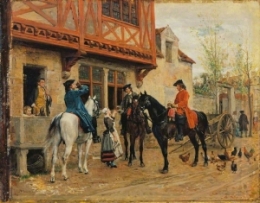
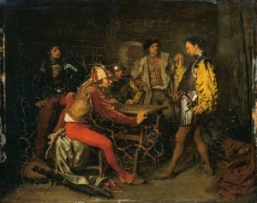
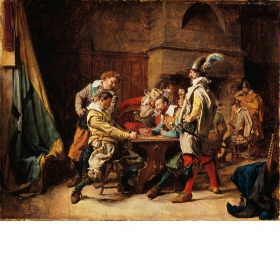
Jenkins reflects on Gwatkin: “There was an air of resolve about him, the consciousness of playing a part to which a high destiny had summoned him. I suspected he saw himself in much the same terms as those heroes of Stendhal – not a Stendhalian lover, like Barnby, far from that – an aspiring, restless spirit, who, released at last by war from the cramping bonds of life in a provincial town, was about to cut a dashing military figure against a back-cloth of Meissonier-like imagery of plume and breastplate: dragoons walking their horses through the wheat, grenadiers at ease in a tavern with girls bearing flagons of wine.” [VB 17-18/13]


The Halt at the Inn Jean-Louis Ernest Meissonier - circa 1862-1863 oil on panel, 8 x 10 in The Wallace Collection photo in the public domain from the Athenaeum.org

Halt at an Inn
Jean-Louis Ernest Meissonier  ~1862-1863
oil on panel, 8 x 10 in
The Wallace Collection
photo in the public domain from  Athenaeum.org

The Guard Room Jean-Louis Ernest Meissonier - ~1847 oil on panel, 6 x 8 in The Wallace Collection photo in the public domain from Athenaeum.org

The Guard Room
Jean-Louis Ernest Meissonier  ~1847
oil on panel, 6 x 8 in
The Wallace Collection
photo in the public domain from Athenaeum.org

Jean-Louis Ernest Meissonier (French 1815-1891) painted small, detailed genre scenes, reminiscent of the seventeenth century Dutch style, purportedly because they fit the walls of Parisian apartments and sold much better than more grandiose canvases. Ruskin praised his work; his prices soared during his lifetime; at age 14, Proust called Meissonier his favorite painter, but Meissonier’s reputation was eclipsed by the Impressionists. We show Halt at an Inn and The Guard Room, now among 17 Meissoniers in The Wallace Collection, because Powell was very familiar with The Collection and was a great friend of its curator. (Between November, 2005, and February, 2006, The Wallace Collection mounted a special exhibition Dancing to the Music of Time: The Life and Work of Anthony Powell.) Perhaps Powell imagined the grenadiers at the tavern based on small panel paintings like these.

lost game

The Lost Game, Jean-Louis Ernest Meissonier, 1858, oil on mahogany panel, image size 8 x 10 in, The Wallace Collection https://i1.wp.com/picturesinpowell.files.wordpress.com/2015/06/lost-game.jpg?ssl=1


In Album, Lady Violet Powell chooses The Lost Game, also in the Wallace Collection, as her illustration of this passage.

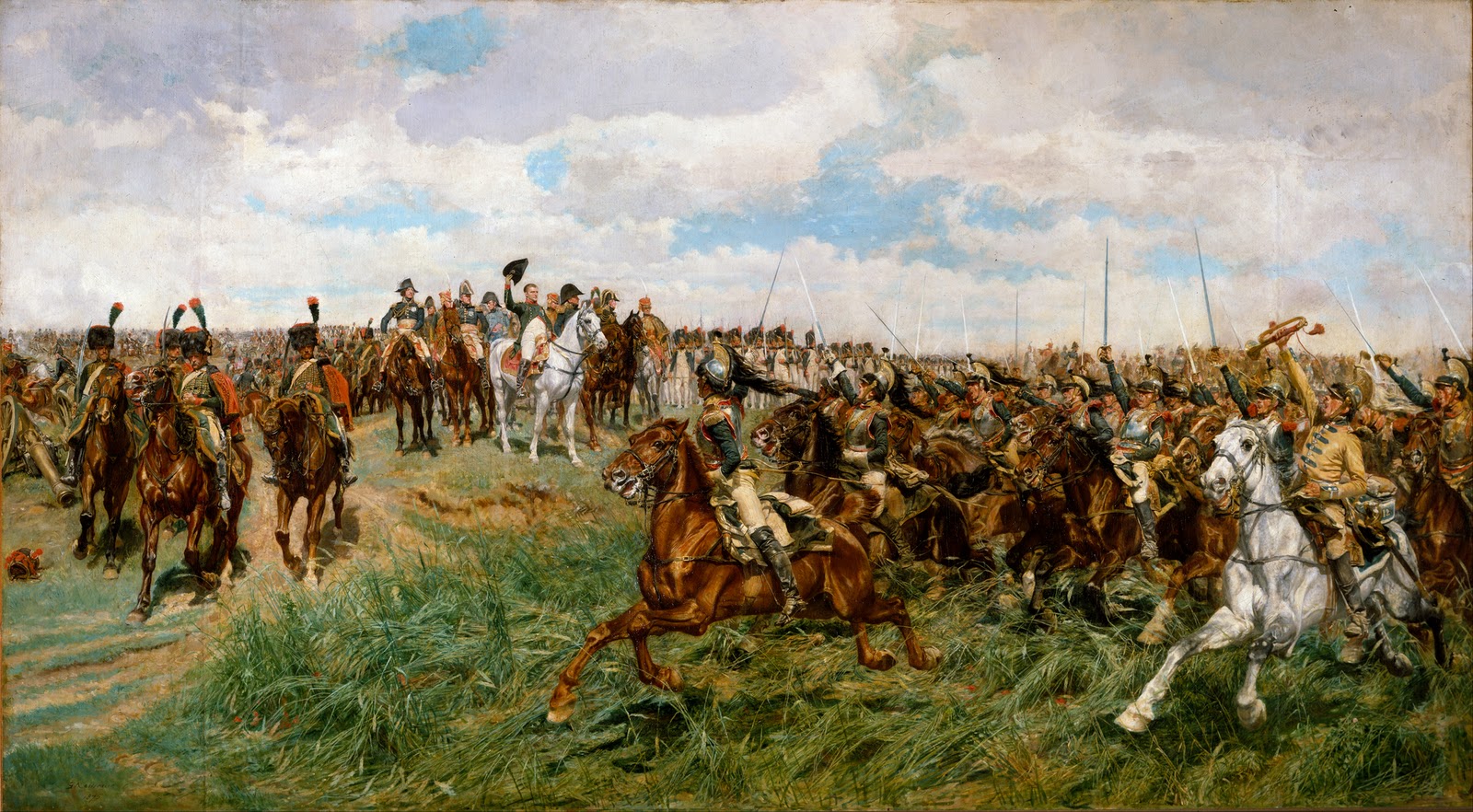
1807, Friedland Jean-Louis Ernest Meissonier - 1875 oil on canvas, 54 x 100 in Metropolitan Museum, New York photo in public domain from The Anthenaeum.org

1807, Friedland
Jean-Louis Ernest Meissonier – 1875
oil on canvas, 54 x 100 in
Metropolitan Museum, New York
photo in public domain from The Anthenaeum.org

Later in his career, Meissonier turned to painting larger canvases of scenes from military history. In 1859, he was commissioned by Napoleon III to illustrate some of his military campaigns. These military canvases show many dashing figures for Gwatkin to emulate.

Posted in Uncategorized | Leave a comment

Officers in Wonderland

We have already seen Powell’s propensity to compare his characters to those from Lewis Carroll, as envisioned by Sir JohnTenniel (The Mad Hatter, The Frog Footman, The Red Queen.) He does this again as Jenkins describes his fellow officers:


Tweedledum (center) and Tweedledee (right) with Alice  John Tenniel illlustration for Lewis Carroll Through the Looking Glass, 1871 public domain via Wikimedia.org

Tweedledum (center) and Tweedledee (right) with Alice
Sir John Tenniel, 1871
illlustration for Lewis Carroll Through the Looking Glass
public domain via Wikimedia.org

“Almost all the officers looked alike to me at that early stage; Maelgwyn-Jones, the Adjutant, and Parry his assistant sitting beside him at the table as indistinguishable as Tweedledum and Tweedledee, …” [VB 13/8] Although these twins were introduced in nursery rhyme at least as early as 1805, their best known image is Tenniel’s illustration for Through the Looking Glass.


The Walrus and the Carpenter Sir John Tenniel, 1871 Illustration for Lewis Carroll Alice in Wonderland photo in public domain via Wikimedia.org

The Walrus and the Carpenter
Sir John Tenniel, 1871
Illustration for Lewis Carroll Alice in Wonderland
photo in public domain via Wikimedia.org

“Bithel was wearing the khaki side-cap that had been set on the sponge-bag the night before. … The cap was cut higher than normal (like Saint-Loup’s I thought), which gave Bithel a look like a sprite in pantomime; perhaps rather — taking into account his age, bulk, moustache — some comic puppet halfway between the Walrus and the Carpenter ” [ VB 36-7 /32] (Robert Saint-Loup is a friend of Marcel’s from In Search of Lost Time. We have not yet found an illustration of his cap.)


Posted in Uncategorized | Leave a comment