Jenkins reads Proust

Reading Remembrance of Things Past one night in bed, Jenkins is struck by a passage that he quotes extensively.  The writing is typically Proustian:  a memoir of a conversation that The Narrator had with the Turkish Ambassadress at a party given by a Princesse, replete with myriad characters, seemingly endless subordinate clauses, gossipy asides about a Prince Odoacer, and parenthetical digressions. [MP 124-125/119-121 ]

Powell has often been called the British Proust because both Dance and Remembrance are long novels, reminiscences of time and milieu,  in which haut bourgeois narrators recall their lives among the aristocratic and cultured. Powell, the perceptive critic, dismissed the analogy in The Paris Review (1978) :

INTERVIEWER [Michael Barber]

Could we just settle the comparison to Proust? I believe you reject it?

POWELL

Well, I do to this extent: that I’m a great admirer of Proust and know his works very well. But the essential difference is that Proust is an enormously subjective writer who has a peculiar genius for describing how he or his narrator feels. Well, really tell people a minimum of what my narrator feels—just enough to keep the narrative going—because I have no talent for that particular sort of self-revelation.

The painting references in the passage quoted by Jenkins are to a “hunting scene by Wouwerman” and to La Gioconda,  the nickname given to a youth by “his fellow inverts. ”

We first realized that the Proust text is a pastiche, or as Spurling says,  a passage that “seems to be known only to Nicholas Jenkins” (Invitation to the Dance, p. 542), when we found that Proust mentions neither La Gioconda (The Mona Lisa) nor  Philips Wouwerman (1619-1668), a master of the Dutch Golden Age, especially noted for his portrayal of horses in military and hunting scenes.  Proust does pay homage to other Golden Age painters, like Rembrandt, Vermeer, and Wouwerman’s teacher Hals.

Setting Out on the Hunt Philips Wouwerman, 1660-1665 oil on oak panel, 18 x 25 " Gemäldegalerie Alte Meister, Dresden photo in public domain from Wikimedia Commons, source Web Gallery of Art

Setting Out on the Hunt
Philips Wouwerman, 1660-1665
oil on oak panel, 18 x 25 in.
Gemäldegalerie Alte Meister, Dresden
photo in public domain from Wikimedia Commons,
source Web Gallery of Art

Powell draws attention to the homosexual motif in Remembrance by having Proust’s Narrator hear La Gioconda as the nickname for a young man.  Da Vinci painted Mona Lisa ostensibly as a portrait of  Lisa Gherardini, the wife of Francesco del Giocondo, but one of many theories about the actual model names him as Gian Giacomo Caprotti, Leonardo’s long-time apprentice. Da Vinci’s painting of Saint John the Baptist, shown below, was modeled on Caprotti and has some resemblance to Mona Lisa. Scholars in Proust’s time wrote of Leonardo’s suspected homosexuality and possible relationship with Caprotti (CJ Farago ed Biography and Early Art Criticism of Leonardo Da Vinci U. Of Chicago 1999).

Saint John the Baptist Leonardo da Vinci, 1513-1516 oil on panel, 27 x 22 in. The Louvre photo in public domain from Wikimedia Commns

Saint John the Baptist
Leonardo da Vinci, 1513-1516
oil on panel, 27 x 22 in.
The Louvre
photo in public domain from Wikimedia Commns

We are among those guilty of speculating about the actual person who serves as an artist’s or novelist’s model. After “quoting” Proust, Powell teases those who search for real counterparts of fictional characters; Jenkins says:

This description of Prince Odoacer was of special interest because he was a relation — possibly a great-uncle — of Theodoric’s. I thought about the party for a time, whether there had really been a Turkish Ambassadress, whom Proust found a great bore; then, like the Narrator himself in his childhood days, fell asleep early. [MP 125/121 ].

Of course, there is no Prince Odoacer in Remembrance.  The historical Theodoric the Great, king of the Ostrogoths from 475 to 526, assinated Odoacer, king of Italy, in 493.

Posted in Uncategorized | 3 Comments

The Cenotaph

Jenkins and Farebrother walk together into Whitehall.

Farebrother suddenly raised his arm in a stiff salute. I did the same, taking my time from him, though not immediately conscious of whom we were both saluting. Then I quickly apprehended that Farebrother was paying tribute to the Cenotaph, which we were at the moment passing.  [MP 121/116]

The Cenotaph Whitehall, London

The Cenotaph
Sir Edwin Lutyens, 1919
Height 35 feet
Whitehall, London
photo by Creative Commons license from Wikimedia Commons, taken April 14, 2014, uploaded by Godot13

The Cenotaph (Greek for empty tomb) in Whitehall was designed by Sir Edwin Lutyens and executed in Portland Stone by Holland, Hannens & Cubitts, 1919-1920, as a memorial to the dead of the Great War. Lutyens (1869-1944) works ranged from British country houses to monuments of British India, including many of the government buildings in New Delhi. His Cenotaph was much copied, and he designed at least 50 memorials to World War I, including the India Gate, which was designed as the All India War Memorial.

Powell briefly alluded to World War I memorials in BM (see The Haig Statue), but now as World War II is approaching its end, he is repeatedly reminding us of the First World War, also memorialized by Olivier’s paintings and the bust of Kitchener.  The Cenotaph is now seen as a memorial to British military lost in both World Wars and in subsequent conflicts.

Posted in Uncategorized | 2 Comments

Royal Portrait of King Leopold

Jenkins, sent to the Cabinet Offices to pick up some Belgian papers, reflects:

The position of the King of the Belgians was delicate. Formally accepted as monarch of their country by the Belgian Government in exile, the royal portrait hanging in Kucherman’s office,  King Leopold, rightly or wrongly, was not, officially speaking, very well looked on by ourselves. His circumstances had been made no easier by a second marriage disapproved by many of his subjects. [MP 109/104 ]

King Leopold III of Belgium from The Belgian Monarchy Official Website © The Belgian Monarchy

King Leopold III of Belgium
from The Belgian Monarchy Official Website
© The Belgian Monarchy

Leopold III (1901-1983) was king of Belgium from 1934-1951. When Germany invaded Belgium in 1940, Leopold personally surrendered unconditionally on May 28, and chose to remain in Belgium rather than accompany the Belgium government into exile. Churchill publicly criticized his decision to surrender. Leopold said he felt compelled to stay in country with his subjects, but many Belgians, especially in the government-in-exile, saw him as a collaborator with, rather than as a prisoner of, the Germans

His first wife died in a car accident in 1935  In 1941 he married Mrs. Lilian Baels. The religious wedding ceremony did not comport with Belgian law, and their child was born 7 months later.

Both his actions during the war and his second marriage were unpopular with many Belgians, and he renounced the throne under pressure in 1951.

Posted in Uncategorized | Leave a comment

Gainsborough Hats

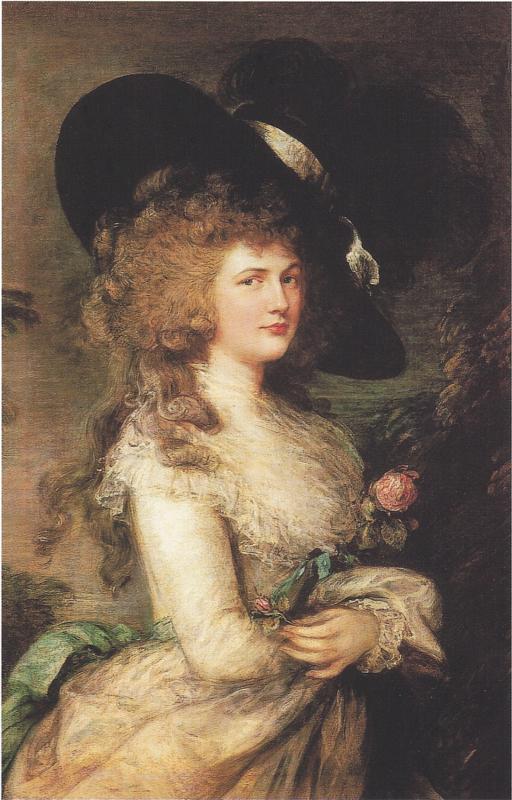
At the theater, Nick sees Prince Theodoric sitting with Lord Huntercombe, both wearing dark suits, and Lady Huntercombe, “in a rather different role implied by her pre-war Gainsborough hats” who “was formidable in Red Cross commandant’s uniform.” [MP 103/98]

Voluntary Aid Detachment Uniform British Red Cross (Beatrice Jane Hayward, center), 1945 from www.qarnac.co.uk

Voluntary Aid Detachment Uniform
British Red Cross (Beatrice Jane Hayward, center), 1945
from http://www.qarnac.co.uk

Nick has previously compared Lady Huntercombe to Gainsborough’s portrait of Mrs. Siddons.  The Gainsborough hat became famous based on another portrait painted about the same time (1785). He exhibited his portrait of Georgiana, Duchesss of Devonshire, at the Royal Academy. She was a fashion setter who designed the hat herself. After the exhibition, large black hats with generous brims and prominent feathers were the vogue in London. The style, sometimes called the ‘Gainsborough chapeau’ or the ‘portrait hat’, has been in and out of fashion ever since.


Georgiana, Duchess of Devpnshire Thomas Gainsborough, 1783 oil on canvas, 50 x 40 in Chatsworth House, Derbyshire photo in public domain from wikiarts.org via Wikimedia Commons

Georgiana, Duchess of Devpnshire
Thomas Gainsborough, 1783
oil on canvas, 50 x 40 in
Chatsworth House, Derbyshire
photo in public domain from wikiarts.org via Wikimedia Commons

Two interesting stories — Georgiana’s notorious adventures and the adventurous travels of her portrait after her death — are beyond the millinery goals of this post. The portrait was returned to Chatsworth House when the 11th Duke of Devonshire bought it back at auction in 1994 and now is displayed there next to another portrait of Georgiana by Sir Joshua Reynolds.

Posted in Uncategorized | 1 Comment

Memling, Teniers, Brouwer

Memling, Teniers, Brouwer

While overseeing the Belgian attaches in London, Nick muses:

On the whole, a march-past of Belgian troops summoned up the Middle Ages or the Renaissance, emaciated, Memling-like men-at-arms on their way to supervise the Crucifixion or some lesser martyrdom, while beside them tramped the clowns of Teniers or Brouwer, round rubicund countenances, haled away from carousing to be mustered in the ranks.  These latter types were even more to be associated with the Netherlands contingent—obviously a hard and fast line was not to be drawn between these Low Country peoples—Colonel Van der Voort himself an almost perfect example. [MP 93/88]

The Martyrdom of St. Ursula Hans Memling, 1489 oil on panel, 15 x 14 in Hans Memling Museum, Bruges, Belgium photo in public domain from the Yorck Project via Wikimedia Commons

The Martyrdom of St. Ursula
Hans Memling, 1489
oil on panel, 15 x 14 in
Hans Memling Museum, Bruges, Belgium
photo in public domain from the Yorck Project via Wikimedia Commons

Hans Memling (1430-1494) was a German-born Flemish painter, the disciple of Rogier van der Weyden and a master of Rogier’s jewel-like early Renaissance realism.  Memling was much adored in both the Low Countries and Italy for his many portrait paintings and his religious scenes, though not battle scenes in which one might expect to find the types to which Nick alludes.  But sure enough, men-at-arms populate the odd Memling martyrdom, such as this one of St. Ursula in the Memling Museum in Bruges.

Guardroom Scene with the Deliverance of St. Peter David Teniers, the Younger, 1645-7 oil on copper, 14 x 20 in The Wallace Collection, London photo in public domain from BBC Your Paintings via Wikimedia Commons

Guardroom Scene with the Deliverance of St. Peter
David Teniers the Younger, 1645-7
oil on copper, 14 x 20 in
The Wallace Collection, London
photo in public domain from BBC Your Paintings via Wikimedia Commons

Whether or not the reader will find the Memling men-at-arms to be “emaciated,” they will certainly seem so in comparison to “the clowns of Teniers or Brouwer.”  The Teniers whom Nick mentions is undoubtedly David Teniers the Younger (1610-1690), one of four generations of Flemish painters and the most universally admired.  His work included, though was not limited to, scenes of village life populated by the gentry and the carousing peasantry.

Inn with Drunken Peasants Adriaen Brouwer, 1625-1626 oil on panel, 8 x 10 in Royal Picture Gallery Mauritshuis, The Hague photo in public domain from G. Knuttel Wzn, Openbaar Kunstbezit, vol. IV, no. 9 via Wikimedia Commons

Inn with Drunken Peasants
Adriaen Brouwer, 1625-1626
oil on panel, 8 x 10 in
Royal Picture Gallery Mauritshuis, The Hague
photo in public domain from G. Knuttel Wzn, Openbaar Kunstbezit, vol. IV, no. 9 via Wikimedia Commons

An influence on Teniers’ imagination is believed to be Adriaen Brouwer (1605-1638), a Flemish painter who not only took the carousing of the peasantry as a subject but also as a lifestyle, and is thought to have died of its excesses.  Brouwer’s types are rather less affectionately portrayed than Teniers’, but in the works of both painters, their “round rubicund countenances” are easy to spot.  Apparently, the Belgian troops under Nick’s gaze are no more refined of countenance than their Renaissance forebears.


Posted in Uncategorized | 1 Comment

A Bust of Kitchener

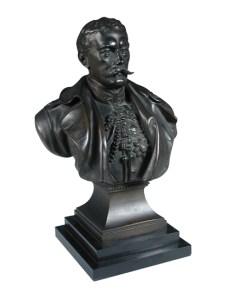
Jenkins mentions a bust of Lord Kitchener seen as one climbed the staircase at the War Office. He sees “Kitchener’s cold angry eyes, haunting and haunted, surveying with deepest disapproval all who came that way.” [MP 55/51, 59/54]

Lord Horatio Herbert Kitchener (1850-1916) was a hero of the Sudanese war in 1898. At the beginning of World War I, Prime Minister Asquith appointed him Secretary of War. One of his tasks was recruiting, and his poster with the caption “Join Your Country’s Army” became iconic. He was blunt in his assessments of the challenges of the war. A different aspect of his personality was his enthusiasm for collecting the finest Chinese porcelains. (Jenkins mentions this twice times in Dance; see for example, Lord Huntercombe’s remarks about fine china in CCR) [QU 62/61, CCR 165/169].  Lord Kitchenedied in 1916 when the cruiser that was taking him to a diplomatic meeting in Russia was sunk by a mine.

Kitchener World War I Recruitment Poster Alfred Leete 1914 photo in public domain from Wikemedia Commons

Kitchener World War I Recruitment Poster
Alfred Leete 1914
photo in public domain from Wikemedia Commons

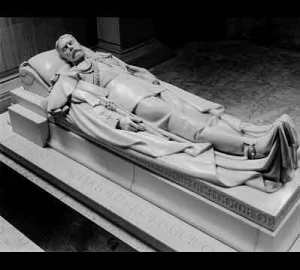
Spurling identifies the sculptor of the Kitchener bust as Sir William Reid Dick, RA (1879-1961). [Invitation to the Dance, p. 327]

Lord Kitchener Sir William Reid Dick, 1925 St. Paul's, London photo © 2007 Armchair Travel Co. Ltd

Lord Kitchener
Sir William Reid Dick, 1925
St. Paul’s, London
photo © 2007 Armchair Travel Co. Ltd

Dick was commissioned  to do a number of pieces for a memorial chapel at St. Paul’s Cathedral dedicated to Kitchener in 1925. A life sized white marble effigy of Kitchener lies on the floor of the chapel. However, as far as we can tell, Dick did not do a bust of Kitchener for the War Office. (see appendix listing Reid Dick’s work in Wardleworth, D William Reid Dick, Sculptor, Farnham, Surrey  Ashgate Publishing, 2013).

Horatio Herbert Kitchener Richard Belt, 1917 Ministry of Defense Art Collection, United Kingdom

Horatio Herbert Kitchener
Richard Belt, 1917
Ministry of Defense Art Collection, United Kingdom

Lord Kitchener Richard Belt bronze bust, reduced 14.5 in high Listed for auction at The Saleroom.com (accessed 9/20/15)

Lord Kitchener
Richard Belt
bronze bust, reduced
14.5 in high
Listed for auction at The Saleroom.com (accessed 9/20/15)

We wonder whether a better candidate for this image is a bust of Kitchener displayed by Richard Claude Belt (1851-1920)  at the Royal Academy in 1917.  Bronze copies of this bust have been available at auction inscribed ‘No. 1 Reduction of Bust in War Office.’ (Lot 766 – Richard Claude Belt (1851-1920), a bronze bust of Lord Kitchener together with other memorabilia, The Saleroom.com, accessed 9/20/15). Belt’s bust of Kitchener shows those “cold angry eyes” that guard the staircase.

Posted in Uncategorized | 3 Comments

Outside the Army Council Room

Jenkins, on his way to Finn’s office on the second floor, notes the decor:

Outside the Army Council Room, side by side on the passage wall, hung,  so far as I knew, the only pictures in the building, a pair of subfusc, massively framed oil-paintings, subject and technique of each I could rarely pass without re-examination.  The murkily stiff treatment of these two unwontedly elongated canvases, although not in fact executed by Horace Isbister RA, recalled his brushwork and treatment, a style that already germinated a kind of low grade nostalgia on account of its naive approach and total disregard for any ‘modern’ development in the painter’s art. The merging harmonies — dark brown, dark red, dark blue — depicted incidents in the wartime life of King George V: Where Belgium greeted Britain, showing the bearded monarch welcoming Albert, King of the Belgians, on arrival in this country as an exile from his own: Merville, December 1st, 1914 in which King George was portrayed chatting with President Poincaré, …. MP [42/37]

Where Belgium greeted Britain, 4 December 1914 Herbert Arnould Olivier, 1915 oil on canvas, 68 x 143 in UK, London, Government Hospitality, Lancaster House © Estate of Herbert Arnould Olivier

Where Belgium Greeted Britain, 4 December 1914
Herbert Arnould Olivier, 1915
oil on canvas, 68 x 143 in
UK, London, Government Hospitality, Lancaster House
© Estate of Herbert Arnould Olivier

Merville, 1 December 1914 Herbert Arnould Olivier, 1916 oil on canvas, 69 x 143 in UK, London, Government Hospitality, Lancaster House © Estate of Herbert Arnould Olivier

Merville, 1 December 1914
Herbert Arnould Olivier, 1916
oil on canvas, 69 x 143 in
UK, London, Government Hospitality, Lancaster House
© Estate of Herbert Arnould Olivier

The subtitle of Where Belgium Greeted Britain is The meeting of King George V and Albert I, King of the Belgians, at Adinkerke, then the last remnant of Belgian territory, on 4 December 1914.The subtitle of Merville is The meeting of King George V and President Poincaré of France at the British Headquarters at Merville, France, on 1 December 1914.  These were both painted by Herbert Arnould Olivier (1861-1952), who was an Official War Artist and presented the canvases to King George V in 1924. They did both hang during World War II in the War Office in Whitehall. The Royal Collection presented them to the Government Art Collection in 1983, and they now hang in Lancaster House.

Posted in Uncategorized | 2 Comments

Sporting Prints

Jenkins, speaking of their Polish counterparts, asks Pennistone,

You put them through their literary paces as a matter of routine? …

Pennistone laughed at the thought. Though absolutely dedicated to his duties with the Poles, he also liked getting as much amusement out the job as possible.

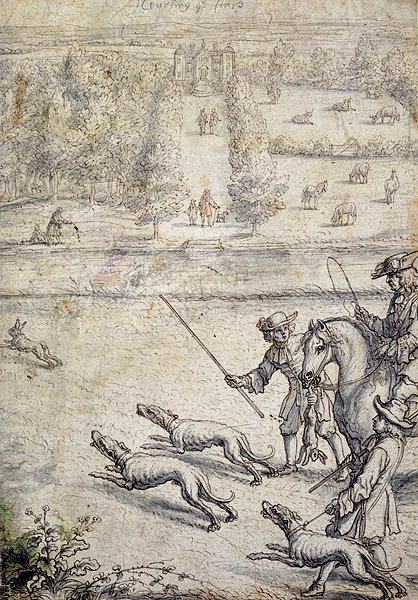
‘In the course of discussing English sporting prints with Bobrowski,’ he said, ‘a subject he’s rather keen on. It turns out the Empire style in Poland is known as “Duchy of Warsaw”. That’s nice, isn’t it?’  [MP 37/33]

Coursing the Hare Francis Barlow, Illustration to Richard Blome's 'The Gentleman's Recreation' pub. 1686 photo in public domain from Wikipedia Commons source artprints.leeds.gov.uk

Coursing the Hare
Francis Barlow, Illustration to Richard Blome’s ‘The Gentleman’s Recreation’ 1686
engraved by Hollar, photo in public domain from Wikipedia Commons
source artprints.leeds.gov.uk

We have already shown some sporting prints while discussing the decor of Stringham’s rooms.  The heyday of the British sporting prints, mid seventeenth to mid nineteenth century was during the glory days of the British Empire (Snelgrove British Sporting and Animal Prints, 1658-1874 ).  The prints were widely circulated and hung in both aristocratic and middle class homes all over England. Francis Barlow (1626-1704 ) is often credited with being a founder of the style, adopting the etching techniques of the Dutch masters to popularize English country scenes. The British love of sport and of sporting prints survives the shrinkage of the Empire, but the production of sporting prints waned with popularization of photography.


The Duchy of Warsaw was created by Napoleon in 1807 as a Polish state and destroyed in 1815 by the Congress of Vienna, which divided it between Russia and Prussia. As far as we can tell, the art associated with the Duchy was much more likely to be military than sporting; see for example, Juliusz Kossak’s portrait of Prince Józef Poniatowski, Commander in Chief of the army of the Duchy.

Posted in Uncategorized | Leave a comment

Gericault’s Raft of the Medusa

Géricault’s  Raft of the Medusa

Nick enjoys lunching with the Free French at their headquarters in London.  “Their headquarter mess in Pimlico was decorated with an enormous fresco, the subject of which I always forgot to enquire. Perhaps it was a Free French version of Géricault’s Raft of the Medusa, brought up to date and depicting themselves as survivors from the wreck of German invasion.” [MP 145/140]

Théodore Géricault (1791-1825) was a French painter whose heroic depictions of military and equine subjects form a bridge between the neoclassical and romantic styles.  Illness ended his life prematurely, and while his works suggest the beginnings of a brilliant career, his enduring fame is almost entirely attributable to his 1819 masterpiece, The Raft of the Medusa.

The Raft of Medusa Jean Louis Theodore Gericault, 1818-9 oil on canvas, 193 x 282 in Louvre Museum photo in public domain from Wikimedia Commons

The Raft of Medusa
Jean Louis Théodore Géricault, 1818-9
oil on canvas, 193 x 282 in
Louvre Museum
photo in public domain from Wikimedia Commons


The nominal subject of Géricault’s masterpiece is the 1816 shipwreck of the naval frigate Meduse off the coast of Africa.  Its visual content, however, is the agony of passengers and crew members stranded on a flimsy raft of timbers lashed together, surrounded by treacherous waves and voracious sharks.  In fact, only 15 of the 147 who actually fled the sinking Meduse on just such a raft survived to tell its story, which included starvation and a resort to cannibalism.  The actual event was an international scandal due to the incompetence and self-serving actions of the ship’s captain, allegedly acting under the instructions of his employers. Géricault’s huge, riveting painting secured its creator’s reputation and a permanent place of prominence in the Louvre shortly after the painter’s death.

4 Carlton Gardens, in St. James, was the actual headquarters of the Free French for four years during the War. It is now a private residence, and we have been unable to look inside to see if any fresco was part of the décor.  In any case, if Nick’s surmise is correct, that the the fresco in the Free French mess is indeed based on The Raft of the Medusa, its implication is that the collaborators in the Vichy government have abandoned the French people to the Germans in order to save themselves.


Posted in Uncategorized | 2 Comments

A Corot Landscape

A Corot landscape

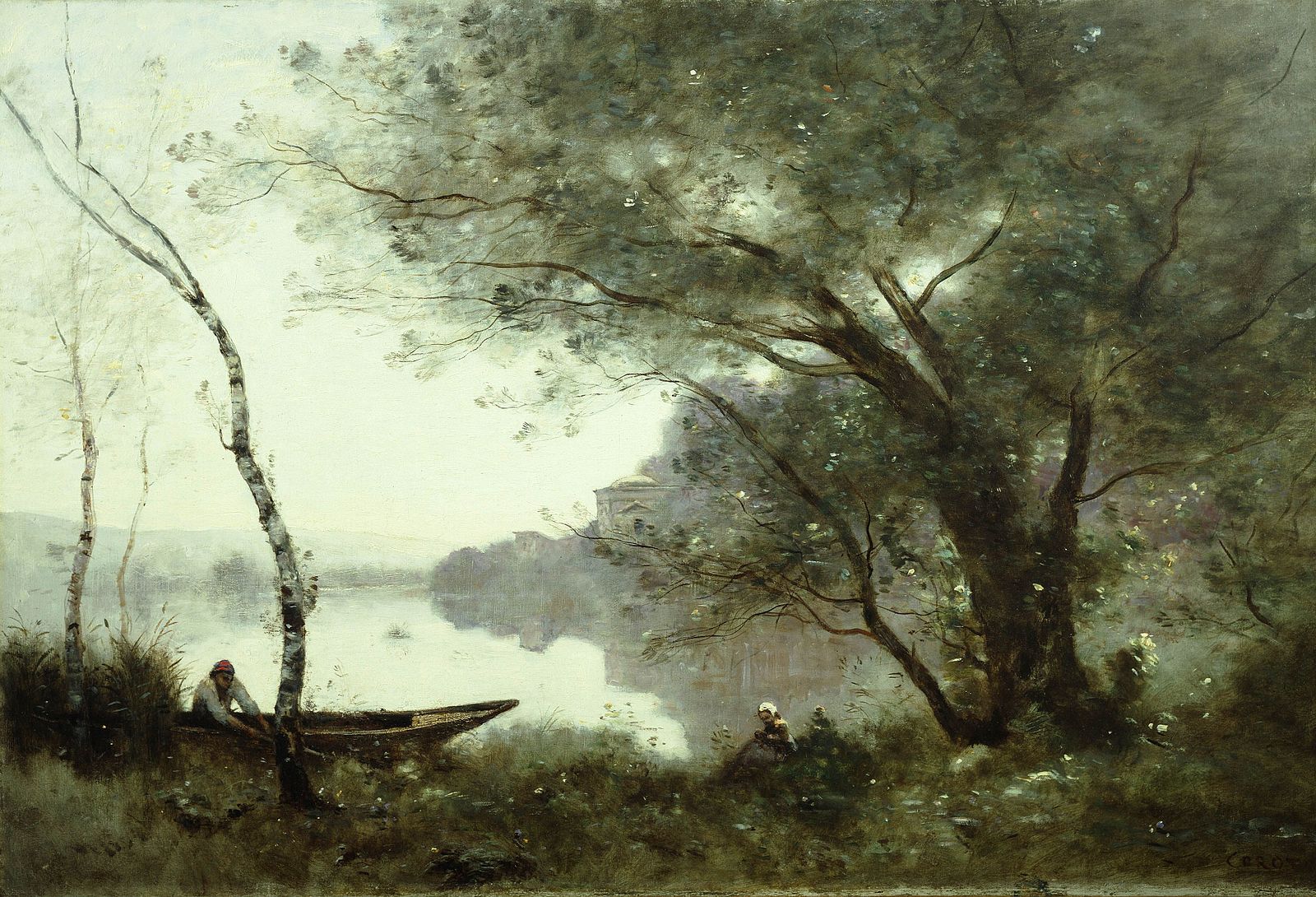
Nick and Flynn are flown to Normandy in the company of military attaches from allied nations across the globe.  They drive through scenes of recent battles, evidenced by wrecked armored vehicles strewn across the landscape.  “This residue was almost always concentrated within a comparatively small area, in fact wherever, a month or two before, an engagement had been fought out.  Then would come stretches of quite different country, fields, woodland, streams, to all intents untouched by war.

“In one of these secluded pastoral tracts, a Corot landscape of tall poplars and water meadows executed in light grays, greens and blues, an overturned staff car, wheels in the air, lay sunk in long grass.” [MP 162/157]

Le Batelier de Mortefontaine Jean Baptiste Camille Corot, 1865-1870 oil on canvas, 24 x 35 in The Frick Collection, New York photo in public domain from Wikimedia.org

Le Batelier de Mortefontaine
Jean Baptiste Camille Corot, 1865-1870
oil on canvas, 24 x 35 in
The Frick Collection, New York
photo in public domain from Wikimedia.org

The landscape to which Nick compares this melancholy vision is one of those by Jean-Baptiste-Camille Corot (French, 1796-1875), a painter of neoclassical training whose landscapes anticipate those of some Impressionists who relied on the capacity of soft-edged shapes to suggest the subtle and fleeting movements in nature observed plein-air.  Early in his career Corot worked directly from nature to produce views of Rome and the Italian countryside that startle the viewer with their crystalline clarity of vision.  But later in life Corot painted increasingly from memory, producing what he called “souvenirs” of scenes he had studied directly and now recalled as in a dream.  It is one of these paintings that we believe Nick has in mind as he himself recalls the dream-like beauty of the Normandy countryside, punctuated by nightmarish souvenirs of recent battles.


Posted in Uncategorized | 2 Comments