Zealots of All Sorts

As part of his introduction of Dr. Trelawney, Jenkins writes: “Simple-lifers, utopian socialists, spiritualists, occultists, theosophists, quietists, pacficists, futurists, cubists, zealots of all sorts in their approach to life and art … were then [1914] thought of by the unenlightened as scarcely distinguishable from one another …” [TKO 32/ ]

Among this list of zealots, cubists, futurists, and perhaps simple-lifers merit more discussion of their approach to art. We have already mentioned cubists more than once.

The Italian Futurists, like the Surrealists, extended their philosophy beyond art to many aspects of life.  In 1910 Boccioni, Carrà, Russolo, Balla, and Severini concluded their Manifesto of the Futurist Painters:

With our enthusiastic adherence to Futurism, we will:

Destroy the cult of the past, the obsession with the ancients, pedantry and academic formalism.

Totally invalidate all kinds of imitation.

Elevate all attempts at originality, however daring, however violent.

Bear bravely and proudly the smear of “madness” with which they try to gag all innovators.

Regard art critics as useless and dangerous.

Rebel against the tyranny of words: “Harmony” and “good taste” and other loose expressions which can be used to destroy the works of Rembrandt, Goya, Rodin

Sweep the whole field of art clean of all themes and subjects which have been used in the past.

Support and glory in our day-to-day world, a world which is going to be continually and splendidly transformed by victorious Science.

The dead shall be buried in the earth’s deepest bowels! The threshold of the future will be swept free of mummies! Make room for youth, for violence, for daring!

The Guggenheim Museum, New York, mounted an extensive retrospective of Futurist Art in 2014, including examining the relationship of Futurism to Italian politics during the eras of the two World Wars.

The City Rises Umberto Boccioni, 1910 oil on canvas,  The Museum of Modern Art, New York photo public domain from Wikimedia Commons

The City Rises
Umberto Boccioni, 1910
oil on canvas, 79 x 119 in
The Museum of Modern Art, New York
photo public domain from Wikimedia Commons

We show Boccioni’s The City Rises not only because it is one of earliest Futurist paintings, but also because it illustrates the interest of the Futurists in looking at modern cities in new ways.

A sad postscript to the Futurist’s tale is that their First Manifesto also included the witless boast, “We will glorify war–the world’s only hygiene . . . .”  A few years later, the First World War carried off Boccioni and several other Futurist zealots, along with countless millions of young soldiers less enamored of war’s glamour.

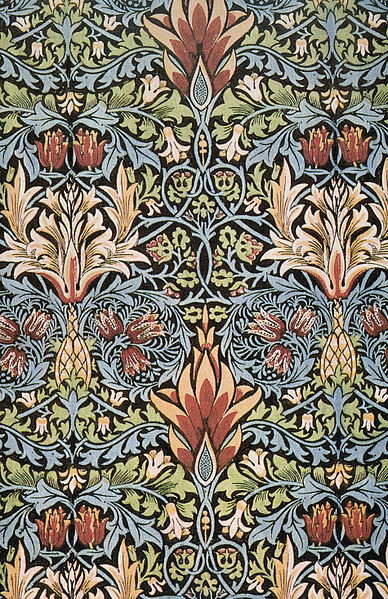
Yearning for the Simple Life has been a recurring human theme for generations, but we suspect Powell is referring in particular here to the Victorian simple-lifers, who intertwined with the British Arts and Crafts Movement inspired by William Morris.

Snakeshead printed cotton designed by William Morris (1876). (Identification from Linda Parry: William Morris Textiles, New York, Viking Press, 1983, p. 150) digitally enhanced photo in public domain from Planet Art CD of royalty-free PD images William Morris: Selected Works via Wikimedia Commons

Snakeshead printed cotton designed by William Morris (1876). (Identification from Linda Parry: William Morris Textiles, New York, Viking Press, 1983, p. 150)
digitally enhanced photo in public domain from Planet Art CD of royalty-free PD images William Morris: Selected Works via Wikimedia Commons

This Snakeshead textile pattern by William Morris (1834-1896) is hardly simple, but Morris promoted production of his textiles with organic dyes and was concerned for the lives of the textile workers and for wide availability of his art to the middle class. He was friendly with many of the Pre-Raphaelites, and his design firm encouraged artisans in glass, furniture, metal work, architectual carving, and murals.

Posted in Uncategorized | 3 Comments

Indian Decor

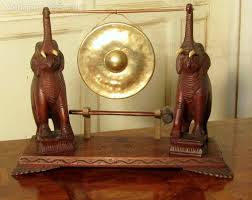
Stonehurst, where the Jenkins were living in 1914, had been furnished by its former owners in a style reflecting their prior service in India. “In the hall the brass gong was suspended from the horn or tusk of some animal;

Indian Carved Elephant Table Gong 18” wide and 7” deep and 14” high 1900s antique brass formerly for sale at http://www.antiques-atlas.com/

Indian Carved Elephant Table Gong 18” wide and 7” deep and 14” high, 1900s antique brass, formerly for sale at http://www.antiques-atlas.com/


in the dining-room hung water-colours of the Ganges at Benares [now Varanasi], the Old Fort at Calcutta, the Taj Mahal;

The City of Benares James Diston, ~1890 watercolor, 26 x 19 in for sale (12/19/14) at http://www.onlinegalleries.com/

The City of Benares
James Diston, ~1890
watercolor, 26 x 19 in
for sale (12/19/14) at http://www.onlinegalleries.com/

The Old Fort, the Playhouse, Holwell's Monument from Views of Calcutta Thomas Daniell, 1786 Aquatint, ink on paper 18 x 23" photo public domain from Wikimedia Commnos

The Old Fort, the Playhouse, Holwell’s Monument from Views of Calcutta
Thomas Daniell, 1786
Aquatint, ink on paper
18 x 23″
photo public domain from Wikimedia Commons

The Taj Mahal Mughal, 19th century watercolor on paper 8 x 12 in Freer/Sackler Gallery, The Smithsonian

The Taj Mahal
Mughal, 19th century
watercolor on paper
8 x 12 in
Freer/Sackler Gallery, The Smithsonian

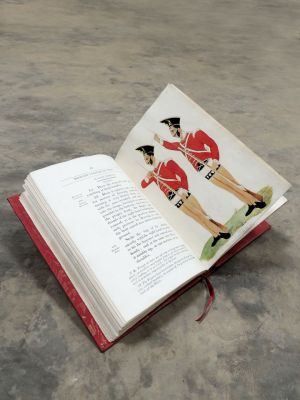
in the smoking room, a small revolving book case contained only four books: Marie Corelli’s Sorrows of Satan, St. John Clarke’s Never to the Philistines, an illustrated volume of light verse called Lays of Ind, a volume of coloured pictures of Sepoy uniforms;

Rotating Book Shelf Teak, twentieth century H 41 x W 24 x D 24 in Bangalore for sale (12/19/14) at www.phantom.hands.in

Rotating Book Shelf
Teak, twentieth century
H 41 x W 24 x D 24 in
Bangalore
for sale (12/19/14) at phantomhands.in

Sepoy Uniforms of British India, 1813 formerly on sale at phantonhands.in

Sepoy Uniforms of British India, 1813
formerly on sale at phantomhands.in


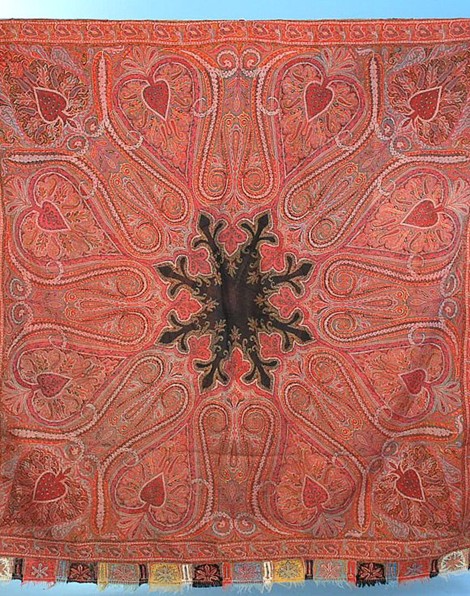
in the drawing-room, the piano was covered with  a Kashmiri shawl of some size and fine texture,

Hand Twill Tapestry Kashmiri Shawl ~ 1860 72 in square formerly for sale at http://carolynforbestextiles.com/

Hand Twill Tapestry Kashmiri Shawl ~ 1860
72 in square
formerly for sale at http://carolynforbestextiles.com/


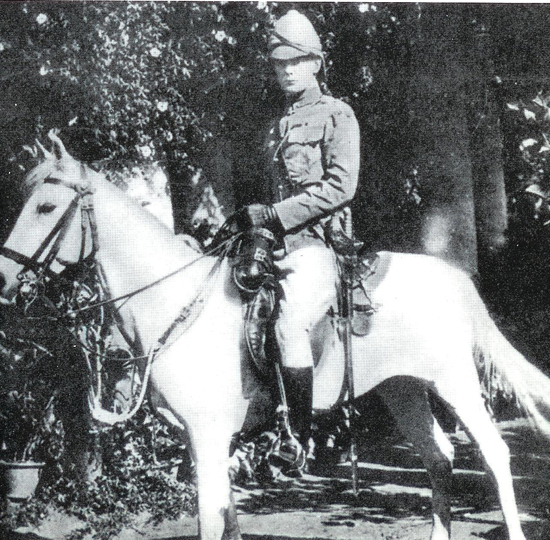
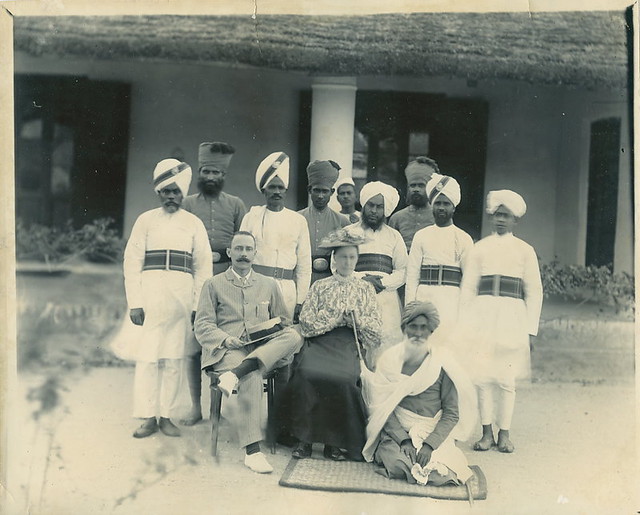
upon which, in silver frames, photographs of the former owner of Stonehurst (wearing a pith helmet surmounted with a spike) and his family (flanked by Indian servants) had stood before being stowed away in a drawer.” [TKO 63 /61 ]


Winston Churchill with pith helmet serving with 4th Hussars in India, 1898 photo from www.swordforum.com

Winston Churchill with pith helmet
serving with 4th Hussars in India, 1898
photo from http://www.swordforum.com

British family with servants taken April 15, 1911 posted by Tahir Iqbal on Flickr.com Copyright,  All rights reserved

British family with servants
taken April 15, 1911
posted by Tahir Iqbal on Flickr.com
Copyright, All rights reserved


Writing a century after this scene, many of the images that we find on the Internet are of objects that are displayed in museums or offered for sale. In contrast, much of the Stonehurst decor was probably kitsch rather than high art and would be unlikely to survive to the twenty-first century, just as Marie Corelli’s Sorrows of Satan was one of the most popular novels at the beginning of the twentieth century but is largely unknown today.

Powell provides a précis in a paragraph, summarizing volumes of cultural history. For those who want to continue to explore, please “look inside the book” Lays of Ind  (1837) by Aliph Cheem, a pseudonym for Walter Yeldham,  which is a collection of ‘exalted doggerel‘ about British India, accompanied by drawings that expand Powell’s collage of the Raj.

Posted in Uncategorized | Leave a comment

Mr. Lloyd George

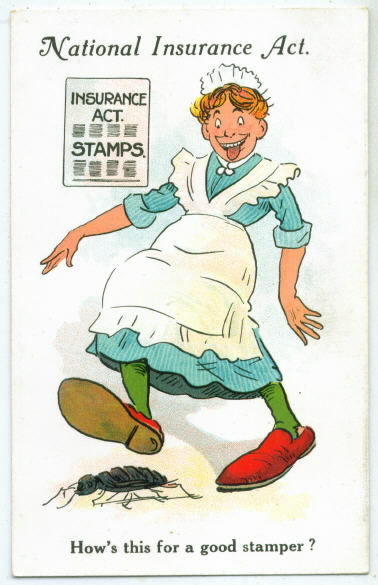
The Kindly Ones (TKO) begins with young Jenkins helping Albert lock-up for the night. Jenkins examines “a coloured picture, fastened to the wall by four rusting drawing-pins, of Mr. Lloyd George, fancifully conceived as extending from his mouth an enormous scarlet tongue, on the liquescent surface of which a female domestic servant in cap and apron, laughing heartily as if she much enjoyed the contact, was portrayed vigorously moistening the gum of a Health Insurance stamp.” [TKO 5/1]

Unidentified, "The stamp that wants a lot of licking... and the man." (PZ617/12 Post Card Collection) Unidentified, "This stamp will take a bit of licking."  (PZ6177/12 Post Card Collection © National Library of Wales

Unidentified, “The stamp that wants a lot of licking… and the man.”
(PZ617/12 Post Card Collection)
Unidentified, “This stamp will take a bit of licking.”
(PZ6177/12 Post Card Collection
© National Library of Wales

Health Insurance stamp

Health Insurance stamp postcard, 1911

David Lloyd George (1863-1945),  was a Liberal cabinet minister from 1906 to 1916.  He proposed a National Health Insurance Act in 1909. It was passed in 1911. Each week every worker contributed four pence and the employer added three pence to purchase an insurance stamp; general taxation funds contributed another two pence. Later Lloyd George was British Prime Minister from 1916 to 1922.


Posted in Uncategorized | Leave a comment

Conder, Steer, John and Sickert at Stourwater

When Nick returns to Stourwater with Templer, the “exuberant” jumble of the decorations impresses him more favorably than it had on his earlier visit with the Walpole-Wilsons.  “Between bookshelves” in a paneled gallery “hung drawings: Conder, Steer, John, a couple of Sickerts. Barnby’s nude of Norma, the waitress from Casanova’s Chinese Restaurant, was beside the fireplace, above which stood a florid china statuette of Cupid Chastised” [TKO 112/109]

Here Powell pays homage to some  early twentieth century British artists of personal importance to him.

Charles Conder (1868-1909) was an English-born Australian painter and printmaker associated with a late-19th century Australian art movement known as the Heidelberg School.  Conder was also a contributor to The Yellow Book, the provocative English art and literary quarterly of the 1890’s that featured many of the top artists of the day.  Since Nick mentions that Morland and Barnby had a hand in freshening  up Sir Magnus’s medieval taste, perhaps they would have favored The Yellow Book’s contemporary aesthetic.  Accordingly, we have chosen to show Souvenir de Paris, one of Charles Conder’s illustrations for that periodical,  as a Conder drawing that might have hung at Stourwater. Conder died when Powell was quite young, but Powell was still a teen when he browsed Conder’s illustrations in his father’s copy of Balzac’s La Fille aux Yeux d’Or.  [TKBR 117] We also show a drawing by Conder’s fellow Yellow Book contributor, Philllip Wilson Steer (1860-1942).  Steer trained at the Ecole des Beaux Arts in Paris and made his reputation in Britain as an Impressionist painter of the English landscape.

"Souvenir de Paris." Conder, Charles.  The Yellow Book 6 (July 1895): 255. The Yellow Nineties Online. Ed. Dennis Denisoff and Lorraine Janzen Kooistra. Ryerson University, 2011. Web. [Accessed 1/10/15]]. http://www.1890s.ca/HTML.aspx?s=YB6_conder_souvenir.html

Souvenir de Paris
Charles Conder 5 x 6 in The Yellow Book 6 (July 1895): 255. The Yellow Nineties Online. Ed. Dennis Denisoff and Lorraine Janzen Kooistra. Ryerson University, 2011. Web. [Accessed 1/10/15]]. http://www.1890s.ca/HTML.aspx?s=YB6_conder_souvenir.html

The Star and Garter, Richmond Philip Wilson Steer 6 x 5 in The Yellow Book 6 (July 1895): 165. The Yellow Nineties Online. Ed. Dennis Denisoff and Lorraine Janzen Kooistra. Ryerson University, 2011. Web. [Date of access]. http://www.1890s.ca/HTML.aspx?s=YB6_steer_star_garter.html

The Star and Garter, Richmond Philip Wilson Steer 6 x 5 in The Yellow Book 6 (July 1895): 165. The Yellow Nineties Online. Ed. Dennis Denisoff and Lorraine Janzen Kooistra. Ryerson University, 2011. Web. [Date of access]. http://www.1890s.ca/HTML.aspx?s=YB6_steer_star_garter.html


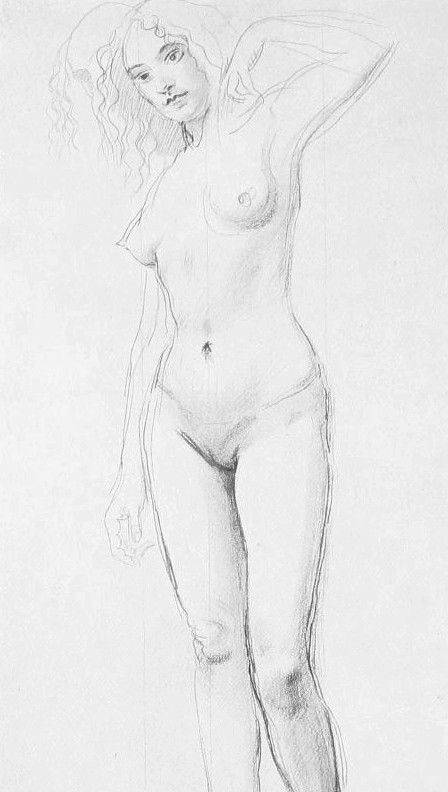
Nude Sketch Augustus John, 1909 The Slade; a collection of drawings and some pictures done by past and present students of the London Slade School of Art photo public domain from Wikimedia Commons

Nude Sketch
Augustus John, 1909
The Slade; a collection of drawings and some pictures done by past and present students of the London Slade School of Art
photo public domain from Wikimedia Commons

The John drawing Nick sees in the paneled gallery is presumably by Augustus John, the flamboyant and immensely talented Welsh-born portraitist . [We have previously shown a portrait of John by Powell’s friend Adrian Daintrey, the reputed model for Barnby.]  John was another good friend of Powell’s and drew portraits of him [TKBR 138-9]. Augustus’ sister, Gwen John, was also a distinguished portraitist, though with a less showy manner as a painter and a less sensational personal life.  Eventually, Gwen’s artistic reputation came to eclipse that of her brother Augustus, whose early brilliance seemed to wane as he aged.  But at the time of Nick’s visit to Stourwater, Augustus was at the peak of his career and was painting portraits of many of the luminaries of his day, including W.B. Yeats, T.E. Lawrence, and later on, Dylan Thomas. This nude figure drawing by Augustus might have appealed to Sir Magus Donners’ tastes.

Walter Richard Sickert (1860-1942) was, like Augustus John, a member of the Camden Town Group, a London cohort of early modernists known more for their bohemian-neighborhood lifestyle than for a unifying stylistic trait.  Sickert was a German-born disciple first of Whistler, then of Degas.  He is often called an Impressionist, less for his plein-air effects than for his interest in social-realist subjects, which he drew from life or photographs and then painted from his drawings.  Pictured here is one of Sickert’s many drawings for his famous painted subject, L’Ennui.

Sketch for L'Ennui William Sickert, 1913-1914 Ink on Paper, 24 x 20 in The Tate

Sketch for L’Ennui
William Sickert, 1913-1914
Ink on Paper, 24 x 20 in.
The Tate

Powell recalled that while he was an undergraduate at Oxford in the mid 1920s, he heard Sickert give a Slade lecture : “Tall, gray-haired, crimson in face, wearing a thick greenish loudly-checked suit, he chatted in a conversational voice, humorous and resonant, while he flourish a cigar…. delivering his direct no-nonsense art criticism…” [TKBR 80]

Lord Beaverbrook is thought to have been a model for Sir Magnus Donner.  Presumably Stourwater shared some characteristics with Beaverbrook’s estate Cherkley Court. Sickert became friendly with Lord Beaverbrook, who reportedly had the largest collection of Sickert’s works, some of which are now displayed at the Beaverbrook Art Gallery in Beaverbrook’s native New Brunswick. Sickert’s portrait of Beaverbrook is in the National Portrait Gallery. During World War I, Beaverbrook recruited Steer to paint pictures of the Royal Navy. Beaverbrook also commisioned Augustus John to paint a large historical mural about World War I for the a war memorial art gallery in Ottawa. The gallery and the mural were never completed, but the unfinished mural is now displayed at the Canadian War Museum.

Cupid Chastised by Venus Follower of Étienne Maurice Falconet (1716 - 1791) marble statuette, height 15 " The Wallace Collection photo from the Wallace Collection by Creative Commons License

Cupid Chastised by Venus
Follower of Étienne Maurice Falconet (1716 – 1791)
marble statuette, height 15 “
The Wallace Collection
photo from the Wallace Collection by Creative Commons License


We cannot leave the room without providing a facsimile of Cupid Chatised.

Posted in Uncategorized | 4 Comments

Raphael’s La Madonna della Sedia

Nick muses on both the likely and unlikely aspects of his friendship with Moreland.  A list of their shared childhood prejudices makes it seem as if they had known each other long before they had met, and includes a “capricious distaste for Raphael’s La Madonna della Sedia in framed oval reproduction.” [TKO 85/82]

The capriciousness of Nick’s and Moreland’s early distaste for La Madonna della Sedia is perhaps a hint of their shared intellectual snobbery, for it is surely one of Raphael’s most widely reproduced paintings and images of it no doubt furnished many a Victorian parlor and school room in their youth.  Its very popularity would make it a likely target for the contempt of adolescent aesthetes everywhere, though it is undoubtedly one of the loveliest paintings of the late Renaissance.

Madonna della Sedia Raphael, 1513-1514 oil on panel, circle diameter  28 in. Pitti Palace, Florence photo in public domain from Wikimedia Commons

Madonna della Sedia
Raphael, 1513-1514
oil on panel, circle diameter 28 in.
Pitti Palace, Florence
photo in public domain from Wikimedia Commons

Though Raphael Sanzio (1483-1520) painted La Madonna della Sedia in 1514 in Rome, it has been hanging for centuries in the Palatine Gallery of the Pitti Palace in Florence.  (It’s also widely known as La Madonna della Seggiola.  Both sedia and seggiola refer to the carved chair in which Mary sits.)  The painting is judged to exhibit a late nod by Raphael to the Venetian schools of Titian and Sebastiano del Piombo, reputedly evidenced by the painting’s warm coloration and the softened geometry of the tondo format.

Speaking of which, the painting’s round format is so famous and conspicuous a feature of its appeal that is is curious to read Nick’s recollection of its “framed oval reproduction.”  Either this is a rare occasion of a slip of memory by Powell, or else the Victorian decorative penchant for gilding the lily caused Victorian framers to try to augment the Madonna’s elegant simplicity with a more complex treatment.


Posted in Uncategorized | Leave a comment

The Literary Content of Some Picassos

Moreland is talking to Maclintick, who is drunk and depressed. Maclintick is bemoaning how his wife Audrey treats him; Moreland sees a parallel: “It wasn’t for nothing that Petrach’s Laura was one of the de Sade family.”[CCR 204/212 ]

Petrarch and Laura de Noves Venetian School, ~1510 oil on canvas 22 x 28 in photo credit: The Ashmolean Museum of Art and Archaeology from BBC Your Paintings

Petrarch and Laura de Noves
Venetian School, ~1510
oil on canvas 22 x 28 in
photo credit: The Ashmolean Museum of Art and Archaeology
from BBC Your Paintings

Petrarch (1304-1374), the Italian poet, wrote sonnets of unrequited love to Laura. She rejected him, not because she was a distant ancestor of the Marquis de Sade, but because she was married. Not surprisingly, there is no fourteenth century picture of them together and the unknown sixteenth century Venetian artist shows them side by side by juxtaposing existing portraits of the two.
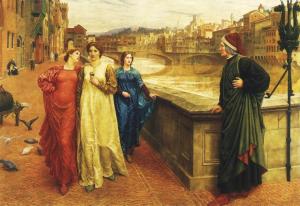
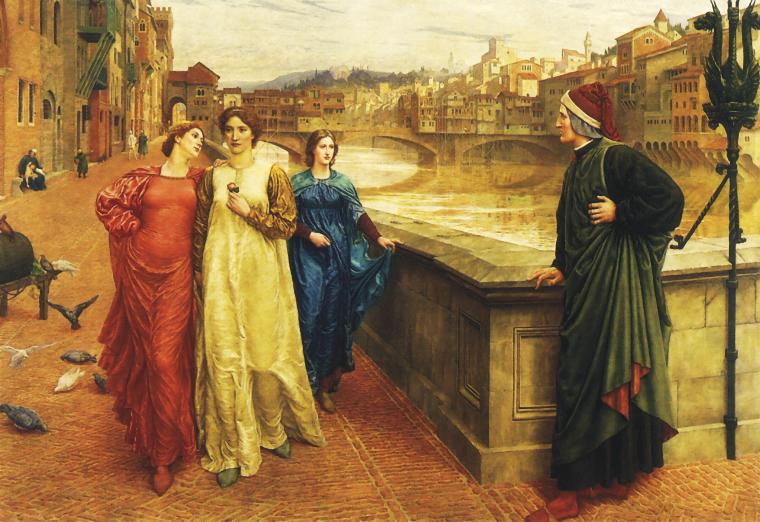
Dante and Beatrice Henry Holliday, 1893 oil on canvas, 55 x 78 Walker Gallery of Art photo public domain from Wikimedia Commons

Dante and Beatrice
Henry Holliday, 1893
oil on canvas, 55 x 78
Walker Gallery of Art, Liverpool
photo public domain from Wikimedia Commons

Maclintick recalls a picture of Petrarch and Laura, but Moreland corrects him, reminding him of a picture of Dante and Beatrice.  This painting by the Pre-Raphaelite painter Henry Holliday (1839  – 1927  ) shows Beatrice in white, walking with 2 woman friends. She is ignoring Dante because she had heard gossip about his infatuation with her. Like Petrarch’s, Dante’s love was unrequited; he is thought to have met Beatrice only twice; the first time, she was eight and he was nine years old. Holliday traveled to Florence for research to paint the locale accurately. This is Holliday’s best known painting. Maclintick says that reproductions of it were commonly displayed in boarding houses.
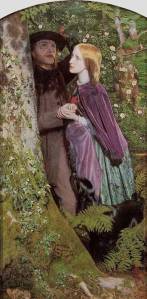
The Long Engagement Arthur Hughes, 1859 oil on canvas, 42 x 21 in Birmingham City Art Gallery, Birmingham, England photo in public domain from Wikimedia.org

The Long Engagement
Arthur Hughes, 1859
oil on canvas, 42 x 21 in
Birmingham City Art Gallery, Birmingham, England
photo in public domain from Wikimedia.org

A Hopeless Dawn Frank Bramley, 1888 oil on canvas 49 x 67 in The Tate, London photo from The Tate via BBC Your Paintings

A Hopeless Dawn
Frank Bramley, 1888
oil on canvas 49 x 67 in
The Tate, London
photo from The Tate via BBC Your Paintings

Moreland, who relishes speaking of art and literature, makes an enigmatic statement: “The literary content of some Picassos makes The Long Engagement or A Hopeless Dawn seem dry pedantic studies in pure abstraction.”  The Long Engagement and A Hopeless Dawn are sad Victorian scenes. The engagement is long because the curate is too poor to marry his fiancee. The dawn is hopeless because the kneeling woman knows that her husband is lost at sea. When Moreland calls these “studies in pure abstraction,” perhaps he means that although the paintings were superficially realistic, their portrayal of emotion was so excessive that they were unrealistic.

We repeatedly read this conversation of Moreland and Maclintick, which ranges from Petrarch to James Joyce, looking for clues as to which Picassos were on Moreland’s mind. By the mid 1930’s Picasso was the richest, most famous, and perhaps most prolific living painter. Moreland might have been thinking of Picassos beyond our ken.
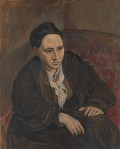
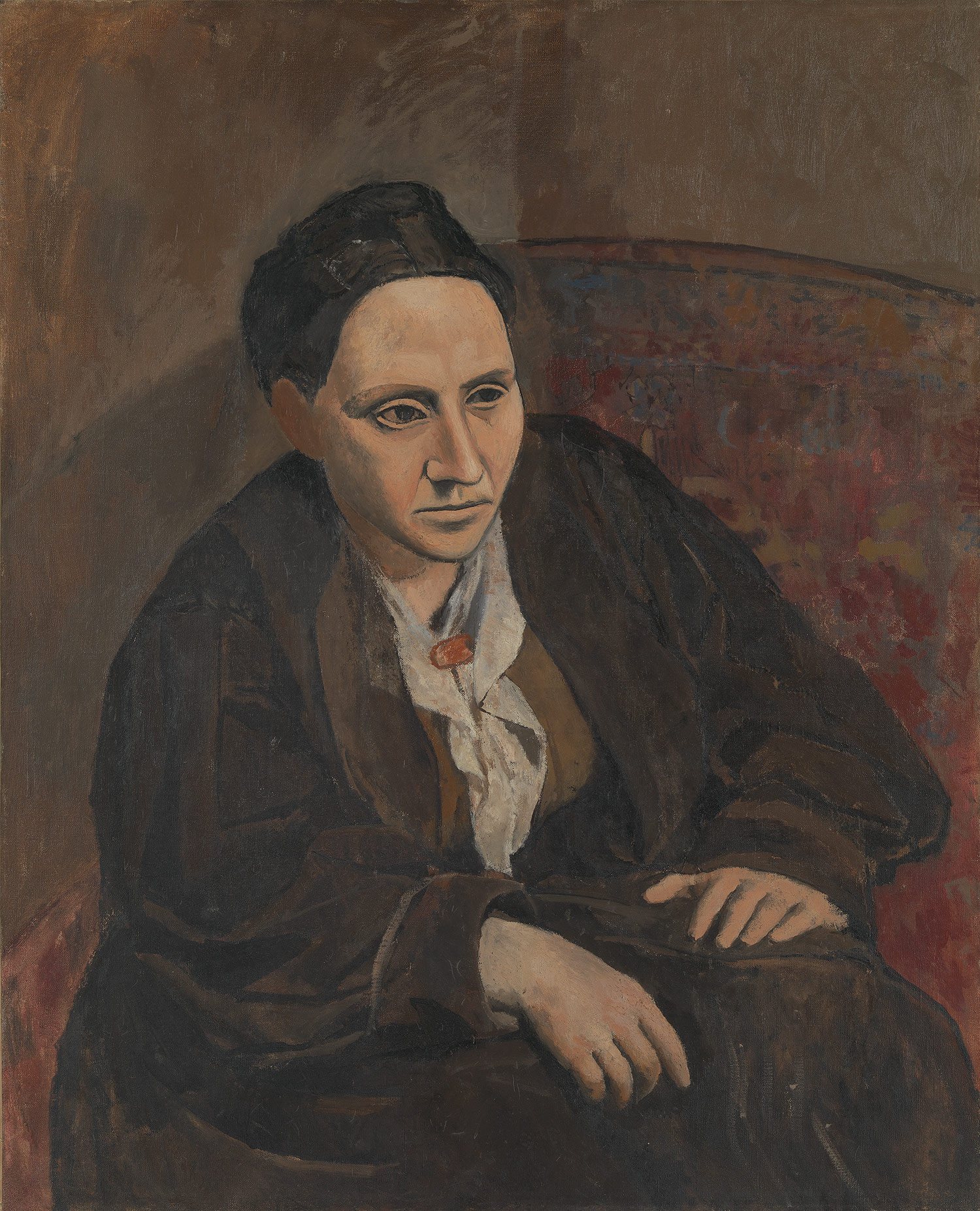
Gertrude Stein Pablo Picasso, 1905-1908 oil on canvas, 39 x 32 in Metropolitan Museum of Art, New York © 2011 Estate of Pablo Picasso / Artists Rights Society (ARS), New York

Gertrude Stein
Pablo Picasso, 1905-1908
oil on canvas, 39 x 32 in
Metropolitan Museum of Art, New York
© 2011 Estate of Pablo Picasso / Artists Rights Society (ARS), New York

We have puzzled over what Moreland meant by the ‘literary content of some Picassos.” Is he talking about art featuring writers, about art illustrating writing, or about art telling a story? Picasso wrote poetry and plays and was friendly with many writers, but in the context of the other paintings Moreland was discussing, portraits of these friends, like Gertrude Stein, do not seem to us to have the  ‘literary content’ in question.
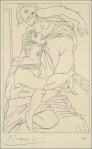
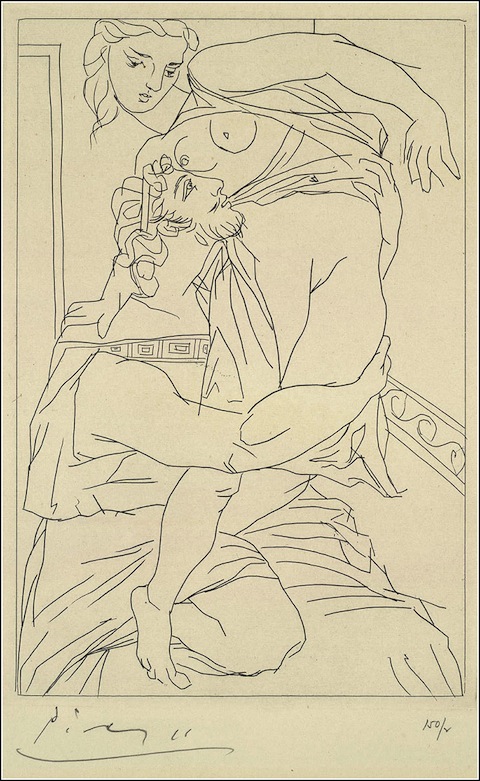
Illustration for Lysistrata Pablo Picasso, 1934 The Print Club, New York photo from OpenCulture.com presumed under copyright

Illustration for Lysistrata
Pablo Picasso, 1934
The Print Club, New York
photo from OpenCulture.com
presumed under copyright

If Moreland is talking about art illustrating writing, many Picasso images merit consideration. Picasso illustrated over 50 books and articles. His Don Quixote has become much more widely reproduced than Dante and Beatrice, but this image is from 1955, so Moreland could not be referring to it in the 1930’s. However, in the 30’s Picasso was illustrating works like Ovid’s Metamorphoses and Aristophanes’ Lysistrata with etchings that are much less “dry and pedantic” than Hughes’ or Bramley’s work.

If Moreland is talking about art that tells a story, some works by Picasso qualify more than others. Picasso, along with Braque, is credited with inventing Cubism, one of the pioneering forms of Abstract Art.  While the real basis of some Cubist works is discernable, the style evolved to more abstract works that lack any evident narrative (see for, example, Picasso’s early collage, Still Life with Chair Caning), so that we do not think of these Picassos as ‘literary.’
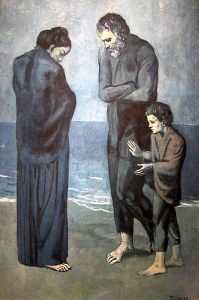
The Tragedy Pablo Picasso, 1903

The Tragedy
Pablo Picasso, 1903 oil on wood, 40 X 28 in The National Gallery of Art, Washington photo public domain in US from Wikipedia

During his Blue Period (1901–1904), Picasso literally had “the blues,” becoming severely depressed after the suicide of a friend. His paintings, monochromatic shades of blue, with attenuated but still recognizable depictions of the sad, poor, or oppressed, could match Victorian melodrama tear for tear. We do not know what befell the trio shown at the left, but we instinctively see them as a family and wonder about their pain.  The Tragedy is as much of a story picture as The Long Engagement or  A Hopeless Dawn.  We doubt that Picasso of the Blue Period is what Moreland had in mind when he is rejecting the sentimentality of Bramley and Hughes.

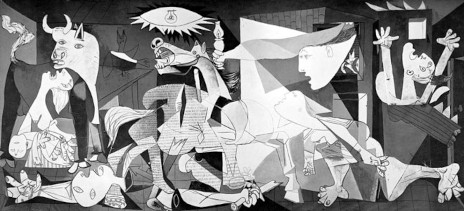
Maclintick cares little for art or novels, yet introduces James Joyce’s Ulysses  into the conversation.   We wonder if this is a clue to a different interpretation of Moreland’s statement. Some of Picasso’s later work, including paintings from the mid 1930s when Moreland and Maclintick were talking, told stories in much more symbolic, less direct ways, requiring more work from the viewer to understand the metaphors, just as Ulysses tells a story but is not the easiest novel to read.  We are thinking specifically of Guernica.
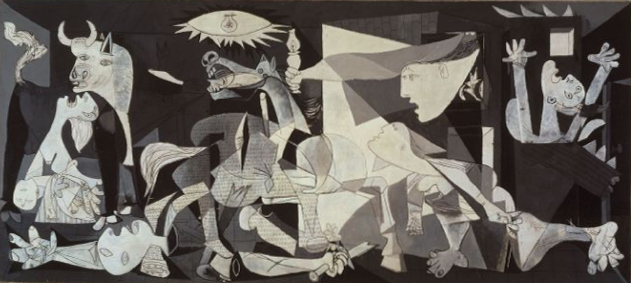
Guernica Pablo Picasso, 1937 oil on canvas, 140 x 310 in Museo Reina Sofia, Madrin image from Wikipedia. org presumed under copyright, see Wikipedia for non-free media rationale

Guernica
Pablo Picasso, 1937
oil on canvas, 140 x 310 in
Museo Reina Sofia, Madrin
image from Wikipedia. org
presumed under copyright, see Wikipedia for non-free media rationale

Guernica is full of anguish, showing a tragedy, not of an anonymous trio, but of a whole town devastated by bombing in the Spanish Civil War. The multiple distorted bodies and the iconography, particularly of the bull and the horse, have spawned many controversies about their interpretation.  This is literary modernism to contrast with the classicism of Dante and of Pre-Raphaelites like Henry Halliday.

Powell is showing us a Moreland who is sick of the sentimentalism and narrative literalism of the age he grew up in, and who is championing the modern taste for metaphor as representation.  After all, to the extent that Moreland is modeled on Constant Lambert, he is modeled on a composer who wrote music for Romeo and Juliet and Cymbeline, and the classical tales of Pomona and of Tiresias.  He must constantly have been struggling with how music, that most abstract of arts, could represent known stories without resorting to narrative literalism and sentiment.

We have used ‘literary’ as a launch pad for a selective recap of Picasso’s career and for flights of speculation about Moreland’s intent.  We are sure that Moreland would welcome further conversation.
Posted in Uncategorized | 2 Comments

Fauvism and Surrealism

We will mention some references to art movements in CCR almost as briefly as Powell does.

Stringham refers to his former sister-in-law Anne Stepney “chattering away about Braque and Dufy.” [CCR 170/175] This is a reprise of an similar statement he made in 1933 [AW 208/199].  About 1906-1907 Braque and Dufy were fauvists like Derain and Matisse. Members, writing about St. John Clarke, referred to “an ephemeral, if almost painfully sincere, digression into what was for him the wonderland of fauviste painting.” [CCR 185-186/190-192 ]

Later Jenkins tells about his brother-in-law Hugo, who goes to work for an antique dealer, Mrs. Baldwyn Hodges, “a middle-aged, capable leathery woman of a type Mr. Deacon would have particularly loathed had he lived to see the rise of her shop…” [CCR 194/200-201].  Mr. Deacon would have also been appalled that Hugo and Mrs. Baldwyn Hodges met at the Surrealist Exhibition, since surrealism was on the list of styles that he detested.

Andre Breton photo by Man Ray, 1931. Gelatin silver print (solarized), 11 1/2 x 8 3/4″  Museum of Modern Art, New York © 2012 Man Ray Trust/Artists Rights Society (ARS), New York/ADAGP, Paris 92.1941

André Breton
photo by Man Ray, 1931.
Gelatin silver print (solarized), 11 1/2 x 8 3/4″
Museum of Modern Art, New York
© 2012 Man Ray Trust/Artists Rights Society (ARS), New York/ADAGP, Paris
92.1941

Surrealism began as a Parisian literary movement. It had antecedents in the 1910s, but the documented birth year is 1924 when André Breton published the Manifesto of Surrealism. Surrealism had intellectual connections to Freudian psychology and Marxist politics. The writers strove to release their subconscious imaginations.  Soon, visual artists associated with the movement, which Breton encouraged by reproducing their works in his journal La Révolution Surréaliste and by helping to organize exhibits of their work, whether paintings, drawings, sculpture, or photographs. Visual surrealist art is quite diverse but united by efforts to break with conventional culture and see the world in new ways. We show Man Ray’s photographic portrait of Breton, because Ray (1890-1976) was a prominent surrealist.


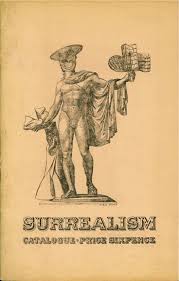
Surealism Exhibition Catalog Cover Contemporary Poetry and Prose, Issue 2, 1936 Editor Roger Roughton Image : Max Ernst

Surealism Exhibition Catalog Cover
Contemporary Poetry and Prose, Issue 2, 1936
Editor Roger Roughton
Image by Max Ernst

The London International Surrealism Exhibition ran for three weeks at the New Burlington Gallery beginning June 11, 1936. It was organized by a small group of British surrealist painters with the help of Breton and others. Arp, Calder, Dali, Miro, Ernst, Magritte, Picasso, Duchamp, Klee, Man Ray, Henry Moore, Giacometti, and many more exhibited works; Dali almost suffocated while performing in a deep sea diver’s helmet. Forty thousand people attended the exhibit, yet Powell later wrote that Surrealism never really took hold in Britain [SPA 295-299].

Posted in Uncategorized | 2 Comments

Isbister according to St. John Clarke

Jenkins reflected after St. John Clarke’s death: “If so tortuous a comparison of mediocre talent could ever be resolved, St John Clarke was probably to be judged a ‘better’ writer than Isbister was a painter.” [CCR 184/190 ]

Mark Members recalled St. John Clarke’s jealousy of all the acclaim Isbister received: “‘Isbister was beloved of the gods, Mark,’ he had cried, looking up with a haggard face from The Times of New Year’s Day with its list of awards, ‘R.A. before he was forty-five — Gold Medalist of the Paris Salon — Diploma of Honour at the International Exhibition at Amsterdam — Commander of the Papal Order of Pius IX — refused a knighthood. Think of it, Mark, a man the King would have delighted to honour. What recognition have I compared to these?'”

The Cider Press Frank Brangwyn, 1902 oil on canvas The Japan Times | © DAVID BRANGWYN, LISS FINE ART PHOTO

The Cider Press
Frank Brangwyn, 1902
oil on canvas
from The Japan Times
© DAVID BRANGWYN, LISS FINE ART PHOTO

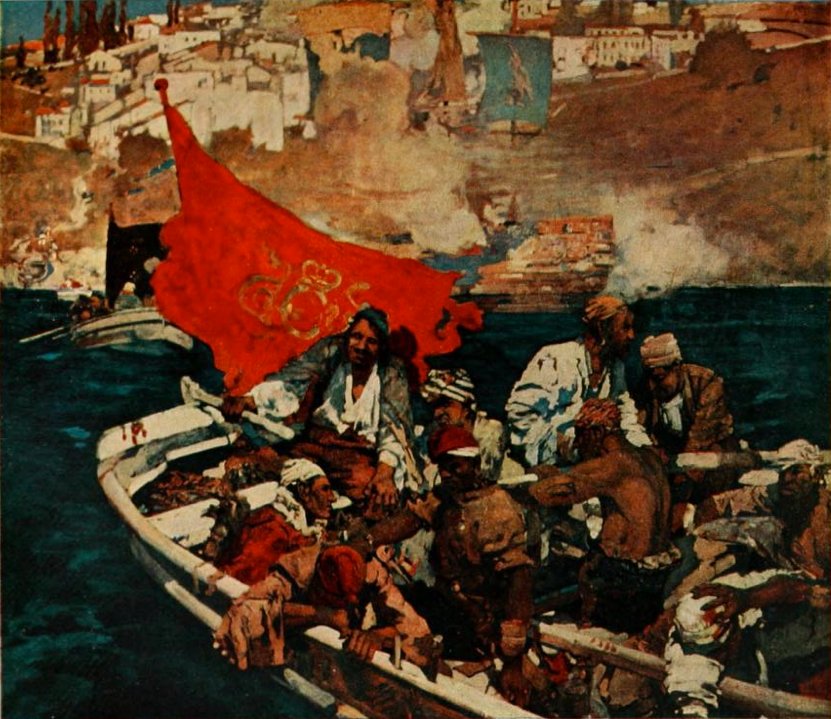
We have already speculated about models for Isbister, a portraitist, the ‘British Frans Hals,’ a genre painter.  Now we offer Frank Brangwyn as a possibility.  Maybe Isbister’s genre paintings would look something like Brangwyn’s The Cider Press.  Brangwyn was acclaimed early in his career; The Buccaneers was a sensation at the Paris Salon of 1893. In the table below,  we compare Isbister to Frank Brangwyn to show how Isbister’s biography overlaps with real events. The parallels are striking when we outline their careers side by side.

The Buccaneers Frank Brangwyn, 1893 Internet Archive version of a copy in the Ontario College of Art. Web. 28 December 2012   from Victorian Web

The Buccaneers
Frank Brangwyn, 1893
Internet Archive version of a copy in the Ontario College of Art. Web. 28 December 2012 from Victorian Web

Horace Isbister Frank Brangwyn
Born  1867
Paris Salon Gold Medalist Gold Medal, 1891, for Funeral at Sea
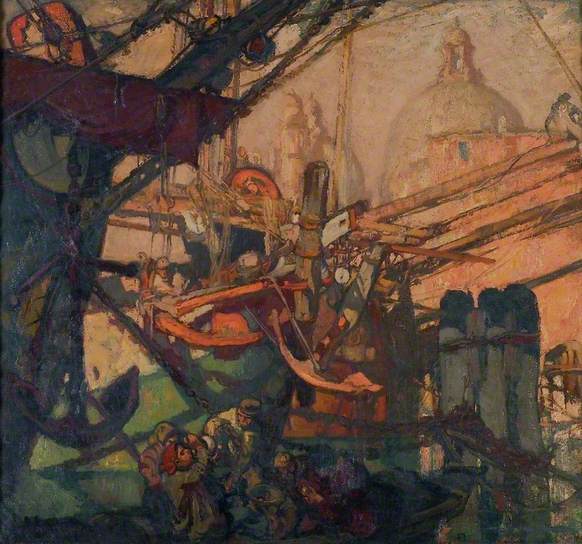
Amsterdam International Exhbition Diploma of Honour Gold medal, 1906, for Santa Maria della Salute
Elected RA Before age 45 1919 (age 52)
Papal Order of Pius IX Commander Not known but was Catholic
Knighthood Declined the honour Knighted, 1941, but skipped dubbing ceremony
Died  1932  1956
Santa Maria della Salute, Venice Frank Brangwyn, 1906, repainted 1933 oil on canvas, 59 x 64 in Ferens Art Gallery Kingston upon Hull, East Riding of Yorkshire, England photo BBC Your Paintings

Santa Maria della Salute, Venice
Frank Brangwyn, 1906, repainted 1933
oil on canvas, 59 x 64 in
Ferens Art Gallery
Kingston upon Hull, East Riding of Yorkshire, England
photo BBC Your Paintings


Of course, Isbister is drawn from a mixture of his contemporaries, and  the comparison to Brangwyn is imperfect. For example, Brangwyn was more a muralist than a portraitist; however, we do know that Powell derided the styles of both artists, referring to “Royal Academy pictures in the sententiously forcible manner of Brangwyn–once much imitated …” [TKBR 147].  Like Isbister,  after World War I Brangwyn’s reputation waned, but today he has new enthusiasts.

Posted in Uncategorized | 2 Comments

Lely’s Portrait of Judge Jeffreys

After discussing the attribution of the Prince Rupert, Lord Huntercombe continues his rivalry with Smethyck: “I was even able to carry the war into Smethyck’s country by enquiring whether he felt absolutely confident of the supposed portrait of Judge Jeffreys, attributed to Lely, on loan from his own gallery.” [CCR 165/169]

George Jeffreys, 1st Baron Jeffreys of Wem  John Michael Wright, 1673 oil on canvas, 1673 47 3/4 in. x 39 3/4 in. oil on canvas 48 x 40 in Purchased, 1989 NPG 6047 NPG 6047 © National Portrait Gallery, London by Creative Commons license

George Jeffreys, 1st Baron Jeffreys of Wem
John Michael Wright, 1673
 oil on canvas 48 x 40 in
© National Portrait Gallery, London
by Creative Commons license

George Jeffreys, 1st Baron Jeffreys of Wem, (1645 – 1689), also known as “The Hanging Judge”, was a Welsh judge who was appointed Lord Chief Justice in 1683 and later became Lord Chancellor to King James II.

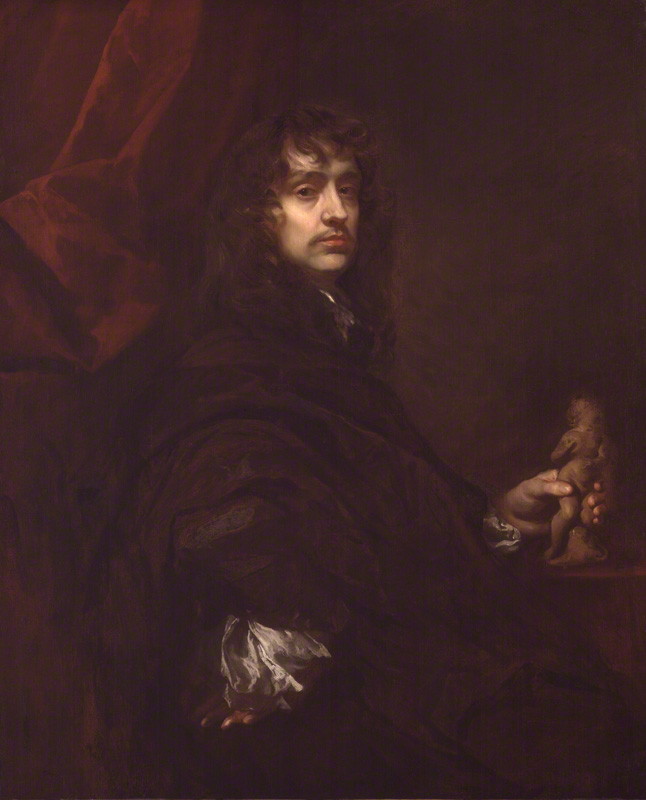
Self Portrait Sir Peter Lely, circa 1660 oil on canvas, 43 x 35 in. NPG 3897 © National Portrait Gallery, London by Creative Commons license

Self Portrait
Sir Peter Lely, circa 1660
oil on canvas, 43 x 35 in.
NPG 3897
© National Portrait Gallery, London
by Creative Commons license

Sir Peter Lely (1618-1680) was born in Germany of Dutch descent. He moved to London about 1640 and, after the deaths of Van Dyck in 1641 and Dobson in 1646, became the leading portraitist of the day. He painted Charles I and Oliver Cromwell. When Charles II ascended to the throne with Restoration in 1660, Lely became the court painter. He had a prolific workshop, so that for some works that bear his name, how much of the paint he personally applied to the canvas is in question.  The BBC Your Paintings Website is aware of 609 Lely works currently in Britain. At times it seems that he painted everyone of importance in Restoration London. Jeffreys was a prominient contemporary, but we have not found a Lely portrait of Jeffreys.

Posted in Uncategorized | Leave a comment

William Dobson

Lord Huntercomb said, “Smethyk showed  himself anxious to point out that my Prince Rupert Conversing with a Herald was painted by Dobson, rather than Van Dyck. Fortunatley I had long ago come to the same conclusion and recently caused its label to be altered.” [CCR 165/169]

When Prince Rupert was mentioned in BM, we were unable to find an actual Van Dyck to match it, so we are not surprised by Smethyk’s opinion.

Prince Rupert , Colonel William Murray and Colonel, The Hon. John Russell William Dobson, circa 1640 oil on canvas, 60 x 82 in Ashdown House, Berkshire ©National Trust Images

Prince Rupert , Colonel William Murray and Colonel, The Hon. John Russell
William Dobson, circa 1640
oil on canvas, 60 x 82 in
Ashdown House, Berkshire
©National Trust Images

William Dobson (1611-1646)  actually did paint Prince Rupert at least 3 times, but again we have not found the exact painting in the Huntercombe collection. Dobson became a royal court painter in 1641, when Van Dyck died. Powell may have had a special interest in Dobson because Dobson’s contemporary, John Aubrey (subject of Powell’s John Aubrey and his Friends),  called him “the most excellent painter that England hath yet bred.” Dobson is believed to have copied Van Dycks earlier in his career, but his mature style is not easily confused with Van Dyck’s.  Naturally, Lord Huntercombe, the connoisseur, is one step ahead of Smethyck.

Posted in Uncategorized | Leave a comment