The Drunkenness of Lot

Rushing to see the Candaules and Gyges fresco, Dr. Brightman provides ongoing commentary:

These tapestries must be Florentine — look, The Drunkenness of Lot. The daughter on the left greatly resembles a pupil of mine, but we must not tarry, or the mob will be upon us again. [TK 82/76]

We have not been able to find an image of this particular tapestry; it could well be another invention by Powell, but we will comment briefly on the medium and the message.

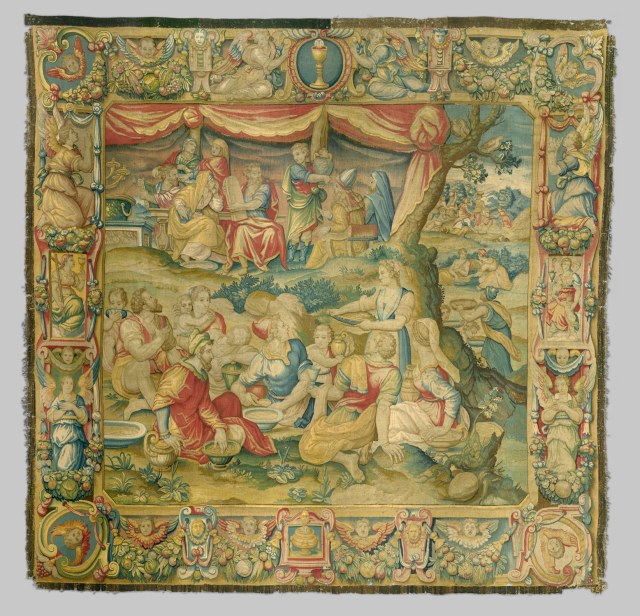
The Gathering of Manna Medici workshop under the direction of Guasparri di Bartolomeo Papini, 1595-1596 Wool and silk, 176 x 168 inches The Metropolitan Museum of Art, New York

The Gathering of Manna
Medici workshop under the direction of Guasparri di Bartolomeo Papini, 1595-1596
Wool and silk, 176 x 168 inches
The Metropolitan Museum of Art, New York

In 1545 Cosimo I de’ Medici started tapestry workshops in Florence, using designs by Italian artists. The Medici workshops continued into the seventeenth century.

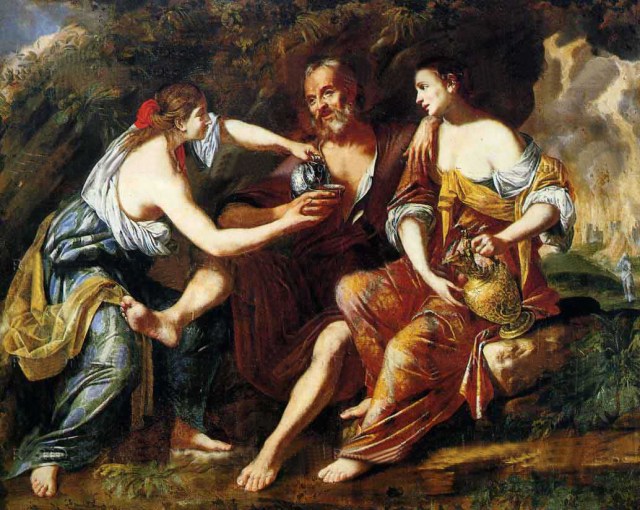
Lot and His Daughters Domenico Maroli seventeenth century Meuo Regionale de Messina photo in public domain from Wikimedia Commons

Lot and His Daughters
Domenico Maroli
seventeenth century
Museo Regionale de Messina
photo in public domain from Wikimedia Commons

There are numerous paintings on the biblical theme of The Drunkenness of Lot. We show Domenico Maroli’s  Lot and His Daughters not necessarily for its artistic superiority but rather as a painting that might have been available to the Medici workshop. Maroli (1612-1676) was born in Sicily but spent part of his career painting in Venice and other parts of northern Italy.  According to Genesis, Lot’s daughters plied their father with drink and slept with him on successive nights, intending to get pregnant. Some read this as the girls raping their father; for others, it as the daughters’ revenge for prior abuse (Genesis 19:8) The life of Lot, Abraham’s nephew, is rich in moral ambiguity, and the fleeting reference to this tapestry hints at the sexual escapades that follow both in the picture of Candaules and Gyges and in the plot of Dance.

Powell was interested in the issue of sexual censorship. He attended and reported on the trial at the Old Bailey in 1960 that acquitted Penguin Books of obscenity for publishing Lady Chatterley’s Lover. In an interview, he was asked whether relaxation of the censorship laws made it easier to describe the sexuality of Pamela Fitton in the later volumes of Dance. Powell replied by citing Philip Larkin’s poem Annus Mirabilis:

Sexual intercourse began
In nineteen sixty-three
(which was rather late for me) –
Between the end of the Chatterley ban
And the Beatles’ first LP.

We benefit from the end of the ban, as we proceed to see Candaules and Gyges

Posted in Uncategorized | Leave a comment

Luca Giordano

Referring to art works in the Bragadin Palazzo, Dr. Brightman says. “These Luca Giordano will keep them most of them quiet for the time being.” [TK 80]

Jenkins adds, “Gwinett, preferring to go over the Palazzo at his own speed, strolled away to examine the Roman emperors on their plinths. He may also have had an interest in Luca  Giordano [TK 80/81]

Venus, Cupid, and Mars Luca Giordano, 1663 oil on panel 61 x 51 in National Gallery of Capodimonte, Naples photo in public domain from Wikimedia Comms

Venus, Cupid, and Mars
Luca Giordano, 1663
oil on panel 61 x 51 in
National Gallery of Capodimonte, Naples
photo in public domain from Wikimedia Commons

Luca Giordano (1634-1705) was a Neapolitan painter and etcher. Until he was eclipsed by Picasso, he was the most prolific known artist. He spent much of his working life in Naples, Rome, and Florence. For a decade, he was court painter to Charles II in Spain. He was probably in Venice about 1667 but at other times sold his works to Venetian patrons. For example, his Annunciation, now in the Metropolitan Museum in New York, apparently was first displayed in the church  San Daniele in Venice from 1674 to 1809. 

We show two of  Giordano’s versions of Venus and Mars because we will soon be discussing a Venus and Mars by Tiepolo.  In Venus, Cupid, and Mars, the earlier version (shown above), the pasty flesh reminds us of heavy, tasteless, braided cookie dough, but Giordano  learned from many of his contemporaries, including Veronese. By the time by painted Venus and Mars Captured by Vulcan, he had adopted a lighter frothy style, so he is sometimes called the “proto-Tiepolo.”

Venus and Mars Luca Giordano, 1670s oil on canvas, 91 x 72 in Academy of Fine Arts, Vienna photo in public domain from Wikimedia Commons

Venus and Mars Captured by Vulcan
Luca Giordano, 1670s
oil on canvas, 91 x 72 in
Academy of Fine Arts, Vienna
photo in public domain from Wikimedia Commons

"Vitellio Grimani" plaster cast, brown paint early sixteenth century copy of bust from second century AD

“Vitellio Grimani”
plaster cast, brown paint
early sixteenth century copy of bust from second century AD

For the Baroque bust of a Roman Emperor we show the “Vitellio Grimani.” When Domenico Grimani gave it to the Venetian Serenissima in 1523, copied from a second century Roman bust, it was considered a portrait of the Emperor Vitellius. Tintoretto studied it in his studio and sketched it. The head has now be re-identified as a court official from Hadrian’s time.

Posted in Uncategorized | Leave a comment

Tiepolo IV: Guardi’s Sister and The Agony in the Garden


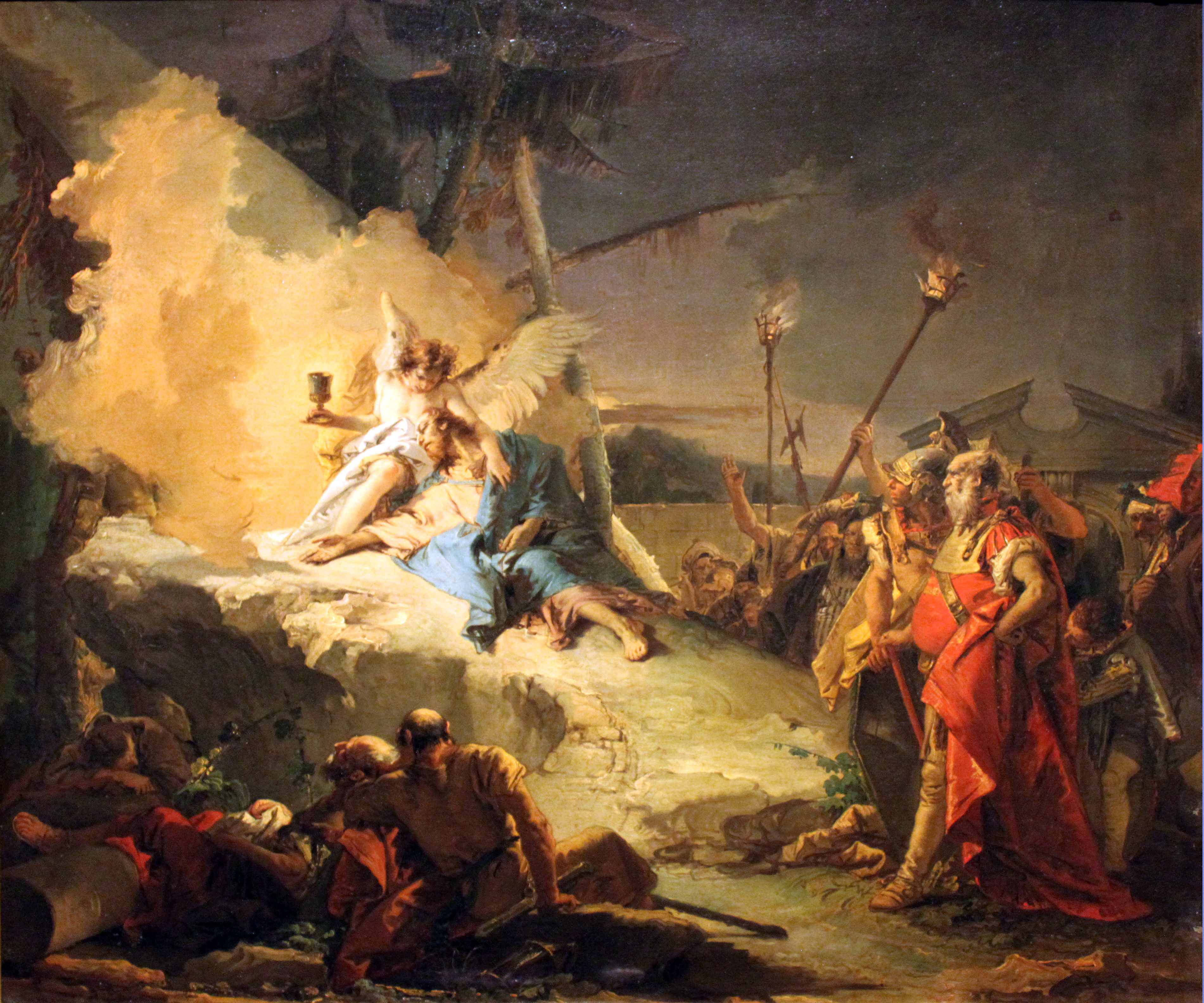
Continuing her reflections on Tiepolo’s Candaules and Gyges, Dr. Brightman muses, “I wonder whether the model was the painter’s wife . . . If so, she was Guardi’s sister.  Gyges looks rather like the soldier in The Agony in the Garden, who so much resembles General Rommel.” [TK 92/85]

Here it seems Powell’s cluster of art-historical allusions serves to illustrate Dr. Brightman’s erudition rather than advance the plot of Temporary Kings. She drops the name of Guardi as if he were her faculty colleague.  Actually, the Guardi name might describe the three brothers Francesco, Nicolo, and Giovanni Antonio Guardi, whose sister, Maria Cecilia, married Giovanni Battista Tiepolo and bore his nine children.  Francesco (Italian 1712-1793) is usually the cited as the Guardi of record, but in fact it was a workshop that included all three brothers which produced the glorious paintings of the Guardi brand. They include panoramic scenes of 18th century Venice that vie with those of Canaletto for majesty and clarity of detail, but unlike Canaletto, Guardi also produced religious works of great distinction.

Dr. Brightman is not the only one to speculate on the identity of Tiepolo’s models. Maria Cecilia Guardi was often his model. See for example, Alexander the Great and Campaspe in the Studio of Apelles (1740) now in the Getty Museum in Los Angeles. To us, the woman in this picture closely resembles Tiepolo’s Cleopatra; however, others have speculated that Cleopatra, whom Dr. Brightman earlier compared to Candaules wife, was based on the patroness of the Villa Labia or on Cristina, the daughter of a Venetian gondolier, for whom Tiepolo abandoned Maria Cecilia when he was 66 (see J. Anderson  Tiepolo’s Cleopatra)

General Field Marshall Erwin Rommel photo, 1942 German Federal Archives via Wikimedia Commons Creative Commons Share Alike Attribution Bundesarchiv, Bild 146-1973-012-43 / CC-BY-SA 3.0

General Field Marshall Erwin Rommel
photo, 1942
German Federal Archives via Wikimedia Commons
Creative Commons Share Alike Attribution Bundesarchiv, Bild 146-1973-012-43 / CC-BY-SA 3.0

Like all survivors of World War II, Dr. Brightman must have had the name and likeness of General Erwin Rommel (German 1891-1944) vividly in memory. Known as “The Desert Fox” for his brilliant command of Nazi forces in North Africa, Rommel was esteemed by Axis and Allied observers alike. His implication in a plot to assassinate Hitler and his own forced suicide as a consequence must have kept his photo appearing often in British newspapers toward the end of the war.

The same renown does not extend to the soldier in Tiepolo’s Agony in the Garden, which is also known as Christ in the Garden of Gethesmane, which is the garden where Jesus went after the Last Supper and where he was arrested.

Christ in the Garden of Gethesmane Giovanni Battista Tiepolo, 1757 oil on canvas, 20 x 35 in Kunsthalle, Hamburg photo in public domain from Wikimedia Commons

Christ in the Garden of Gethesmane
Giovanni Battista Tiepolo, 1757
oil on canvas, 20 x 35 in
Kunsthalle, Hamburg
photo in public domain from Wikimedia Commons

The Agony motif does not require the presence of a soldier, and if one of the two hazy figures at the right in Tiepolo’s Agony is indeed a Roman soldier who looks like Rommel, it is only a brilliant scholar like Dr. Brightman who would notice it.  But then, who better than an invention such as Dr. Brightman to give voice to Powell’s own wit and erudition in Temporary Kings?

The centrality of Tiepolo’s work in Temporary Kings serves as a kind of complement to the classicism of Nicolas Poussin, that other giant of the eighteenth century upon whom Powell relies for his animating metaphors.  Poussin’s Dance is a stately round of rising and falling fortunes.  Powell invokes Tiepolo to remind us how sexual desire, lust for power, hubris and nemesis distort and complicate that stately parade.

Posted in Uncategorized | Leave a comment

Tiepolo III: Mars and Venus, Moses saved from the Water, Cleopatra

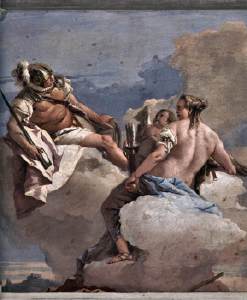
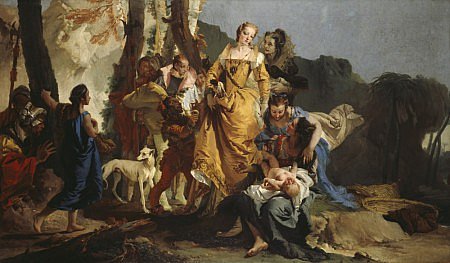
Upon their discovery of Tiepolo’s Candaules and Gyges ceiling, Dr. Brightman begins to lecture Nick:  “As Russell Gwinnett said, one is a little reminded of Iphigenia in the Villa Valmarana, or the Mars and Venus there.  The usual consummate skill in handling aerial perspectives.  The wife of Candaules—Gautier calls her Nyssia, but I suspect the name invented by him—is obviously the same model as Pharoah’s daughter in Moses saved from the water at Edinburgh, also the lady in all the Antony and Cleopatra sequences, such as those at the Labia Palace, which I was once lucky enough to see.” [TK 83/77]

Here Powell is using his thorough knowledge of art history to inform our vision of his imaginary Tiepolo (Candaules and Gyges) by likening it to Teipolo’s well-known real paintings. We have already inspected The Sacrifice of Iphigenia at Villa Valmarana.  In the Guest House, or Foresteria, of that splendid villa near Vicenza are frescoes by Giovanni Battista Tiepolo’s son, Giovanni Domenico.  The sole painting there by the father is the one Dr. Brightman cites, known as Mars, Venus and Amor.

Mars, Venus and Amor
Giovanni Baptista Tiepolo, 1757
fresco
Villa Valmarana ai Nani, Vicenza
photo in public domain from Wikimedia Commons via the Yorck Project

Powell’s cleverness even allows us to form an image of Candaules’ wife, by having Dr. Brightman identify her as the same model Tiepolo used for the real paintings of Pharoah’s daughter and of Cleopatra.

The Finding of Moses Giovanni Battista Tiepolo, circa early 1730s painting, 81 x 133 in National Gallery of Scotland

The Finding of Moses
Giovanni Battista Tiepolo, circa early 1730s
painting, 81 x 137 in
National Gallery of Scotland

The Meeting of Antony and Cleopatra Giovannia Battista Tiepolo, 1747-1749 fresco, 260 x 120 inches Villa Labia, Venice photo from the Web Gallery of Art

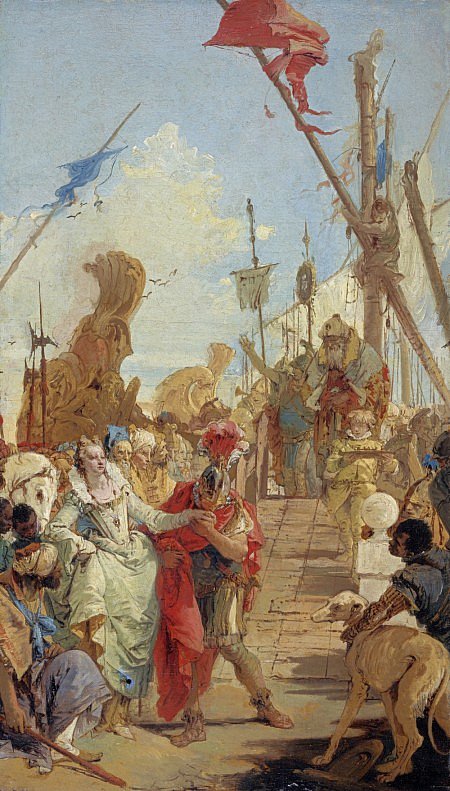
Pharoah’s daughter appears in a painting known as The Finding of Moses, now in the National Gallery of Scotland.  And as Dr. Brightman insists, she is a ringer for the Cleopatra meeting Antony, part of his Antony and Cleopatra series in the Palazzo Labia in Venice.


The Meeting of Antony and Cleopatra Giovanni Battista Tiepolo oil on canvas, 27 x 15 in National Gallery of Scotland

The Meeting of Antony and Cleopatra
Giovanni Battista Tiepolo
oil on canvas, 27 x 15 in
National Gallery of Scotland

Her face is easier to study in a preparatory sketch for this fresco, now in the National Museum of Scotland.  Soon, in Powell’s imagination, she will be doffing her clothes to pose as King Candaules’ queen.

Posted in Uncategorized | Leave a comment

Tiepolo II: Candaules and Gyges

We have anticipated seeing Candaules and Gyges. Earlier in TK, Nick discussed the day’s extra-curricular activities with Russell Gwinnett and Dr. Emily Brightman.  We learned that the Venitian palazzo of the socialite Jacky Bragadin, distant descendant of Marcantonio Bragadin, the patron of Giacomo Casanova, harboured a Tiepolo ceiling almost never on view to the public.  Dr. Brightman described the ceiling as “‘One of the painter’s classical scenes—Candaules and Gyges.   The subject, thought to have  some contemporary reference, caused trouble at the time the ceiling was painted.  That’s why the tradition of playing the picture down, keeping it almost a secret, has persisted almost to the present day.’”  Gwinnett added, “”I’ve been told it’s not unlike the Villa Valmarana Iphigenia in composition . . . The owner won’t allow it to be photographed.’” [TK 41-43]

As with several others of Dance’s most evocative works of art (e.g., The Seven Deadly Sins tapestries at Stourwater [BM 199/190]), this one also is Powell’s fiction, a convincing synthesis of art-historical clues and clever plot drivers.  There is a Bragadin palazzo in Venice, now made into a boutique hotel that boasts Marcantonio and Casanova as former occupants of the building.  And of course, Venice is home to many Tiepolo ceilings, but none anywhere depicting Candaules and Gyges, a somewhat obscure tale of sexual intrigue and betrayal.

We learn at length, and soon enough, the image content of Tiepolo’s ceiling and the extended tale on which it is based [TK 81-90], so there is no need to spoil the reader’s fun by revealing it here.  But it is worth remarking on the cleverness of Powell’s conceit that this painting is said to be similar in composition to Tiepolo’s Sacrifice of Iphigenia, for it allows Powell to describe in the most vivid terms this imaginary ceiling while looking at its alleged real-life look-alike in the Villa Valmarana, which we have documented earlier. [TK 26-27/22-23]  This extended evocation of a glorious–if imaginary– work of art stands out from Powell’s usual brief, deceptively casual, artistic references. Here Powell rivals the majesty of his ekphrasis of the Poussin painting that sets in motion the entire enterprise of the Dance. The prominence of this description of Candaules and Gyges  announces its importance as a metaphor in Temporary Kings and reminds us of Powell’s deep conviction of art’s power to assign meaning to life’s apparent chaos.

Even Tiepolo’s sublime color palette is harnessed to Powell’s enterprise.  Nick looks from the colors on the ceiling to Pamela Fitton’s costume:

White trousers, thin as gauze, stretched skintight across elegantly compact small haunches, challengingly exhibited, yet elegantly formed; hard, pointed breasts, no less contentious and smally compassed, under a shirt patterned in crimson and peacock blue, stuck out like delicately shaped bosses of a shield. These colours might have been expressly designed — by dissonance as much as harmony — for juxtaposition against those pouring down in brilliant rays of light  from the Tiepolo; subtle yet penetrating pinks and greys, light blue turning almost to lavender, rich saffrons and cinnamons melting into bronze and gold. [TK 88]

We wonder if this passage is another Powellian homage to Proust, who was so enchanted by Tiepolo’s colors that he used them to describe the clothes of the women about whom he obsessed — Odette, the Duchesse of Guermantes, and Albertine. Albertine wore a Fortuny gown with sleeves of “cherry pink which is so peculiarly Venetian that it is called Tiepolo pink.” (quoted in Karpeles  Paintings in Proust, p. 260).  We like to imagine that the crimson of Pamela’s shirt rivaled the “cloak of a magnificent Tiepolo red” worn by the Duchesse. (quoted by Stebbins Ruskin, Proust, and Carpaccio in Venice  in  MacDonald and Proulx Proust and the Arts, p. 85)

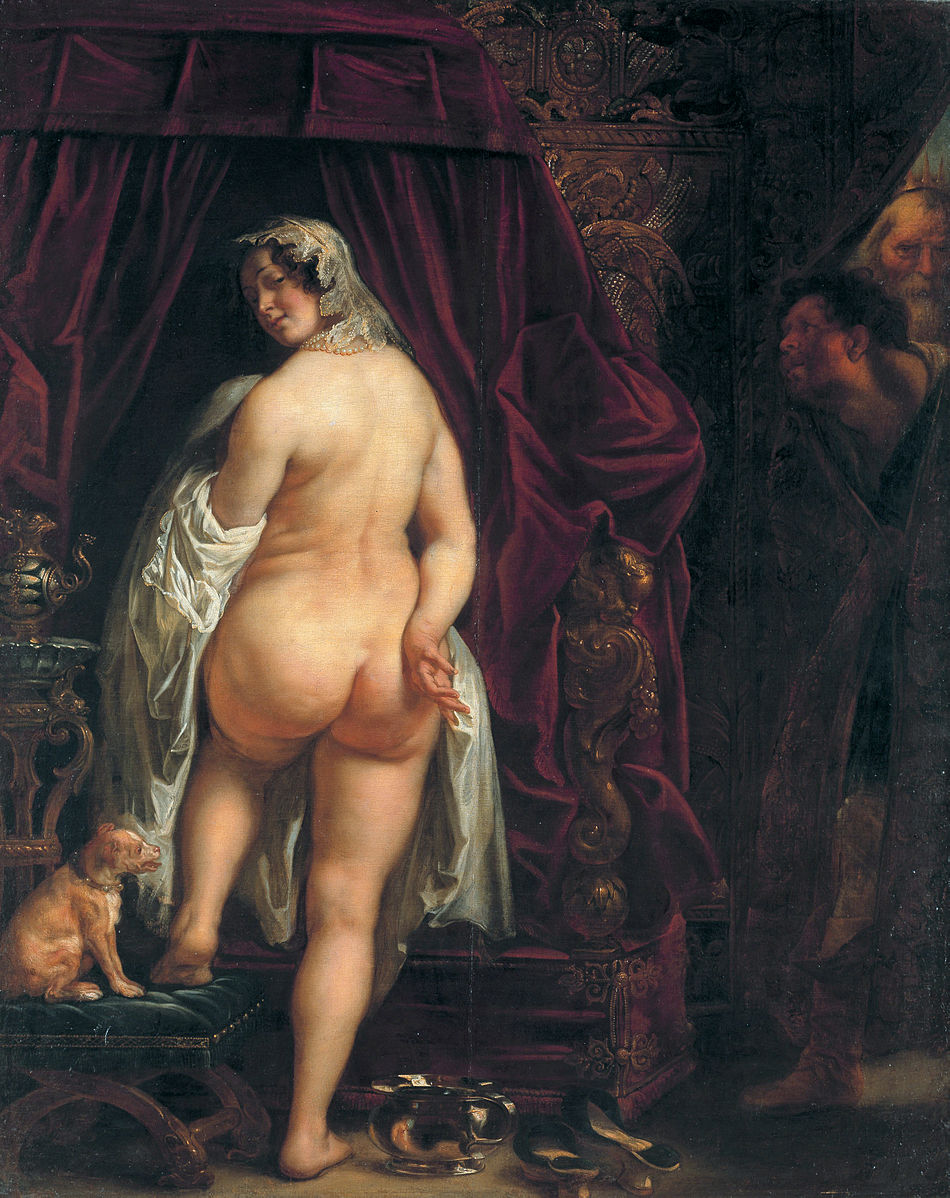
Finally, while a painted episode from the tale of Candaules and Gyges by Tiepolo is a fictional feature of the Dance, the scene of King Candaules offering his naked wife to the secret view of his friend Gyges is the dramatic subject of at least three other paintings that we have identified.  The earliest is by Jacob Jordaens (Flemish 1593-1678) and is notable for its recruitment of the viewer into the voyeurism attributed to Gyges and his enabler, Candaules.

King Candaules of Lydia showing his wife to Gyges Jacob Jordaens, 1646 oil on canvas 76 x 62 in National Museum, Stockholm photo in public domain from Wikimedia Commons

King Candaules of Lydia showing his wife to Gyges
Jacob Jordaens, 1646
oil on canvas 76 x 62 in
National Museum, Stockholm
photo in public domain from Wikimedia Commons

A second Candaules and Gyges is by William Etty (British 1787-1849) and resides currently in the Tate Britain.  It shows passages of expert rendering of flesh, but to our eyes a very awkward pictorial arrangement.

Candaules, King of Lydia, Shews his Wife by Stealth to Gyges, One of his Ministers, As She Goes to Bed William Etty, 1820 photo in public domain from Wikimedia Commons

Candaules, King of Lydia, Shews his Wife by Stealth to Gyges, One of his Ministers, As She Goes to Bed
William Etty, 1820
oil on canvas, 28 x 32 in framed
The Tate, London
photo in public domain from Wikimedia Commons

Finally, a rendition of the same scene in 1859 by the academic Jean-Léon Gérôme (French 1824-1904) is more stately and balanced, if lacking in the drama the scene suggests.
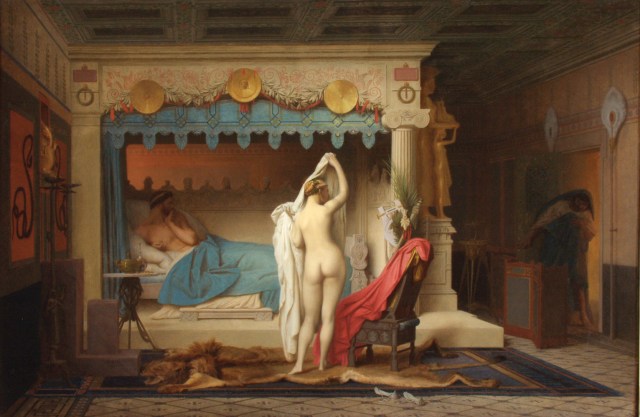
King Candaules Jean-Léon Gérôme, 1859 oil on canvas, 26 x 39 in Museum of Art on Ponce photo in public domain from Wikimedia Commons

King Candaules
Jean-Leon Gerome, 1859
oil on canvas, 26 x 39 in
Museum of Art on Ponce
photo in public domain from Wikimedia Commons

In the preface to Album, Powell wrote:

I had always found the relationship of Caudaules and Gyges of peculiar fascination. … Part of its interest consisted in supposing, so far as I knew, it had never been used by any of the Old Masters.

After I had introduced the incident into Dance I found that, on the contrary, not only had several French painters used Caudaules and Gyges as a subject for their brush, but even our own Etty, and that I must have seen the picture by Jordaens … when I went around to the Gallery in Stockholm not so many years ago.   Somehow it had completely passed from my memory, though it came at once when I saw the photograph [shown in Album].

The Jordaens is in every respect the antithesis of what the Tiepolo would have been. Caudaules’s Queen, a strapping Netherlands vrow, a Flanders mare if ever there was one, is stepping stark naked over the chamber pot on the way to bed. On the right, low in the picture, two lubricious boors, the King and the Captain of his Guard, peer through a gap in the arras. It is. in fact, the story reduced to its lowest common denominator.

Given these less than compelling existing paintings of Caudaules and Gyges, Powell was right to simply invent the painting that would combine Tiepolo’s ethereal color, elegant figures, movement-filled stage management and titillating wit to serve as the central motif in the unravelling mystery of Pamela and Kenneth Widmerpool’s marriage.



Posted in Uncategorized | 1 Comment

La Conchita

Jenkins recalls being 22 or 23 years old (i.e., in about 1927 or 28) when he first met Glober, who at that time wanted to buy an Augustus John drawing. [TK 72/66 ]. Jenkins arranged for him to meet Mopsy Pontner, who was trying to sell one:

Glober bought the Augustus John drawing on sight.  He made no demur about the price, a fairly steep one in the then market. It was a three-quarter length of a model called La Conchita, a gipsy type Barnby, too, sometimes employed. [TK 76/70]

Seated Nude Augustus John, ~1920 Chalk on paper, 14 x 9 '' The Tate © The estate of Augustus John. All Rights Reserved 2014 / Bridgeman Images

Seated Nude
Augustus John, ~1920
Chalk on paper, 14 x 9 ”
The Tate
© The estate of Augustus John. All Rights Reserved 2014 / Bridgeman Images

We have previously mentioned Augustus John (1878-1961) in regard to Sir Magnus Donners’ collection of drawings.  The National Portrait Gallery owns 33 portraits by John of varied aristocratic or otherwise distinguished contemporaries; however, we surmise that Glober, like Donners, wanted a John nude for his collection. La Conchita (the little seashell in Spanish), after all, is not only a legitimate, if exotic, girl’s name, but also vulgar slang for part of the female anatomy, and in the paragraphs that follow, Powell is at his bawdiest in describing Glober’s sexual proclivities with Mopsy.

Posted in Uncategorized | 1 Comment

The Old Curiosity Shop

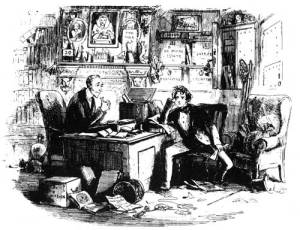
Louis Glober first meets Jenkins in his publishing office, which Jenkins describes as having “walls grimly lined with file copies,” “almost as comfortless as the waiting room,” and marked by “frugality of surroundings. ”

[Glober] sat down in the collapsed armchair, and looked about him.

‘You’ve got a real Dickensian place here.’

[Jenkins] ‘Bleak House?’

Glober laughed his attractive laugh.

The Old Curiosity Shop,’ he said. ‘In the illustration.’ [TK 71-72/66]

Attorney and Client Halbot Browne (Phiz) 1853 etching from Bleak House Charles Dickens illiustration public domain from David Perdue's Charles DIckens Home Page Copyright © 1997-2016 David A. Perdue, All Rights Reserved

Attorney and Client
Halbot Browne (Phiz) 1853
etching from
Bleak House
Charles Dickens
illustration public domain from David Perdue’s Charles Dickens Home Page
Copyright © 1997-2016 David A. Perdue, All Rights Reserved

Charles Dickens (1812-1870) originally published Bleak House (1852-3) and The Old Curiosity Shop (1840-1) as serials. The illustrations for the monthly installments of Bleak House were from steel etchings by Halbot Browne (who signed himself as Phiz). The closest thing to an office illustration in the set is Attorney and Client, shown at right.  The illustrations of the weekly installments of The Old Curiosity Shop were from wood blocks by Phiz, George Cattermole, and others. Cattermole did most of the interior scenes.  We show below the opening illustration from the first installment, published in the weekly Master Humphrey’s Clock, 1840.

The Old Curiosity Shop Opening Illustration George Cattermole wood block print in magazine Master Humphrey's Clock, Image from the Victorian Web

The Old Curiosity Shop
Opening Illustration
George Cattermole, 1840
wood block print in magazine
Master Humphrey’s Clock,
Image from the Victorian Web


The narrator of The Old Curiosity Shop describes the shop when he first sees it as  one of those receptacles of old and curious things which seem to crouch in odd corners of this town, and to hide their musty treasures from the public eye in jealousy and distrust.” In contrast to Nick’s sense of his own milieu as drab, “frugal” and “comfortless,” this is a vision of a secluded but fascinating treasure chest.  Is Glober mis-remembering his Dickens, or is it his charming attempt to soften the barb of his “Dickensian” remark?

Posted in Uncategorized | Leave a comment

The Cubist Blocks


Gwinnett tells Jenkins that Louis Glober is staying at the Bragadin Palazzo, which prompts Jenkins to recall meeting Glober in London in the late 1920s. Glober visited Duckworth’s to discuss a project with Daniel Tokenhouse. “The suggestion was to produce generously illustrated, cheaply produced studies of these [Cubist] painters, blocks to be made in Holland or Germany by some newly devised process.” [TK 70/64]

Houses at Estaque George Braque, 1908 zinkatzung plate 16 from Kannweiler, Der Weg zum Kubismus, 1920

Houses at Estaque
George Braque, 1908
zinkatzung plate 16 from Kannweiler, Der Weg zum Kubismus, 1920


Georges Braque and Pablo Picasso are credited with jointly developing Cubism, starting in 1906. Some of Braque’s earliest pieces were done during his summer stay at the French fishing village of Estaque. (The original oil painting that is akin to the print at left is at the Hermann and  Margrit Rupf Foundation in Bern Switzerland.) Their abstract style using angular planes, eschewing or distorting perspective, and avoiding bright colors was dubbed Cubism in 1908 and initially derided by traditionalists in Paris. However, Braque and Picasso were soon joined by Leger, Gris, and others and championed by critics, like Apollinaire, and by their dealer Kannweiler, in his book in German, Der Weg zum Kubism  (1920). We are unsure what ‘newly derived process’ Glober had in mind, but Kannweiler illustrated his book with zinkatzungen, prints made using zinc plates,  a process call zincography,  which was developed in the nineteenth century and is cheaper than limestone lithography.


Nude Descending a Staircase, #2 Marcel Duchamp, 1912 oil on canvas 58 x 35 in Philadelphia Museum of Art photo probably in public domain in US from Wikimedia.org but still under copyright in France

Nude Descending a Staircase, #2
Marcel Duchamp, 1912
oil on canvas 58 x 35 in
Philadelphia Museum of Art
photo probably in public domain in US from Wikimedia.org but still under copyright in France

In the 1920s and 30s, when the Cubists had become less controversial in France, Anne Stepney could talk of Braque, and Jenkins and Barnby could joke about Cubist collages. Moreland was familiar with work of Albert Gleizes, another early cubist who wrote a text on cubist theory. However, Jenkins recalls that when he first met Glober, “the Cubists were still generally regarded as wild men…” [TK 70/64]  in both Britain and the United States.  Mr. Deacon’s suspicion of Cubism was a prevailing view in Britain and the United States between the wars, long after his other betes noires like  Impressionism had     become mainstream.
Cubism and other forms of avant garde art were first shown in the United States at the New York Armory Show of 1913. The work was not appreciated by most American critics. One of the most lampooned works was Marcel Duchamp’s cubist Nude Descending a Staircase (shown right.)  Our favorite newspaper cartoon mocking the piece is The Rude Descending a Staircase (shown below left). By 1936, Cubism had enough  acceptance in America that the New York Museum of Modern Art had a Cubist exhibition. However, despite advocates, such as the British critic and collector Douglas Cooper, the general acceptance of Cubism in Britain was delayed.  Kannweiler’s Der weg zum Kubism  (1920)  (The Rise of Cubism) was not published in English until 1949.

The Rude Descending a Staircase (Rush Hour at the Subway) J. F. Griswold, The New York Evening Sun, March 20, 1913 in public domain from Wikimedia Commons

The Rude Descending a Staircase (Rush Hour at the Subway)
J. F. Griswold, The New York Evening Sun, March 20, 1913
in public domain from Wikimedia Commons

The first major exhibition in Britain devoted to Cubism was not held until 1958 when the Tate showed “The Essential Cubism: Braque, Picasso and Their Friends, 1907-1920.”   This delay of British appreciation of the Cubists until the 1950s is reflected later in TK when Ada Leintwardine suggests that her husband’s publishing house might now be interested in acquiring the rights to the still unpublished Cubist blocks from Tokenhouse [TK 138/131 ].

Posted in Uncategorized | 1 Comment

Pennell’s Life of Whistler

In Venice, Jenkins reminisces about being there as a boy with his parents. This leads to an anecdote about his father’s two volume set of Pennell’s Life of Whistler, “a painter he admired,” which he bought in Paris because the French edition had the same illustrations as the English edition but was cheaper. [TK 59/54]

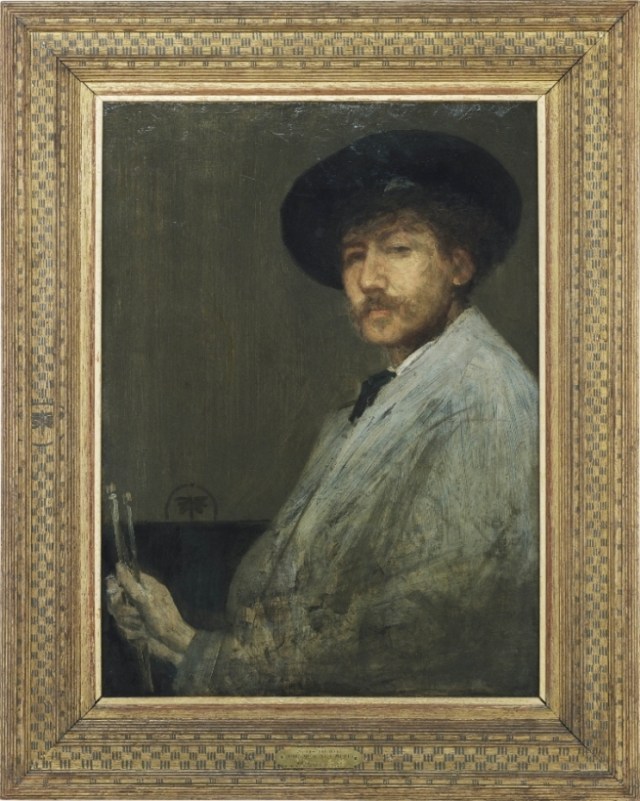
Arrangement in Grey: Portrait of the Painter James McNeill Whistler, ~1872, oil on canvas, 30 x 21 in Detroit Institute of Art photo in public domain from National Endowment for the Humanities

Arrangement in Grey: Portrait of the Painter
James McNeill Whistler, ~1872,
oil on canvas, 30 x 21 in
Detroit Institute of Art
photo in public domain from National Endowment for the Humanities

Mr. Deacon referred to Whistler (1843-1903) in A Buyer’s Market.  We have also mentioned Whistler when Jenkins reflected on Proust’s Balbec.  Here we show a Whistler self portrait because a reproduction of it is the frontispiece of The Life Of James McNeill Whistler by Elizabeth Pennell and Joseph Pennell (1908), which includes numerous illustrations. Joseph Pennell (1857-1926) was an American artist distinguished for his work in lithography and etching.  Joseph and his wife Elizabeth (1855-1936) met Whistler after they moved to London in 1884.  The three became close friends, and Whistler asked the Pennells to write Whistler’s biography, to which he contributed suggestions. To sample the reverential tone of the biography read the beginning of volume 2, where Joseph recalls first meeting Whistler. The Pennells donated their collection of Whistleriana to the Library of Congress in 1917.


Posted in Uncategorized | Leave a comment

Mona Lisa Stolen from the Louvre

Jenkins recalls his father’s aesthetic tastes: “He never stood in front of the Mona Lisa without remarking that, in the eyes of trivial people, the chief interest of Leonardo’s masterpiece was to have once been stolen from the Louvre.” [TK 58/53]

Leonardo da Vinci (1452-1519) painted the Mona Lisa between 1503 and 1506.  In the last century, it has become the most famous painting in world, so much so that when Anne Umfraville, at Sir Magnus’ dinner party, boasts of being compared to it, we are immediately reminded of her superficiality. However, the painting was less well-known for the first 500 years of its existence. Leonardo brought it to France in 1516 and sold it to King Francis I.  It was placed in the Louvre at the time of the French Revolution, hung for at time in Napoleon’s bedroom, and later returned to the Louvre.  In the 1860s Leonardo received increasing critical acclaim and by 1878 Baedeker listed the painting among the Louvre’s attractions; however, it was far from a world-wide icon.

On August 21, 1911, the painting was stolen from the Louvre. On September 7, 1911 the gendarmes detained the poet and art critic Guillaume Apollinaire as a suspect.  Apollinaire had previously suggested burning down the Louvre. They soon also arrested Pablo Picasso. Picasso was released after brief retention, but Apollinaire was jailed for almost a week and remained a suspect for months. The painting was recovered in 1913 when one of the thieves, a Louvre employee and Italian patriot, rather than a modern artist, tried to sell it to a Florentine art dealer.

Theft of the Mona Lisa. Achille Beltrame from La Domenica del Corriere, 3rd-10th September 1911. (Photo by DeAgostini/Getty Images) from CNN.com

Theft of the Mona Lisa.
Achille Beltrame from La Domenica del Corriere, 3rd-10th September 1911. (Photo by DeAgostini/Getty Images) from CNN.com

The theft and recovery of the Mona Lisa received wide international press coverage, which accelerated its ascent to its current superstar status.

We barely registered this mention of Mona Lisa when we first read it, but now that we know the back story, we see it as another instance of Powell’s interest in how tastes change.


L.H.O.O.Q. Marcel Duchamp, 1919 post card reproduction with added moustache, goatee and title in pencil 8 x 5 in public domain in US but protected by French copyright until 2039, from Wikimedia Commons

L.H.O.O.Q.
Marcel Duchamp, 1919
post card reproduction with added moustache, goatee and title in pencil 8 x 5 in
public domain in US but protected by French copyright until 2039, from Wikimedia Commons

The role of Apollinaire and Picasso in the story reminds us that the growing adulation of Leonardo occurred simultaneously with  Modernism’s  influence on changing perceptions of artists generally.  The artist who is credited with making the Mona Lisa was a polymath perfectionist genius, stationed well above the rest of humanity.  The doubting public did not yet recognize the genius of Picasso or of Apollinaire and increasingly saw modern artists as madcap pranksters willing to undertake any outrage to bring publicity to their own careers.  To the conservative critics and the uninitiated masses, ever suspicious of charlatanism, an assault on the Mona Lisa was emblematic of Modernism’s assault on the artistic verities of the past.  And they were right to be worried: only a few years later Marcel Duchamp was to exhibit “L.H.O.O.Q.”

Posted in Uncategorized | Leave a comment