Perugino’s St. Sebastian

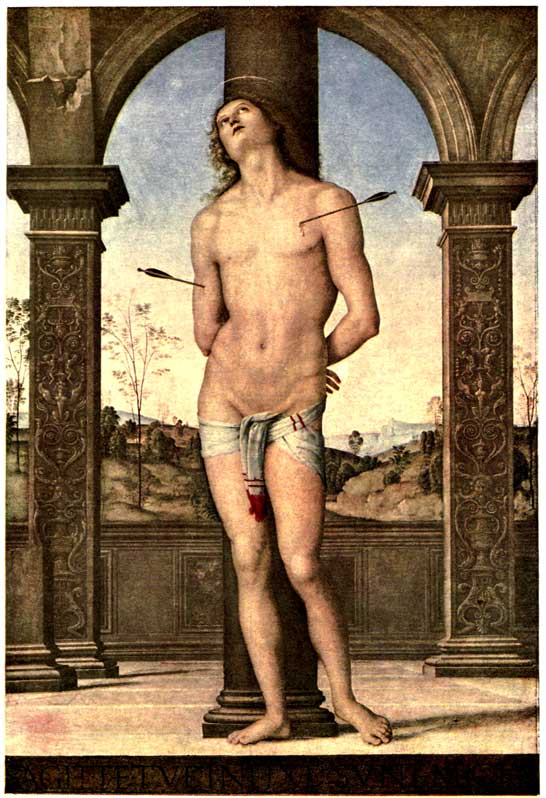
St. Sebastion Pietro Perugino,  The Louvre Plate 2 from Brinton, Perugino, project Gutenberg ebook

St. Sebastion
Pietro Perugino,
The Louvre
Plate 2 from Brinton, Perugino, project Gutenberg ebook

St. Sebastian Pietro Perugino oil on wood, 170 x 117 cm,  after 1490 The Louvre photo public domain from Artmight.com

St. Sebastian
Pietro Perugino
oil on wood, 170 x 117 cm, after 1490
The Louvre
photo public domain from Artmight.com

At the Louvre in about 1919, Nick and his parents run into Mr. Deacon, who has stooped over, magnifying glass in hand , to examine closely a painting of St. Sebastian by Pietro Perugino ( c. 1446-1524). [BM 14/10] Sebastian was a Roman centurion martyred about 286 for his conversion to Christianity. He has been painted many times with his characteristic iconography, wounded by arrows, tied to a post, but he was actually clubbed to death. Perugino painted St. Sebastian at least six times.  Mr. Deacon, “showing an unexpected grasp of military hierarchy — at least of an obsolete order,” commented that the real St. Sebastian, as a centurion, must have been older and more rugged than the youth shown by Perugino.

Perugino was one of the masters of the Quattrocento. His frescoes decorate the walls of the Sistine Chapel by commission of Pope Sixtus IV. He was among the first to paint with oil.

Mr. Deacon claimed that other pictures in the Louvre, attributed to Raphael, were actually Peruginos. Misattribution of paintings is an issue that  resurfaces later in Dance. Here we suspect that Mr. Deacon was showing his contrarian streak rather than his connoisseurship.  In the 1490s Raphael, an orphan, was placed by his relatives in Perugino’s workshop in Florence. His apprentice’s brushstrokes very likely grace more than one Perugino. In 2012  the Alte Pinakothek in Munich mounted an exhibit Perugino: Raphael’s Master, which in part addressed the question of why for the last half millenium Perugino’s reputation has been in the shadow of his contemporaries: Michelangelo, Leonardo, and Raphael.  Vasari (Lives of the Painters, 1568) praised Raphael and denigrated Perugino:

“I will not refrain from saying that it was recognized, after [Raphael] had been in Florence, that he changed and improved his manner so much, from having seen many works by the hands of excellent masters, that it had nothing to do with his earlier manner; indeed, the two might have belonged to different masters, one much more excellent than the other in painting. ”

During his lifetime Perugino’s peers, including Raphael’s father, had called him the ‘divine painter.’  Mr. Deacon seems to have a natural affinity with artists whom history has devalued.
Posted in Uncategorized | 1 Comment

Puvis de Chavannes and Simeon Solomon

Nick says of Mr. Deacon: “Puvis de Chavannes and Simeon Solomon, the last of whom I think he regarded as his master, were the only painters I ever heard him speak of with unqualified approval.” [BM 9/5]

Puvis de Chavannes

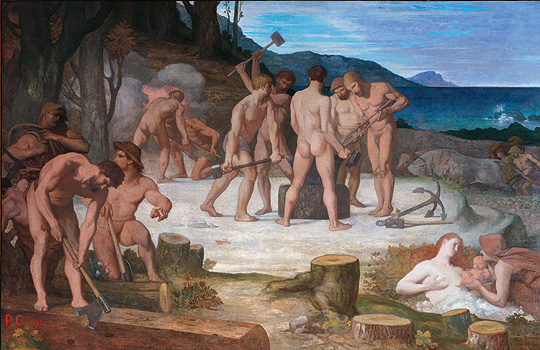
Le Travail
Puvis de Chavannes, 1863
Musee de Picardie
photo public domain from Wikimedia Commons

Pierre Puvis de Chavannes (1824-1898) was a prominent French painter of the mid nineteenth century, known as a Symbolist  and as co-founder of the Societe Nationale des Beaux-Artes. As a painter, he rejected realism in favor of a synthetic idealism, and he transformed traditional linear perspective into an expressive tool by routinely collapsing or compressing space in his images. He was radical for his time and influenced many strands of the development of Modernism (see Musee d’Orsay on his work The Poor Fisherman). We have chosen to show Le Travail, because it almost satisfies Mr. Deacon’s preference for “exclusively male figure compostions.”  Like Alma Tadema and other British nineteenth century painters whom Deacon did not despise, Puvis de Chavannes fell from fashion early in the twentieth century.

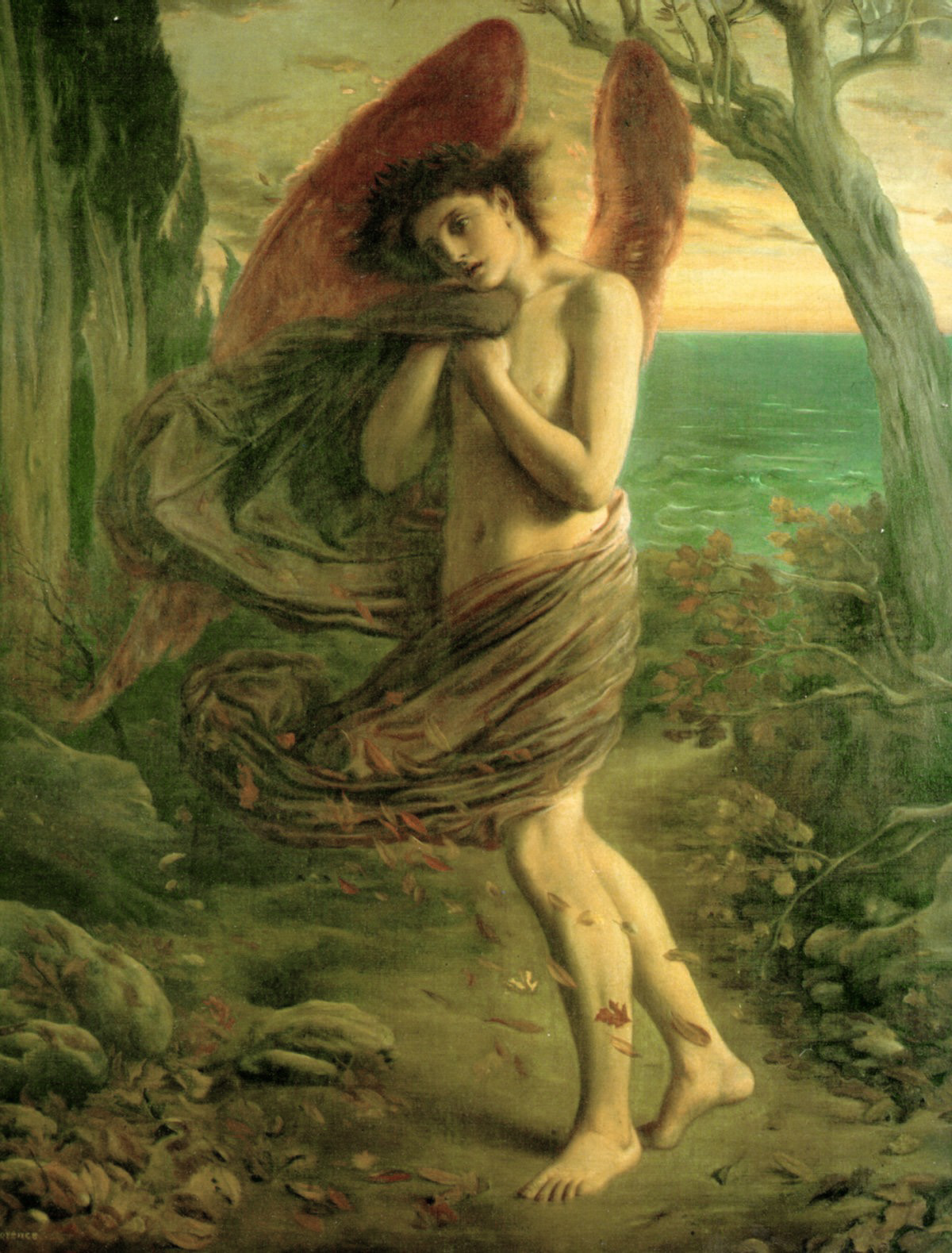
Love in Autumn Simeon Solomon, 1866 photo public domain for Wikimedia Commons better images available at

Love in Autumn
Simeon Solomon, 1866
photo public domain fromWikimedia Commons  

Simeon Solomon (1840-1905) first exhibited at the Royal Academy at age 18. His early paintings share the flamboyance and mastery of his Pre-Raphaelite mentors Rossetti, Burne-Jones, and Millais; his later work is more intimate and favors feeling over bravura draftsmanship and paint handling. Solomon’s themes drew heavily on his Jewish heritage and the Old Testament. He became friendly with Swinburne, whose interests in classicism and erotica, helped move Solomon toward Aestheticism, “art for art’s sake.” His celebrity grew until 1873, when he was arrested for attempted sodomy at a public urinal in London. Later, he was arrested again for sodomy in Paris. Although he continued to paint, he fell from public attention and lived a life of alcohol abuse and poverty, until he died at St. Giles’s Workhouse in Bloomsbury. Presumably, his lack of official approval and bohemian life style enhanced Mr. Deacon’s attraction to him.

Posted in Uncategorized | 5 Comments

Impressionists, Post Impressionists, Cubists, Surrealists

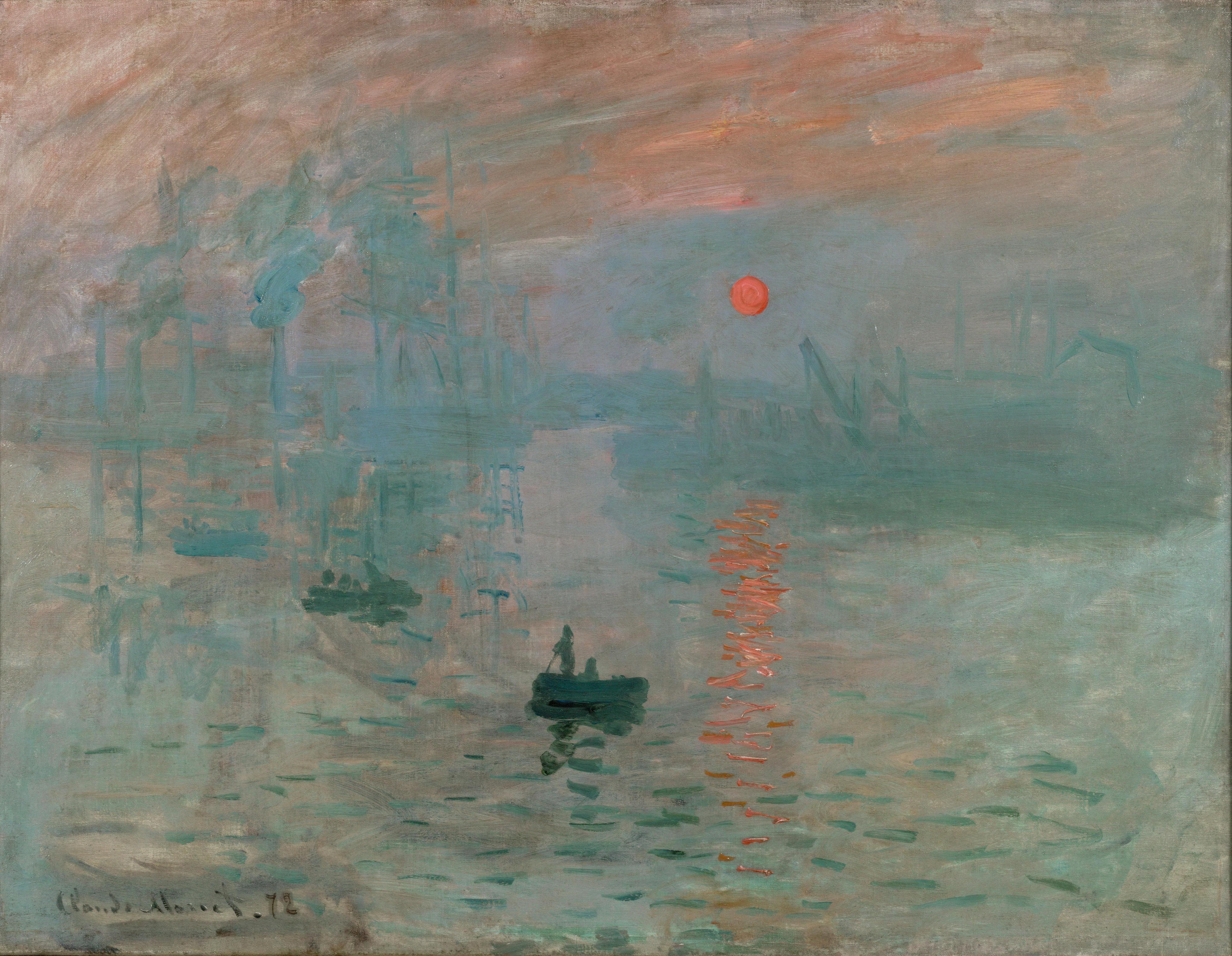
Impression, Sunrise Claude Monet, 1872 Musee Marmotan Monet public domain photo from Wikimedia Commns

Impression, Sunrise
Claude Monet, 1872
Musee Marmotan Monet
public domain photo from Wikimedia Commns

Mr. Deacon “disliked the Impressionists and Post-Impressionists almost equally; and was naturally even more opposed to later trends like Cubism, and to the works of the Surrealists.” [BM 9/~5]

Mr. Deacon had strong historical precedent for his views. In April and May, 1874, thirty French artists who called themselves the Anonymous Society of Painters, Sculptors, Engravers, etc. exhibited their works for sale in a Parisian studio.  Art critic Louis Leroy responded to the show with a scathing review in Le Charivari in the form of a dialogue.  The following except about Claude Monet’s Impression, Sunrise seems to be the origin of the name Impressionists, which the group of artists used proudly by the time of their third exhibition in 1877.

“I glanced at Bertin’s pupil; his countenance was turning a deep red. A catastrophe seemed to me imminent, and it was reserved to M. Monet to contribute the last straw.

‘Ah, there he is, there he is!’ he cried, in front of No. 98. ‘I recognize him, papa Vincent’s favorite! What does that canvas depict? Look at the catalogue.’

‘Impression, Sunrise.’

‘Impression — I was certain of it. I was just telling myself that, since I was impressed, there had to be some impression in it . . . and what freedom, what ease of workmanship! Wallpaper in its embryonic state is more finished than that seascape.'”

Despite this initial critical disdain, Impressionist painting grew in popularity and influenced younger artists. In 1910, a British painter and critic, Roger Fry organized a show of Manet, Cezanne, Gauguin, Van Gogh, Matisse, and others, for whom Fry coined the name Post-Impressionists.  Fry and his contemporary critics touted these artists and by the 1920s they surpassed many of the popular late-nineteenth-century British artists  as  the height of fashion.  This cultural shift was illustrated by Evelyn Waugh, Powell’s friend and competing novelist, providing another view of aristocratic Oxonian youth in the early 1920s; his narrator in Brideshead Revisited says. “in opinion I had made that easy leap, characteristic of my generation, from the puritanism of Ruskin to the puritanism of Roger Fry…”

Mr. Deacon, however,  was not alone in his persistent distaste for Impressionism and almost everything that succeed it. Alma-Tadema shared this prejudice; John Collier, one of his pupils  wrote, ‘it is impossible to reconcile the art of Alma-Tadema with that of of Matisse, Picasso, and Gauguin.”

When John William Godward (1861-1921), a disciple of Alma-Tadema, committed suicide, his suicide note reportedly said that the “the world was not big enough” for him and Picasso.

As late as 1949, Sir Alfred Munnings, a sporting artist in the tradition of George Stubbs, used his valedictory address as president of the Royal Academy for a diatribe against Picasso, Matisse, and their ilk. (see Chew, The Painter who Hated Picasso, Smithsonian Magazine, October, 2006.)

Art movements are referenced repeatedly and knowledgeably in Dance. We will get to Cubism and Surrealism later. Jenkins continues describing Mr Deacon: “Nature had no doubt intended him in some manner to be an adjunct to the art movement of the Eighteen-Nineties.” Many movements competed and elided in late nineteenth century Britain: Pre-Raphaelism, Aestheticism, Symbolism, Arts and Crafts, Realism, Art Nouveau, and so on; there was no single “Art Movement of the Eighteen-Nineties.” By his imprecision, the Narrator is emphasizing how isolated Mr. Deacon was from prevailing styles. “Somehow Mr. Deacon had missed that spirit in his youth, a moral separation that perhaps accounted for a later lack of integration.” [BM 9/~5].

Posted in Uncategorized | 6 Comments

sketch of Antinous

Lansdowne Antinous. Marble, Roman Imperial artwork, ca. 130-140 AD.  Found at Hadrian's Villa, 1769 The crown, nostrils, lips and torso have been restored. Fitzwilliam Museum, Cambridge,  photo public domain from Wikipedia Commons

Lansdowne Antinous. Marble, Roman Imperial artwork, ca. 130-140 AD.
Found at Hadrian’s Villa, 1769
The crown, nostrils, lips and torso have been restored. Fitzwilliam Museum, Cambridge,
photo public domain from Wikimedia Commons

Two Sketches on Antinous John Singer Sargent After the Antique sketchbook page, 1869 The Fogg Museum of Art

Two Sketches on Antinous
John Singer Sargent (1856-1925)
After the Antique
sketchbook page, 1869
The Fogg Museum of Art

A typical patron of Mr. Deacon was “a big iron man” from the Midlands who after visiting Deacon in London would return to Lancashire with “an oil sketch of Antinous, or a sheaf of charcoal studies of Spartan youth at exercise.” [BM 8/~4]

Antinous is sometimes called “the gay god.” He was a beautiful young Bithynian Greek boy, beloved by the Roman emperor Hadrian. When Antinous drowned in the Nile in 130, Hadrian gave him the extraordinary honor of deification. As a result there were many sculptures of his beautiful body, available for sketching by an Englishman on his Italian tour.  By the late nineteenth century his homoerotic beauty was a passing metaphor in three of Oscar Wilde’s works and JA Symonds devoted a chapter to him in his Sketches And Studies In Italy and Greece (1879). Symonds quotes Shelley, who in his The Colliseum, A Fragment of a Romance, written about 1819,  described statutes of Antinous as showing “eager and impassioned tenderness” and “effeminate sullenness of the eye.”

Study of a Figure for Hell John Singer Sargeant, c. 1900 Charcoal and stump on beige-laid paper, 18 7/8 x 24 1/2 in.,  Corcoran Gallery of Art, Washington, D.C. public domain from Wikimedia Commons

Study of a Figure for Hell
John Singer Sargeant, c. 1900
Charcoal and stump on beige-laid paper, 18 7/8 x 24 1/2 in.,
Corcoran Gallery of Art, Washington, D.C.
public domain from Wikimedia Commons

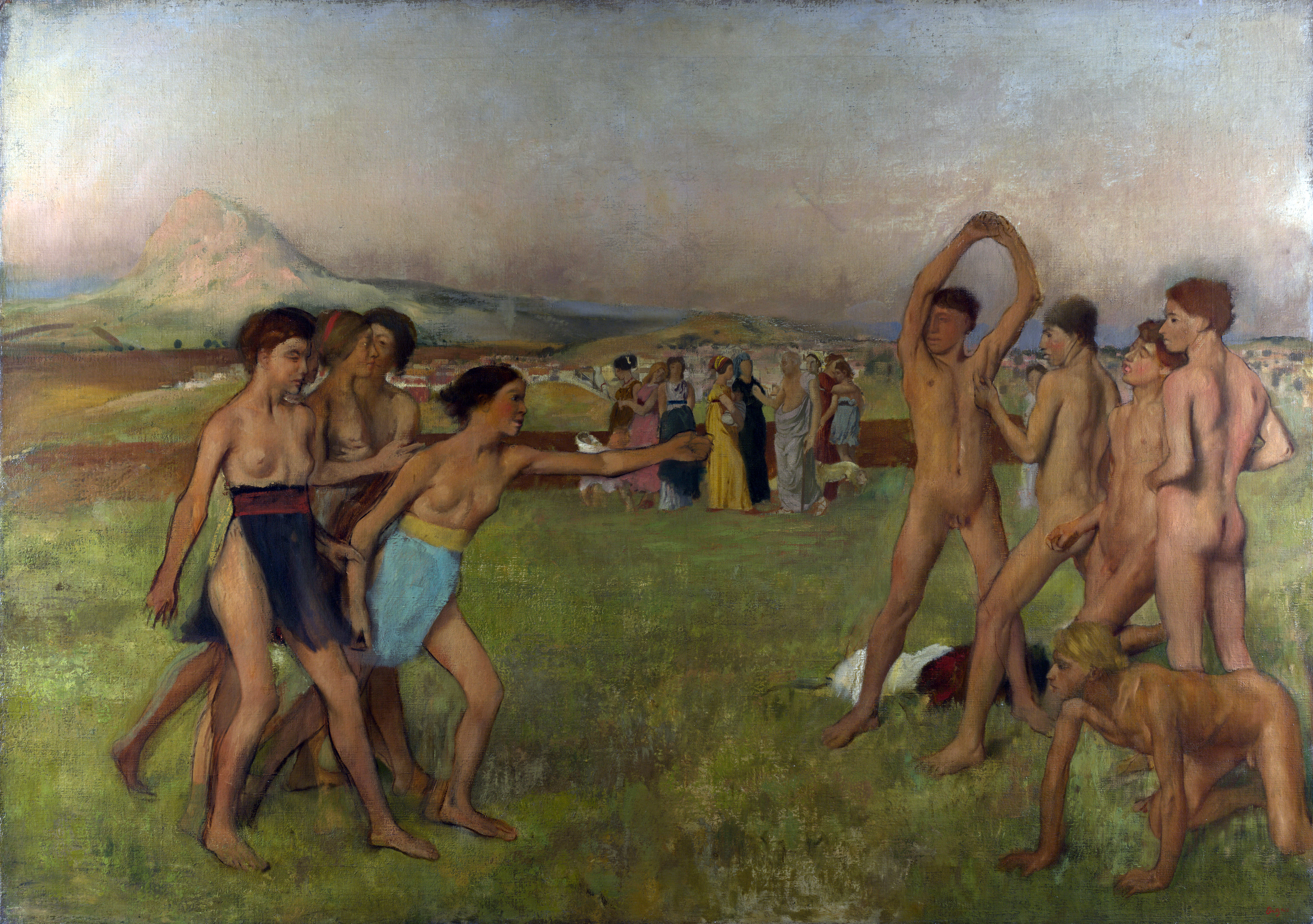
We show here a charcoal nude by John Singer Sergeant, quite a bit more sophisticated than his teenage doodle of Antinous; however, we have not found charcoal sketches of Spartan youth from Mr. Deacon’s era, and he would not have approved of Degas, at least not of his later work, but this painting of the Spartan girls urging the Spartan boys to wrestle illustrates an implication about Mr. Deacon’s patrons: we think the big iron man came to London for more than just art.

Young Spartans Exercising Edgar Degas, 1860 National Gallery photo in public domain for Wikipedia Commons

Young Spartans Exercising
Edgar Degas, 1860
National Gallery, London
photo in public domain fromWikimedia Commons

Posted in Uncategorized | 3 Comments

Mr. Deacon at Auction

Mr. Deacon reappears  throughout A Buyer’s Market. The factual threads from which Powell wove Mr. Deacon are diverse.  For example, as a teen Powell became friendly with Christopher Sclater Millard, the gay owner of a bookshop, a model for Mr. Deacon’s antique store. Nick’s parents had a long friendship with Mr. Deacon, but in reality, when Powell’s father learned the Millard had been in prison for his homosexuality, the elder Powell made his son stop seeing Millard. (TKBR p. 38-42).  We will be paying more attention to Mr. Deacon as a commentary on art than on his politics or life style.

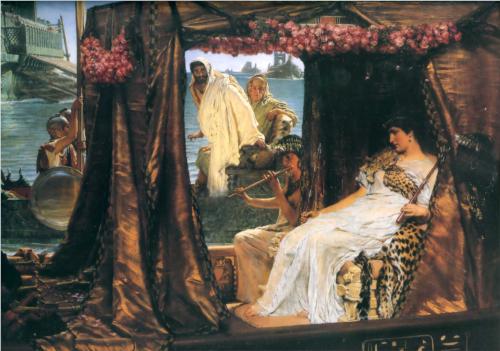
Anthony and Cleopatra Alma-Tadema 1883 private collection photo in public domain for Wikipaintings

Anthony and Cleopatra
Alma-Tadema 1883
private collection
photo in public domain from Wikipaintings

The opening scene in an auction room is apt, because one illustration of Time’s caprice is the fluctuating popularity of artists, particularly reflected in the price of their work.  Mr. Deacon’s four canvases sell at the auction for a few pounds, no more than the value of the frames.

In 2010 Alma-Tadema’s Moses sold at auction for $35 million and in 2011 his Anthony and Cleopatra was gavelled at Sotheby’s for $26 million. Alma-Tadema showed Cleopatra at the Grosvenor Gallery in 1882-3. It was bought by Sir Joseph Robinson, whose collection was shown at the Royal Academy in 1958. It changed hands at a Southeby’s auction in 1962 for £2000 and at Christie’s in 1993 for £879,500. In Alma-Tadema’s day, his works were most valuable if the sale included the right to reproduce them as prints. In 1874 the price for a painting with these rights might have been as high as £10,000. More usual prices rose from £2,000 and £3,000 in the 1880s to about twice that by the early 1900s. However, prices for Victorian paintings collapsed in the early 1920s, and an Alma-Tadema could be had for a few hundred pounds. Prices were still that low when Powell published BM in 1952. Mr. Deacon was no Alma-Tadema, so his values were orders of magnitude less. We will have to wait until the final volume of Dance, set about 1971, to see if his prices recover.

Posted in Uncategorized | 1 Comment

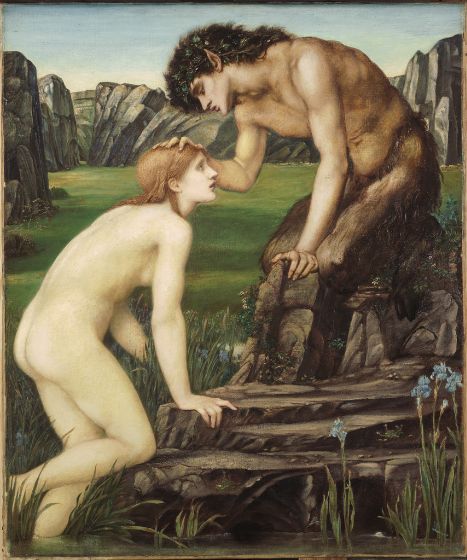
Mr. Deacon’s Pre-Raphaelite Influences

A Buyer’s Market  (BM) opens with  our introduction to the inimitable Mr. Deacon––painter, antique dealer, and enthusiast of radical leftist causes.  Long after Mr. Deacon’s death, Nick comes upon some of his canvases at an auction of items of dubious value near Euston Road:  “All four canvases belonged to the same school of large, untidy, exclusively male figure  compositions, light in tone and mythological in subject: Pre-Raphaelite in influence without being precisely Pre-Raphaelite in spirit: a compromise between, say, Burne-Jones and Alma-Tadema, with perhaps a touch of Watts in method of applying the paint. [BM 2/6]”

The Pre-Raphaelite influence Nick cites refers to the work of the Pre-Raphaelite Brotherhood, formed in 1848, and much championed by the Victorian critic John Ruskin. The founding generation of the Pre-Raphaelites included the English painters John Everett Millais, Dante Gabriel Rossetti, William Holman Hunt, and James Collinson.  Their manifesto revolted against the soulless neo-classical formalism they perceived in the paintings of Raphael and his High Renaissance successors and argued for a return to the more deeply felt values that they attributed to medieval painting and to what they saw as realist painting.  The Pre-Raphaelite Brotherhood’s understanding of those terms­­––medievalism and realism––is different than that of audiences today, which is why we now perceive their paintings as having an exotic romanticism, more associated with fantasy than their creators might have expected.

Pan and Psyche Edward Burne-Jones, 1872-1874 Oil on canvas  sight: 25 5/8 x 21 in. framed: 38 5/8 x 34 x 2 3/4 in. Harvard Art Museums/Fogg Museum, Bequest of Grenville L. Winthrop, 1943.187

Pan and Psyche
Edward Burne-Jones, 1872-1874
Oil on canvas
sight: 25 5/8 x 21 in.
framed: 38 5/8 x 34 x 2 3/4 in.
Harvard Art Museums/Fogg Museum, Bequest of Grenville L. Winthrop, 1943.187

Edward Burne-Jones A.R.A. (1833-1898) was not in the first wave of Pre-Raphaelites though he is generally associated with them. Like Mr. Deacon, Edward Burne-Jones often painted mythological themes, but he did not share Mr. Deacon’s preference for exclusively male compositions. Burne-Jones pictorial goal was beauty, rather than story telling or moralizing. “I mean by a picture a beautiful, romantic dream of something that never was, never will be – in a light better than any light that ever shone – in a land no one can define or remember, only desire – and the forms divinely beautiful – and then I wake up, with the waking of Brynhild.” (from a letter to a friend quoted in Encyclopedia Britannica, 1911)

Sappho and Alcaeus Sir Lawrence Alma-Tadema, R.A. oil on panel, 1881 H: 26 x W: 48 1/16 in.; Framed H: 41 x W: 61 in

Sappho and Alcaeus
Sir Lawrence Alma-Tadema, R.A.
oil on panel, 1881
H: 26 x W: 48 1/16 in.; Framed H: 41 x W: 61 in The Waters Art Museum

Sir Lawrence Alma-Tadema R.A. (1836-1912) was a Dutch-born painter who settled in Britain in 1870 and remained there for the rest of his life, enjoying immense success as a painter of scenes from classical mythology and history.  Alma-Tadema is not associated with the Pre-Raphaelites, but he shared their obsession with hyper-realist rendering of three-dimensional forms and added to it an astonishing command of linear perspective and the depiction of classical architecture.  His particular brand of pictorial realism and his use of bright color seem more in the spirit of the Hollywood epics to come than in medievalist fantasies of his Pre-Raphaelite forebears.

Hope George Frederick Watts and workshop, 1866 Photo: Tate, London, 2011 from Wikipedia

Hope
George Frederick Watts and workshop, 1866
Photo: Tate, London, 2011
from Wikipedia

George Frederic Watts (1817-1904) was a well-known Victorian painter and sculptor, sometimes associated with the Symbolist movement, and in some ways a painter more modern in spirit than either Burne-Jones or Alma-Tadema.  He was adulated at the height of his career, in eclipse by 1930, and back in favor by 1960 (Powell, SPA... p. 219-220). Nick cites Watts in regard to his brushwork, which may refer to Watt’s somewhat looser paint handling, a greater willingness than is visible in either Burne-Jones or Alma-Tadema to let the movement of the painter’s hand become a part of the picture.  And, in the accompanying painting, “Hope” (1886), Watt’s brushwork is sufficiently loose to allow the complimentary color of the underpainting to show through, a technique of optical color mixing more common in the work of the Impressionists than in that of more academic painters of the era.

Posted in Uncategorized | 8 Comments

Le Bas’s Appearance

Bayeux Tapestry scene 25 "And he came to King Harold" Wikimedia Commons

Bayeux Tapestry
scene 25
“And he came to King Harold”
Wikimedia Commons 

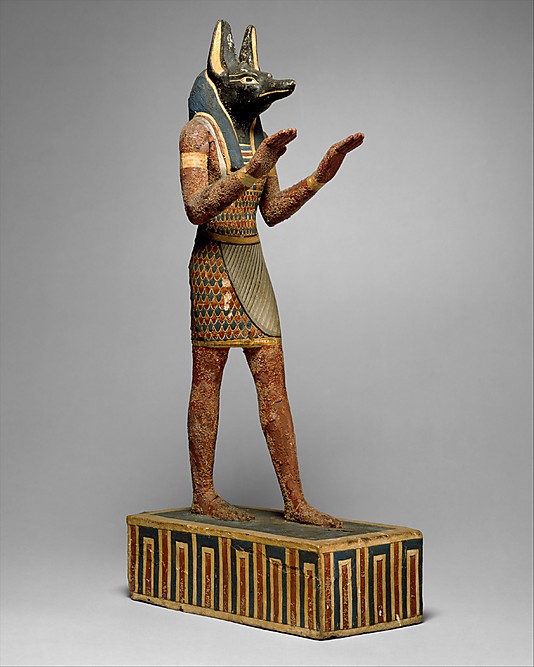
Le Bas visits Jenkins in his Oxford rooms. “He came farther into the room, but appeared unwilling to seat himself; standing in one of his characteristic poses, holding up both his hands, one a little above the other, like an Egyptian god, or figure from the Bayeux tapestry. (QU 214/221)”

When we read this, we had an immediate image of Le Bas — stiff and angular, yet when we tried to find pictures, whether of an Egyptian god or from the tapestry, with the arms in just this posture, we had trouble finding the exact hand position. Rather, the styles of Pharaonic Egypt or Romanesque Normandy perfectly convey the formal Edwardian Etonian housemaster.

The Bayeux tapestry was commissioned about 1070 by Bishop Odo of Bayeux, Normandy to tell the story of the conquest of England in 1066 by his half-brother, William the Conquerer. Rather than an actual tapestry, it is a  nearly 75-yards-long, 19-inches wide strip of embroidered linen, telling its story in 50 scenes. Powell has said: “It is a work of propaganda, of course, but propaganda that has taken art into close alliance” (SPA… p.171). Some of the cartoonish nature of the tapestry might reflect the constraints of embroidery, but even the painting of the time, now classified as early Romanesque, showed flat fiqures with little perspective. If anything, the size of a figure might represent the importance of the person rather than the position in three dimensions, and there was little attempt at realistic portraiture.

Ancient Egyptian artists painted gods as two dimensional figures using stylized conventions (see The Art of Ancient Egypt, The Metropolitan Museum of Art).  The shoulders are seen from the front; the torso and hips are turned 90 degrees, so that the head, arms, and legs are in profile. The height of a figure might indicate its importantance, and ratios are specified, so that a face would always be 2 palms high, a full body 18 palms high.  The pose of the arms had specific icongraphic meaning, Sculpture added a third dimension but maintained the stiffness and formal iconography.

Posted in Uncategorized | 1 Comment

The Pharisee, again

Baronet George Townly Stubbs,; After George Stubbs, (1794)  Hand colored stipple with etching, second state   Dimensions  15 13/16 x 19 3/4in. (40.1 x 50.1cm) image: 15 3/8 x 19 11/16in. (39 x 50cm)   Yale Center for British Art, Paul Mellon Collection

Baronet
George Townly Stubbs,; After George Stubbs, (1794)
Hand colored stipple with etching, second state
Dimensions 15 13/16 x 19 3/4in. (40.1 x 50.1cm) image: 15 3/8 x 19 11/16in. (39 x 50cm)
Yale Center for British Art, Paul Mellon Collection

Stringham brought his horse prints with him to his Oxford rooms. A vistor, Bob Duport, sees the print of The Pharisee and says, “I’ve never seen a jock on land, or sea, sit a horse like that.” (QU 185/191)

“‘Put your shirt on him when you do, Bob,’ said Peter”

The jocular playboys make it clear that our earlier guess at the appearance of the horse prints was incorrect when we chose unmounted horses.

This etching by George Townly Stubbs of Baronet, ridden by Samuel Chifney,  may be on the money. The Prince of Wales (later George IV) owned Baronet, which won the Oatland Stakes in 1791. The Prince won over 17,000 pounds sterling on a single bet. The Prince hired Chifney as his full time rider. Chifney had great success with an unusual slack-rein riding style, but he became the object of a Jockey Club investigation, which prompted the Prince to withdraw from racing (Dictionary of National Biography vol 10, p . 254)

Self Portrait by George Stubbs, enamel on Wedgwood plaque, 1781 National Portrait Gallery NPG 4575 with permission

Self Portrait
by George Stubbs, enamel on Wedgwood plaque, 1781
National Portrait Gallery NPG 4575
with permission

George Townly Stubbs worked from a painting by his father, George Stubbs (1721-1805) one of the best horse painters of his generation. The elder Stubbs studied anatomy and published the Anatomy of the Horse.   He received many commissions from the noblemen who founded the Jockey Club. He exhibited at the Royal Academy, which now has a collection of his anatomic horse studies; however, as a sporting painter, the Academy offered him only associate membership, which he declined.


The etching was done with stippling (more information about this technique is available at Graphics Atlas) and hand painted.  G.T. Stubbs was engraver to his Royal Highness the Prince of Wales. The etching was republished June 4th 1817 by Edw.d Orme, Bond Street, London and as of June 30, 2013,  there were copies for sale at Grosvenor Prints, for those who want to emulate Stringham.


In Album, Lady Violet Powell, perhaps guided by her husband, shows Captain Becher on Vivian, an aquatint by J.A. Mitchell (~1835), [accessed on eBay  Dec. 15, 2017] as an example of the Sporting Print.

Posted in Uncategorized | 1 Comment

Monet weather

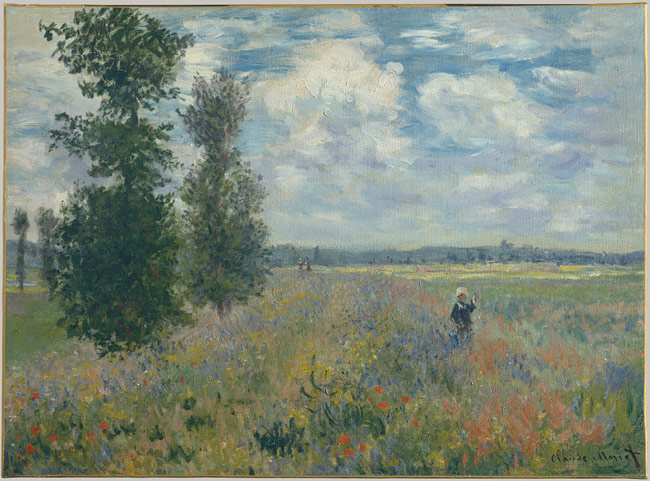
Poppy Field, Argenteuil, 1875 Claude Monet (French, 1840–1926) Oil on canvas  21 1/4 x 29 in. (54 x 73.7 cm) Signed (lower right): Claude Monet The Walter H. and Leonore Annenberg Collection, Gift of Walter H. and Leonore Annenberg, 2001, Bequest of Walter H. Annenberg, 2002 (2001.202.5) "Claude Monet: Poppy Field, Argenteuil (2001.202.5)". In Heilbrunn Timeline of Art History. New York: The Metropolitan Museum of Art, 2000–. http://www.metmuseum.org/toah/works-of-art/2001.202.5 (December 2008)

Poppy Field, Argenteuil, 1875
Claude Monet (French, 1840–1926)
Oil on canvas
21 1/4 x 29 in. (54 x 73.7 cm)
Signed (lower right): Claude Monet
The Walter H. and Leonore Annenberg Collection, Gift of Walter H. and Leonore Annenberg, 2001, Bequest of Walter H. Annenberg, 2002 (2001.202.5)
“Claude Monet: Poppy Field, Argenteuil (2001.202.5)”. In Heilbrunn Timeline of Art History. New York: The Metropolitan Museum of Art, 2000–. http://www.metmuseum.org/toah/works-of-art/2001.202.5 (December 2008)

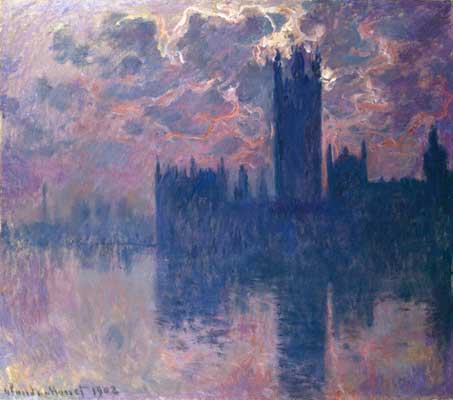
House of Parliament, Sunset Claude Monet 1902 public domain from Wikimedia Commons

Houses of Parliament, Sunset
Claude Monet 1902
public domain from Wikimedia Commons

Jenkins, Stringham, and Members leave Sillery’s together:

“Rain had been falling while we were at tea, but the pavements were now drying under wooly sky.

‘What very Monet weather it has been lately,’ said Members, almost to himself. ” [QU 184/190]

We took a photo of the sky . photo of wooly sky

With Powell’s prompting, we easily saw the resemblance of the confluent fluffy stratocumulus clouds to a large unshorn lamb.

Members’ mumbling about Monet is another matter. So far in Dance the Narrator has alluded to works of art to explicate what he sees or feels or has used visual examples to help describe a place.  Here, instead, the allusion comes from a character and presumably reveals something about the speaker. What do we learn about Member’s from what he says? Monet is much more modern that the artists the Narrator has chosen for his allusions, but by the early 1920s,  Monet was well known and hardly avant garde.   So Members may have artsy pretensions, but he is prosaic, neither a classicist nor on the cutting edge.

Monet is now among the best known Impressionists. He was a master of, among many things, cloudy sky.  We already know from Sillery’s party that Members is clever, but what is he saying about the weather? Is he comparing the weather to a beautiful sunny day along the Seine at Argenteuil or to threatening clouds above the Thames in London?

Monet is renowned for painting a scene, haystacks, or Rouen cathedral, or the Houses of Parliament, repetitively examining the visual effects of changing light. (A number of websites including Wikimedia Commons show other examples from the Houses of Parliament series).

Houses of Parliament, Stormy Sky Claude Monet, 1904 Palais des Beaux-Arts de Lille photo public domain from Wikipedia Commns.

Houses of Parliament, Stormy Sky
Claude Monet, 1904
Palais des Beaux-Arts de Lille
photo public domain from Wikipedia Commns.

The Houses of Parliament, Sunset Claude Monet , 1903 National Gallery, Washington , D.C. photo public domain from Wikipedia Commns

The Houses of Parliament, Sunset
Claude Monet , 1903
National Gallery, Washington , D.C.
photo public domain from Wikipedia Commons

Perhaps Monet weather is changing weather.  Members  runs off without explaining himself, “‘I think I must hurry ahead now as I am meeting a friend.”  For some tastes, Members is too clever by a half.  Stringham is certainly not impressed: “That must be a lie….He couldn’t possibly have a friend.”

Posted in Uncategorized | Leave a comment

The Dying Gladiator

Later at Sillery’s, “Members rose suddenly from the sofa and cast himself with a startling bump, almost full length on the floor in front of the fire place: exchanging in this manner his Boyhood-of-Raleigh pose for that of the Dying Gladiator. (QU 174/181)”

The Dying Gladiator Marble, copy of one of the statues Attalus I gave to Athens (3rd century BC). Capitoline Museum photo by Jean-Pol GRANDMONT from Wikimedia Commons

The Dying Gladiator
Marble, copy of one of the statues Attalus I gave to Athens (3rd century BC).
Capitoline Museum
photo by Jean-Pol GRANDMONT
from Wikimedia Commons

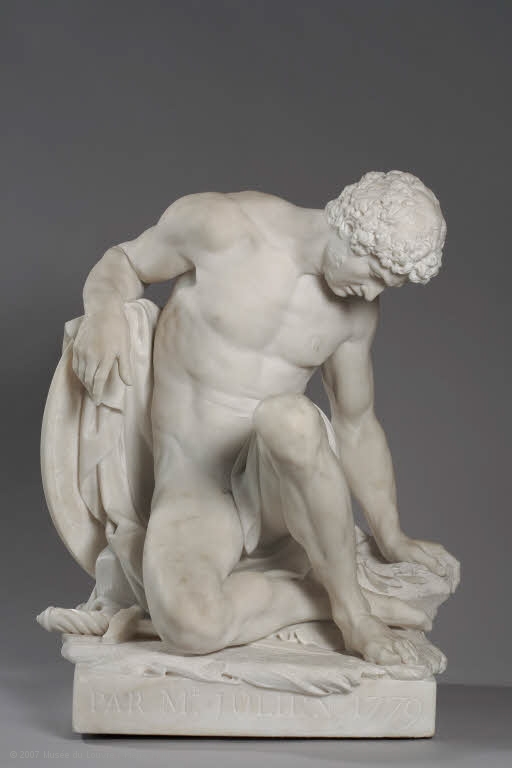
The Dying Gladiator Pierre Julien (1779) © 2007 Musée du Louvre / Pierre Philibert

The Dying Gladiator
Pierre Julien (1779)
© 2007 Musée du Louvre / Pierre Philibert

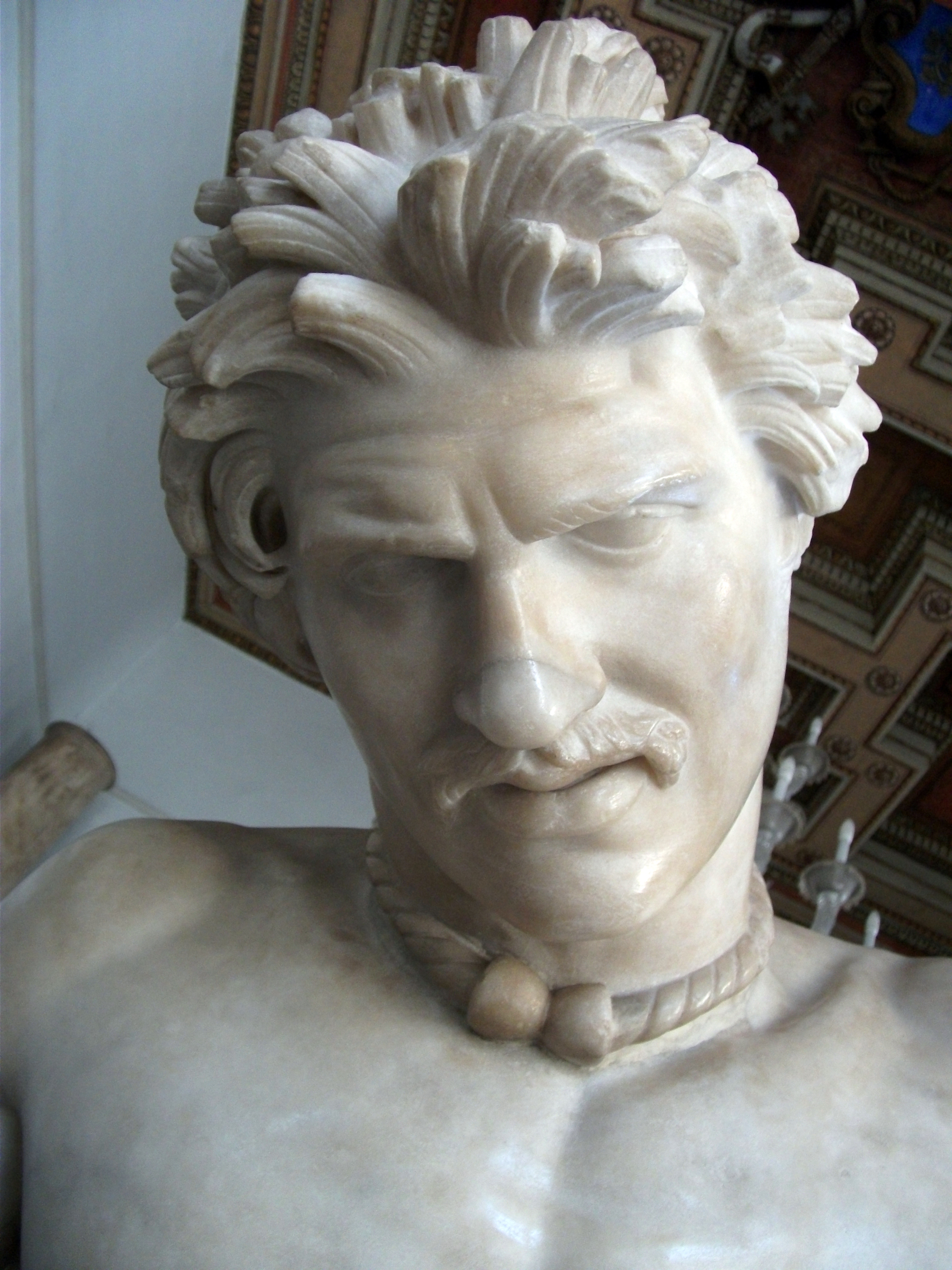
A Google image search shows many options for The Dying Gladiator, but the Narrator must be referring to the sculpture in the Capitoline Museum, not only because Members was  reclining , but also because Powell could expect a reader with a classic British education to be familiar with the piece, which, in the nineteenth century was assumed to represent a wounded gladiator.  It had been uncovered in the seventeenth century in Rome, taken by Napoleon to the Louvre, then returned to Rome in 1816. A rich young Englishman on a European Grand Tour might well want it on his itinerary.  In 1810 this sculpture was designated as the subject for the Newdigate poetry prize competition at Oxford . In 1818 Byron mentioned it in Childe Harold’s Pilgrimage (Canto IV, stanzas 140–141).  Currently, the figure is understood not to be a gladiator, but rather a

The Dying Gladiator Details of Face photo by Johnbod Wikimedia Commons

The Dying Gladiator
Details of Face
photo by Johnbod
Wikimedia Commons

Gaul or Celt; the original bronze, of which the Capitoline marble is a Roman copy, was commissioned about 225 BC by Attalus I of Pergamon in Anatolia to commemorate his victory over the Gauls or Galatians.   The grimace of the dying beautiful boy, of which Byron says, “his manly brow consents to death but conquers agony,” may remind us of Member’s discomfort in Quiggins’ presence.


Posted in Uncategorized | 1 Comment