Mark Members On St. John Clarke

We already know Barnby’s opinion of St. John Clark’s taste. Now Mark Members, dismissed as St. John Clarke’s secretary, tells Jenkins, ” I can say without boasting that I had done a great deal to … improve St. J’s attitude towards intellectual matters. Do you know, when I first came to him he thought Matisse was a plage .. [French for ‘beach’]”  [AW 130/123]

We have already touched on Matisse when we considered Mr. Deacon’s view of Post Impressionism and when Jenkins saw a Derain.  Barnby playfully contrasted him with Masaccio.

Matisse preceded Picasso at the forefront of French twentieth century art, gaining prominence in the first decade of the century as the driving force of Fauvism. Powell learned of Matisse’s paintings early in his years at Eton, about 1919 [TKBR 33]. Members is speaking in 1933; by then Matisse was so well known that he had been on the cover of Time Magazine (Oct. 20, 1930) after he had been the United States to sit on the jury of the 29th Carnegie International exhibition.

Bathers, Composition No. II,  Henri Matisse, 1909. Watercolor on paper. The State Pushkin Museum of Fine Arts, Moscow possible copyright © 2010 Succession H. Matisse / Artists Rights Society (ARS), New York

Bathers, Composition No. II,
Henri Matisse, 1909.
Watercolor on paper. The State Pushkin Museum of Fine Arts,
Moscow
possible copyright
© 2010 Succession H. Matisse / Artists Rights Society (ARS), New York

There are many iconic Matisse images to choose; we picked this version of Bathers, both to recall Clarke’s plage and to reference Matisse’s homage to and evolution from Cézanne. A webpage of The Art Institute of Chicago illustrates how this work was pivotal in Matisse’s development .

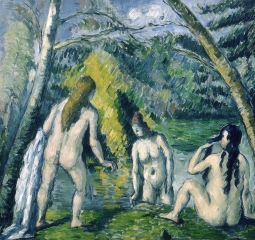
Later in the conversation, Members says, “Then one morning at breakfast he says Cézanne was ‘bourgeois.'”[AW 133/126]

Cézanne (1839-1906) was certainly bourgeois in the Marxist sense; his father was a wealthy banker, and Cézanne gained financial independence from his inheritance. Nonetheless, he was an artistic revolutionary, who learned from the more radical of his immediate predecessors. His use of planes of color to create his compositions inspired succeeding developments like Fauvism and Cubism.  Like Matisse, his work was shown in London in 1910  at Roger Fry’s Post Impressionist exhibit. Cézanne painted over 200 pictures of bathers. The work that we show belonged to Matisse, who acknowledge his artistic indebtedness to Cézanne. Matisse donated this canvas to the Petit Palais museum in 1936, making it the first Cézanne Bathers to be displayed in a western museum.

 Paul Cezanne, 1879-1882 oil on canvas, 22 X 21 in. Petit Palais, Paris

Paul Cézanne, 1879-1882
oil on canvas, 22 X 21 in.
Petit Palais, Paris

Posted in Uncategorized | 1 Comment

At the Isbister Memorial Exhibit

Jenkins attends the Isbister Memorial Exhibition “partly for business reasons, partly for a certain weakness for bad pictures, especially bad portraits.” [AW 113/106] He reflects:

“Pictures, apart from their aesthetic interest, can achieve the mysterious fascination of those enigmatic scrawls on walls, the expression of heaven knows what psychological urge on the part of the executant; for example, the ever anonymous drawing of Widmerpool in the cabinet at La Grenadière.” [AW 113/106]

Jenkins revisits portraits, like that of Lord Aberavon, and also mentions Isbister’s genre paintings, like Clergyman Eating An Apple and The Humorists. In 2007-8 the Royal Academy mounted an exhibition of scenes of the quotidian–  From All Walks of Life: Genre Paintings from the Royal Academ Collection — but so far we have not found a reasonable facsimile for Isbister’s genre oeuvre. We welcome hearing from readers if they have a candidate to show here.

As he wanders through the exhibit, Jenkins meets an number of old friends. Sir Gavin Walpole-Wilson takes some delight that Isbister has painted his old rival Saltsonstall to look like “the Christmas Tree of Taste.” [AW 115/108 ].  Sir Gavin mocks Saltonstall’s pretension as The Man of Taste: ” with his vers de societé, and all his talk about Foujita and Pruna and goodness knows who else — but when it comes to his own portrait, it’s Isbister.’ [AW 116/109]

Léonard Tsuguharu Fujita (1886-1986 ) was a Japanese born painter and print maker who lived in Paris from 1913-1931, achieving some critical and financial success, but he no longer has the name recognition of many of his friends and contemporaries who led the burst of French artistic creativity of that period.

Self Portrait Tsuguhara Foujita
Self Portrait, Tsuguhara Foujita, Hirano Masakichi Museum of Fine Art, Akita, Japan copyright status unknown

Pedro Pruna (1904-1977) also spent time in Paris and was considered a student of Picasso. His work included costumes and scenery of Diaghilev’s Ballet Russe. Later he returned to Spain and supported Franco.

Les trois grâces de la mode Pedro Pruna, 1934 oil on canvas 64X 51 in sold at Christie's for $26,000 in 2009 copyright status unknown
Les trois grâces de la mode,Pedro Pruna, 1934 oil on canvas, 64X 51 in, sold at Christie’s for $26,000 in 2009, copyright status unknown

Sillery is at the exhibit, musing about who should paint his portrait to hang in his College. [AW 119/112] Isbister is no longer available, and the College is too conservative to consider Barnby; in fact, Antonio Moro represents the standard that they want to emulate. Moro (Netherlands 1519-1575), also know as Anthonis Mor van Dashorst,  spent some time in Britain for his portrait of Queen Mary (1554). The portrait we show of Cardinal Granvelle illustrates Moro’s stern formality, which was so appealing to the dons.

Cardinal Granvelle Antonio Moro, 1549 oil on canvas, 43 X 33 in Kunsthistorisches Museum, Vienna photo public domain from Wikimedia Commons

In front of Countess of Ardglass with Faithful Girl, Jenkins sees Lady Ardglass admiring her own portrait. “Isbister had painted her in an open shirt and riding breeches, standing besides the mare, her arms slipped through the reins: with much attention to the high polish of the brown boots.

‘Pity Jumbo could never raise the money for it,’ Bijou Ardglass was saying.” [AW 121/113]

John William Godward (1861-1922) has been mentioned as a model for Isbister as a portraitist.  Godward was a protege of Alma Tadema. Like Isbister, he was a member of the Royal Academy whose reputation waned with the advent of Modernism. Unlike Isbister, the vast majority of Godward’s subjects were women in Greco-Roman settings. He did not seem to paint horsewomen in brown boots; undoubtedly, however, he could have captured Bijou Ardglass’ allure.

The Mirror John William Godward, 1899 oil on canvas 32 X 15 inches private collection photo public domain from Wikimedia Commons via the Art Renewal Center Museum

The Mirror, John William Godward, 1899 oil on canvas 32 X 15 inches, private collection, photo public domain from Wikimedia Commons via the Art Renewal Center Museum

Posted in Uncategorized | 2 Comments

Indifferent Seascapes

Quiggins surveys the Templer’s cottage. “His eyes continued to stray over the very indifferent nineteenth- century seascapes that covered the walls; hung together in patches as if put up hurriedly… ” [AW 87/ 80]

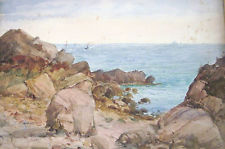
The tradition of painting the sea must be nearly as old as painting itself. British painters in the the eighteenth and nineteenth centuries were inspired particularly by Dutch seventeenth century marine painters. (see, for example, Seascapes: Marine Paintings and Watercolors from the U Collection shown at the Yale Center for British Art).  Some of the finest artists of the nineteenth century counted seascapes among their works, so why concentrate here on the indifferent? Once again, Jenkins is reflecting, somewhat superciliously, on the tastes and patrimony of his friends; the seascapes had hung in Templer’s parents’ seaside house.  What is more intriguing to us is how Powell introduces these paintings so casually here, with no hint that he will revisit  them in more detail in the concluding pages of Dance; we will speculate more about them then. In the meantime, if you want to inexpensively hide the divots in your wallpaper, go to eBay and bid on nineteenth century seascapes. Today (March 1, 2014),  the watercolor below had an asking bid of £21.

Costal Scene George Dunkerton Hiscox (1840-1909) watercolor asking bid on eBay $21 March 1, 2014

Coastal Scene
George Dunketon Hiscox  (1840-1909)
watercolor 


Posted in Uncategorized | 1 Comment

Reynolds, Boucher, Renoir

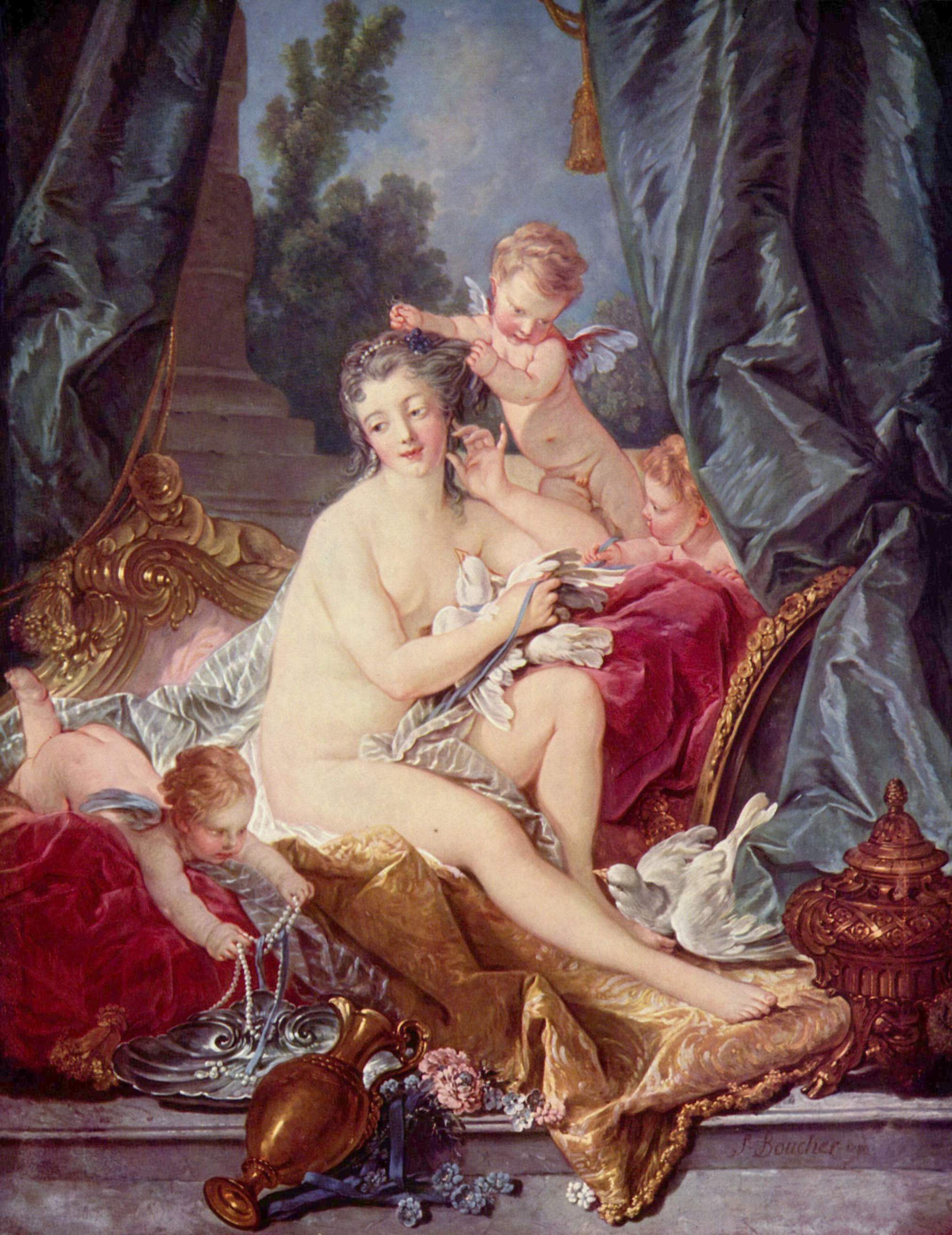
In a protracted exchange with Nick, Barnby insists on the truth-telling ability of painting over writing where women are concerned: “Writers always seem to defer to the wishes of the women themselves.”  Nick replies, “So do painters.  What about Reynolds or Boucher?” [AW 75/69]

Sir Joshua Reynolds (1723-1792) was the pre-eminent British portrait painter of the eighteenth century, notable for his erudition and his ability to synthesize both Italianate and Northern painting traditions into his own elegant compositions.  Reynolds was elected as the first president of the RoyalAcademy at its founding in 1768.  Commentators on the National Gallery of London’s website relate that Reynolds’ portraits have not lasted well over the centuries, faulty pigments having caused the flesh tones to fade, for example.  No doubt his women subjects would have appeared even more ravishing to their contemporaries than they do to us now, though in the case of Lady Jane Halliday, pictured below in Reynolds’ 1779 portrait of her, that would be hard to imagine.

Portrait of Lady Jane Halliday Sir Josuya Reynolds, 1779 oil on canvas, 94 X 59 inches National Trust, Waddesdon Manor (Buckshire, Great Britian) photo public domain from the Yorck project via Wikimedia Commons

Portrait of Lady Jane Halliday
Sir Josuya Reynolds, 1779
oil on canvas, 94 X 59 inches
National Trust, Waddesdon Manor (Buckshire, Great Britian)
photo public domain from the Yorck project via Wikimedia Commons

Francois Boucher (1703-1770), Reynolds’ younger French contemporary, is identified with the most extreme expression of decorative movement and delicate color known as rococo. Unlike Reynolds, who worked almost entirely in portraiture, Boucher energetically explored every genre of painting and made designs for decorative work in printmaking, porcelain and tapestry. Boucher, even at the height of his career and periodically since, has been criticized for elevating style over substance, but no objective observer could fail to acknowledge Boucher’s mastery in asserting a particular vision of feminine beauty, as exemplified by this image of Venus from 1751, now at the Metropolitan Museum of Art.

The Toilet of Venus François Boucher, 1751 oil on canvas, 43 X 34 in Metropolitan Museum of Art photo public domain from Wikimedia Commons

The Toilet of Venus
François Boucher, 1751
oil on canvas, 43 X 34 in
Metropolitan Museum of Art
photo public domain from Wikimedia Commons

Later, Barnby insists, “In writing . . . there is no equivalent, say, of Renoir’s painting. Renoir did not think that all women’s flesh was literally a material like pink satin. He used that color and texture as a convention to express in a simple manner certain pictorial ideas of his own about women. In fact he did so in order to get on with the job in other aspects of his picture. I never find anything like that in a novel.” To which Nick responds, “You find plenty of women with flesh like that sitting in the Ritz.” [AW 75/69]

Nick had had this thought earlier, while actually at the Ritz: “Among a sea of countenances, stamped like the skin of Renoir’s women with that curiously pink, silky surface that seems to come from prolonged sitting in Ritz hotels, I noticed some familiar faces.” [AW 40/34]

Pierre Auguste Renoir (1841-1919) was the French figurative painter most closely associated with the strand of Impressionism that sought to unite the Impressionists’ focus on the mundane aspects of middle-class life with painting’s traditional mission of celebrating and idealizing the glories of feminine flesh. Barnby insists that Renoir might portray women’s physical presence in the same way whether they were to be seen in the bath, the dance hall, or in the lobby of the Ritz.

After the Bath Pierre-Auguste Renoir, 1888 oil on canvas, 26 X 21 in private collection photo public domain from Wikimedia Commons via the Yorck Project

After the Bath
Pierre-Auguste Renoir, 1888
oil on canvas, 26 X 21 in
private collection
photo public domain from Wikimedia Commons via the Yorck Project

Posted in Uncategorized | 1 Comment

Snowy Sisley Landscape

Driving to the Templer home on a snowy night with Templer,  Mona, and Jean,  Nick writes of Mona, “ . . . she jumped out of her side of the car, and ran across the Sisley landscape to the front door, which someone had opened from within.”

Alfred Sisley (1839-1899) was a British painter whom most viewers would identify as a French Impressionist, as indeed he identified himself.  A British citizen, Sisley was born in Paris and spent most of his life in France, painting first rather in the manner of Corot, but gradually coming under the spell of his contemporaries Manet,  Renoir, Monet, and Pisarro.  Sisley exhibited repeatedly with the Impressionist group and always  committed  himself to the goals of plein-air landscape painting and the optical color-mixing effects for which the Impresssions became known.  Evocation of the light on a snowy countryside was a favorite theme of Sisley and his colleagues, and a painting like this one of 1874 might have provided inspiration for Nick’s phrase, “the Sisley landscape.”

Snow on the Road, Louveciennes (Chemin de la Machine) Sisley, 1874 15 X 22 inches private collection photo public domain from Wikipedia

Snow on the Road, Louveciennes (Chemin de la Machine)
Sisley, 1874
15 X 22 inches
private collection
photo public domain from Wikipedia

Posted in Uncategorized | Leave a comment

Delacroix’s Femmes d’Algers dans leur apartement

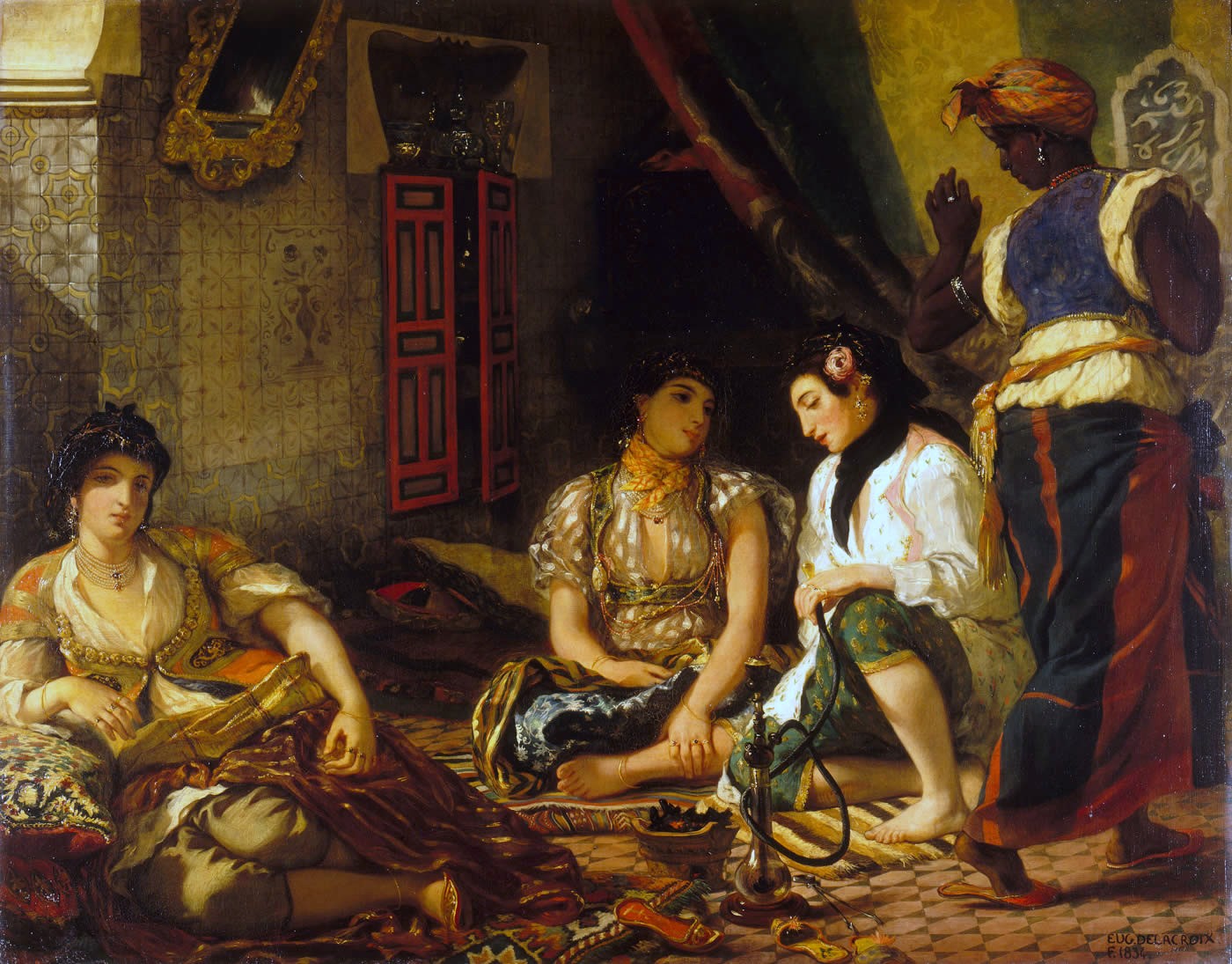
At his weekend visit to Peter Templer’s, Nick once again meets Peter’s sister Jean, now Jean Duport.  “Once she had reminded me of Rubens’s Chapeau de Paille.  Now for some reason––though there was not much physical likeness between them––I thought of the woman smoking the hookah in Delacroix’s Femmes d’Alger dans leur appartement.” (AW 58)

Femmes d’Algers dans leur apartement Eugene Delacroix, 1834 color on canvas, 71 X 90 in Louvre Museum photo public domain via Wikimedia Commons

Femmes d’Algers dans leur apartement
Eugene Delacroix, 1834
color on canvas, 71 X 90 in
Louvre Museum
photo public domain via Wikimedia Commons

Eugene Delacroix (1798-1863) was the pre-eminent French Romantic painter of the nineteenth century, highly regarded by critics in his own time and continuously celebrated into the present.   The term Romanticism applied to Delacroix’s work,  and indeed almost defined by it,  refers to its rejection of neo-classical ideas of stability and clarity of composition and of individual forms in favor movement,  complexity and spatial ambiguity.

Delacroix largely avoided classical motifs in favor of scenes depicting the exoticism of North Africa and the near east, and from this interest arose his Femmes d’Algers of 1834.  His historical paintings feature not the battles of antiquity but moments in more recent European history and in romantic literature when the heroic masses could be depicted as struggling against the tyranny of their oppressors.  Thus, his most well-known painting is Liberty Leading the People, an homage to the July Revolution of 1830 against the reign of Charles X.

Nick compares Jean to an awkward,  virginal saint in an early Flemish drawing, to Ruben’s sly cousin or wife, and to a hookah-smoking Algerienne, whom he says does not actually resemble Jean. These do not add up to a picture of Jean but to a picture of a confounded Nick, who cannot seem to get a handle on his fascination for Jean.  The implication is that his fascination is not with her appearance at all but with her sexual allure, an implication that becomes more explicit as he moves from the saint to the exotic woman with the hookah.

the-giantess-1929(1).jpg!Large

The Giantess, Rene Magritte, 1929 Tempera on cardboard, 22 x 29 in., Museum Ludwig, Cologne, Germany Copyright Rene Magritte, image from WikiArt.org (https://www.wikiart.org/en/rene-magritte/the-giantess-1929) by Fair Use

In Album, Lady Violet Powell offers another view of Jean, by reminding us that shortly after seeing Jean at the Templers, Jenkins visits her apartment in London:

As I entered the hall, closing the door behind me, she ran back along the passage. I saw that she wore nothing but a pair of slippers. [AW 145/ ]

By using Magritte’s The Giantess to illustrate this encounter, Lady Violet adds another dimension to our fantasies of Jean and emphasizes the oversized role she played in Jenkins romantic and erotic memories.

Posted in Uncategorized | 2 Comments

The Nymph at the Ritz

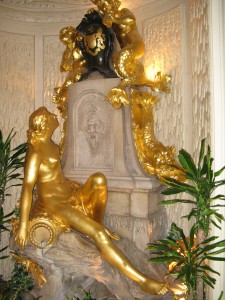
Jenkins, waiting to meet Mark Members at the Palm Court at the Ritz Hotel, gazes on a South American family seated in front of the fountain. “Away on her pinnacle, the nymph seemed at once a member of this Latin family party …  Now she had strayed from her hosts to enjoy delicious private thoughts in peace while she examined the grimacing face of the river-god carved in the short surface of wall by the grotto. Pensive, quite unaware of the young tritons violently attempting to waft her away from the fountain by sounding their conches at full blast … ” [AW 37/31]

La Source The Palm Court Fountain Ritz Hotel London photo from HighTea.com

La Source
The Palm Court Fountain
Ritz Hotel London
photo from HighTea.com

The Ritz, which is the site of a number of key scenes in AW, opened in 1906. Despite his upper class background, Jenkins was not usually among the stylish, rich, aristocratic habitues of the Palm Court. The fountain, called La Source, is part of the Belle Epoque interior decorated by Waring and Gillow  to evoke Parisian elegance, akin to the Paris Ritz.  Powell’s description of the nymph exceeds any two-dimensional picture in capturing the ambience that drew other beautiful people to the room.  Today anyone with access to the Internet can reserve a seat at high tea there, which costs about £ 40 per person.

Posted in Uncategorized | Leave a comment

Isbister, “The British Frans Hals”

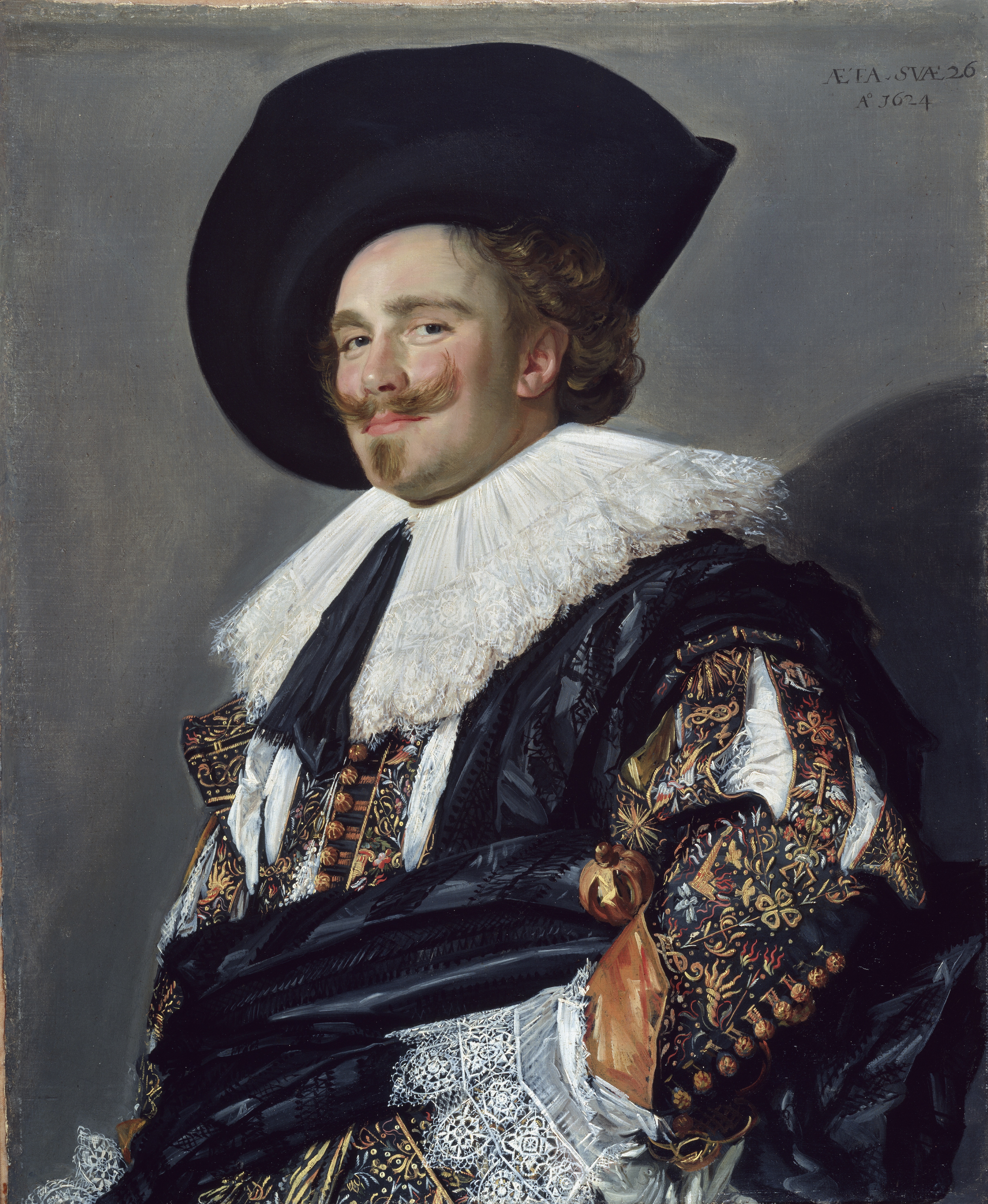
When Isbister died, one of the death notices called him “the British Frans Hals.” [AW 36/30]

The Laughing Cavalier Frans Hals, 1624 oil on canvas, 33 X 27 in. Wallace Collection, London photo public domain from Wikimedia Commns

The Laughing Cavalier
Frans Hals, 1624
oil on canvas, 33 X 27 in.
Wallace Collection, London
photo public domain from Wikimedia Commns

We will start with an art history quiz: Which is true of Hals (Dutch ~1582-1666)? A. He, along with Rembrandt and Vermeer, is one of the enduring stars of the Dutch Baroque. B. He drank heavily and abused his first wife. C. He was a master of genre painting. D. He was in great demand as a portraitist by the Dutch bourgeoise. E. His portraits were vibrant with visible brushwork that was meticulously executed to appear spontaneous. F. He was broke and out of fashion before he died. G. His reputation revived in the nineteenth century, when innovators like Manet learned from Hals’ style. Answer: all of the above except for B. The story of wife abuse appeared in early biographies, but examination of the records showed that the abuser was a different Frans Hals, who also lived in Haarlem at the time. The growth of Hals’ critical stature is shown by enthusiasm for The Laughing Cavalier, which has been immensely acclaimed since it was first shown in Britain in 1872. So, which of these aspects of Hals led the obituary writer to compare him to Isbister?  There is  no suggestion of debauchery nor of mistreatment of  Morwenna, his wife and model. He was hardly a contemporary master; later Jenkins attends the Isbister Memorial Exhibition “partly from a certain weakness for bad pictures, particularly bad portraits. ” [AW 113/106]  Rather, the reference seems to refer to Isbister’s ability to sell portraits to the burghers of Britain, in spite of what Jenkins calls “the crudeness of his accustomed application of paint to canvas,” in no way comparable to Hals’ virtuso brushwork.

Posted in Uncategorized | 3 Comments

St. John Clarke’s Artistic Conversion

Barnby and Jenkins are discussing the prospect of St. John Clarke writing an introduction to the book on Isbister’s paintings. We have already learned some of Clarke’s artistic tastes from his comments on the Keningston Garden statues. In the dialogue, Powell touches on many aspects of the evolution of Modernism.

Jenkins: “St. John Clarke does not know a Van Dyck from a Von Dongen” [AW 31/25]

Almost the only thing these two Dutch painters share is the first four letters of their names and perhaps a penchant for unusual hats.   Jenkins has already mentioned Van Dyck, the seventeenth century British court painter, in AQ.  Van Dyck painted portraits of Lady Shirley and her husband in Rome.

Lady Shirley Anthony Van Dyck, 1622 oil on canvas H.M. Treasury and The National Trust, Petworth House (Sussex) photo from the Yorck project via Wikimedia Commons

Lady Shirley
Anthony Van Dyck, 1622
oil on canvas
H.M. Treasury and The National Trust, Petworth House (Sussex)
photo from the Yorck project via Wikimedia Commons

Powell, reviewing a book about Van Dyck, says: “One is struck by the manner in which van Dyck has treated the Shirleys as if they might be more exotic ramifications of the East India Company in 1840.” [SPA… p. 180]

Van Dongen (1877-1968) was a fauvist, who later identified with the German  expressionists. We know nothing about the model for this portrait, but early in his career, Van Dongen did frequent the Rotterdam red light district and often painted its denizens. By the late 1920s, he was honored with the French Legion of Honor and the Order of the Crown of Belgium.

Woman with a Large Hat Kees Van Dongen, 1906 photo public domain in US from Wikipedia Copyright presumed to be estate of Kees van Dongen.Woman with a Large Hat
Kees Van Dongen, 1906
photo public domain in US from Wikipedia
Copyright presumed to be estate of Kees van Dongen.

“Ah, but he does now,” said Barnby. “That’s where you are wrong. You are out of date.  St. John Clarke has undergone a conversion.”

“To what?”

“Modernism”

“Steel chairs?”

Wassily Chairs, Model B3 Marcel Breuer Creative Commons license from Wikimedia  Commons, contributed by Tankwart from Flickr

Wassily Chairs, Model B3
Marcel Breuer, 1925-6
Creative Commons license from Wikimedia Commons, contributed by Tankwart from Flickr

While working at the Bauhaus, Marcel Breuer (1902-1981) designed this chair made of extruded chrome-plated steel, just like a bicycle frame, and upholstered with canvas. Breuer named it after the painter Vassily Kandinsky, his friend who was also with the Bauhaus at that time. Copies remain commercially available.

“No doubt they will come.”

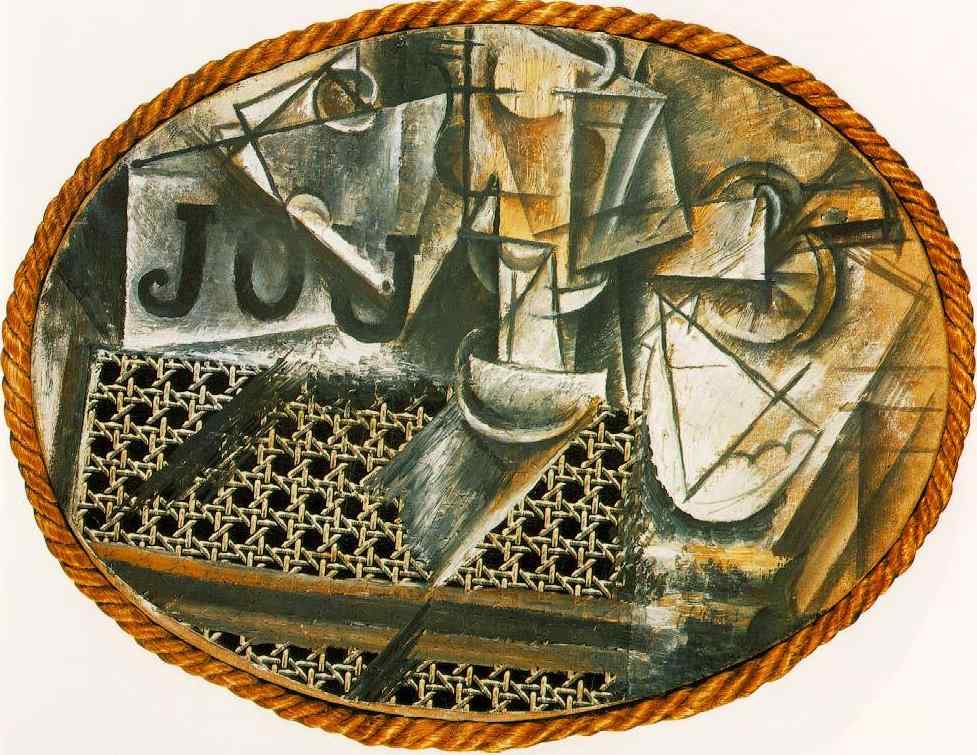
“Pictures made of shells and newspaper?”
Still Life with  Chair Caning Pablo Picasso, 1912 collage on canvas Musee Picasson, Paris copyright Succession Picasso,

Still Life with Chair Caning
Pablo Picasso, 1912
collage on canvas
Musee Picasson, Paris
copyright Succession Picasso,

In May, 1912, Picasso introduced the low-art tradition of decorative collage to modern high-art practice (Edwards and Wood, Art of the Avante Garde, Yale University Press) with his Still Life with Chair Caning.  Braque soon responded with his own collages, both artists gluing found materials onto their canvases.  The use of actual newsprint and bits of shells was to follow, but Picasso anticipates this in Chair Caning with the JOU, hinting at “journal,” French for newspaper, and the three connected arcs in the lower right, suggesting a scallop shell.

“At present he is at a slightly earlier stage…The outward and visible sign of St. John Clarke’s conversion … is that he has indeed become a collector of modern pictures — though as I understand it, he still loves them on this side of Surrealism. As a matter of fact he bought a picture of mine last week.” Barnby goes to to say that he expects to be commissioned to paint Clarke’s portrait.
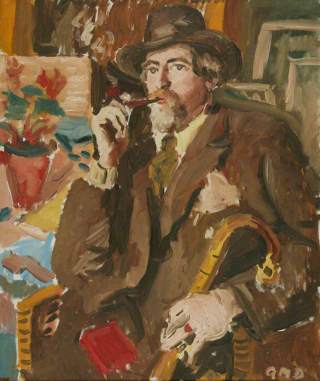
Augustus John by Adrian Maurice Daintrey oil on canvas 31 by 26 inches Manchester Art Gallery from BBC Your Paintings (c) Mr Vernon C. Wallis (great-nephew); Supplied by The Public Catalogue Foundation

Augustus John
by Adrian Maurice Daintrey
oil on canvas 31 by 26 inches
Manchester Art Gallery
from BBC Your Paintings
(c) Mr Vernon C. Wallis (great-nephew); Supplied by The Public Catalogue Foundation

Barnby is thought to be based in part on Powell’s good friend Adrian Daintrey (1901-1988), to whom AW is dedicated.  In Daintrey’s portrait of  the artist Augustus John, we see bold brush strokes and splashes of color to contrast with the brown suit, which probably owe something to his heroes Matisse and Derain, a modern portrait style that might accommodate the limits of Clarke’s ‘conversion.’

Considering whether Clarke’s conversion would improve his life, Jenkins says: “But if you are not really interested in pictures, liking a Bonard doesn’t make you any happier than liking a Bouguereau.” [AW 33/27]

Nude After the Bath William-Adolphe Bouguereau, 1875 photo public domain from Wikipedia.org
Nude After the Bath
William-Adolphe Bouguereau, 1875
photo public domain from Wikipedia.org

William-Adolphe Bouguereau (1825-1095) was a French academic painter who often placed his realistic but idealized nudes in mythical or classical settings.  He was very successful in the mid nineteenth century but was devalued by the Impressionists and their followers. “Degas and his friends used the term ”bouguerated” (bouguereauté) to derogate a finicky, overly finished painting surface.” (Grace Glueck, The New York Times 1/6/1985) Bouguereau was quite out of favor among modernists in the days of AW, but like his contemporary Alma-Tadema, had new admirers later in the twentieth century.
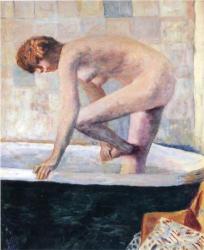
Nude Washing Feet in Bathtub Pierre Bonnard, 1924 oil on canvas, 42 x 38 in. Private Collection, copyright status unknown image from Wikipaintings. org

Nude Washing Feet in Bathtub
Pierre Bonnard, 1924
oil on canvas, 42 x 38 in.
Private Collection,
copyright status unknown
image from Wikipaintings. org

Bouguereau‘s countryman Pierre Bonnard (1867-1947) practiced a very different form of realism, sometimes called Intimism. He often worked from photos of his wife  Marthe, using small brush strokes and colors mixed optically on the canvas to capture skin tones. Bonnard was a friend of Toulouse-Lautrec and was influenced by Gaugin and japonisme. He was riding the modern wave in the days of AW, with a major exhibition at the Art Institute of Chicago in 1933.

Posted in Uncategorized | 6 Comments

St. John Clarke and the Kensington Garden Sculptures

Jenkins discusses St. John Clarke’s interest in art and his suitability to write an introduction to The Art of Horace Isbister: “That a well-known novelist should take on something that seemed to call in at least a small degree for an accredited expert on painting was not so surprising as might at first sight have appeared, because St. John Clarke, although quieter of late years, had in past often figured in public controversy regarding the arts. He had been active, for example, in the years before the war in supporting the erection of the Peter Pan statue in Kensington Garden; a dozen years later vigorously opposing the establishment of Rima in the bird sanctuary in the same neighborhood”  [AW 26/19] Jenkins continues, reflecting on Clarke’s views on the Haig Statue and on Post Impressionism.

Peter Pan Sir George Frampton, 1902 Kensington Gardens

Peter Pan
Sir George Frampton, 1912
Kensington Gardens

In 1902, J. M. Barrie published his first Peter Pan book, The Little White Bird, and commissioned Sir George Frampton to build a statue of Peter for the Kensington Gardens. In 1904 Barrie wrote his famous play about Peter and in 1906 adapted the Kensington garden portions of The Little White Bird for the book Peter Pan in Kensington Gardens.  Sir George Frampton, R.A. (1860-1928) was part of the late nineteenth century British New Sculpture movement, which concentrated on natural, life-like figures. Seven other castings of this beloved statue are displayed around the world.

Rima Sir Jacob Epstein, 1925 Kensington Gardens

Rima
Sir Jacob Epstein, 1925
Kensington Gardens
© The Estate of Sir Jacob Epstein/ Tate, London 2009

Rima, sculpted by Sir Jacob Epstein for the Kensington Garden bird sanctuary in 1925 is a distant departure from New Sculpture. Rima, another popular figure of children’s literature,  was a girl who lived the jungles of Venezuela in Green Mansions: A Romance of the Tropical Forest by W.H.M. Hudson (1904). St. John Clarke’s contrasting views of these two statues reflected public controversies in London in the late 1920s.  Epstein’s work was greeted by some as a grotesque atrocity, but others welcomed it. The critic Holbrook Jackson wrote:  “The statue of Peter Pan is only tolerable for the sentimental effect it has on children who have been wrongly brought up. Rima is one of the greatest examples of the sculpture of modern times.” In 1927, Rima was defaced with green paint; whether this was simple vandalism or an act of public criticism is unknown, but in August, 1928, Peter Pan was tarred and feathered, bringing tears to the eyes of many of its admirers; some believed that Epstein’s supporters were retaliating  for the green paint. In 1929, Rima got the tar and feathers. A week later a tar attack on another Epstein piece was foiled, and other attacks on Rima continued for years. Epstein quipped: “Michael Angelo’s David was stoned by the populace of Florence…so I feel I am in good company.”   We are still in Kensington Gardens but, in artistic terms, have come a long way from the Victorian monuments; in a few lines Powell both illustrates Clarke’s aesthetic politics and calls our attention to cultural history.

Posted in Uncategorized | 1 Comment