Wilson and Greuze at the Jeavon’s

Chips Lovell brings Nick to the Jeavons home, where Nick surveys the scene upon entering the drawing room:  “Some of the furniture was obviously rather valuable:  the rest, gimcrack to a degree.  Pictures showed a similar variation of standard, a Richard Wilson and a Greuze (these I noted later) angling among pastels of Moroccan native types.” [ALM 24/21]

Richard Wilson (1714-1782) was a Welsh-born painter, one of the earliest British landscape painters and well-known for his idealized bucolic scenes in the tradition of Claude Lorrain.  Wilson became a founding member of the Royal Academy. Pictured here is his view of the Thames at Twickenham from 1762.
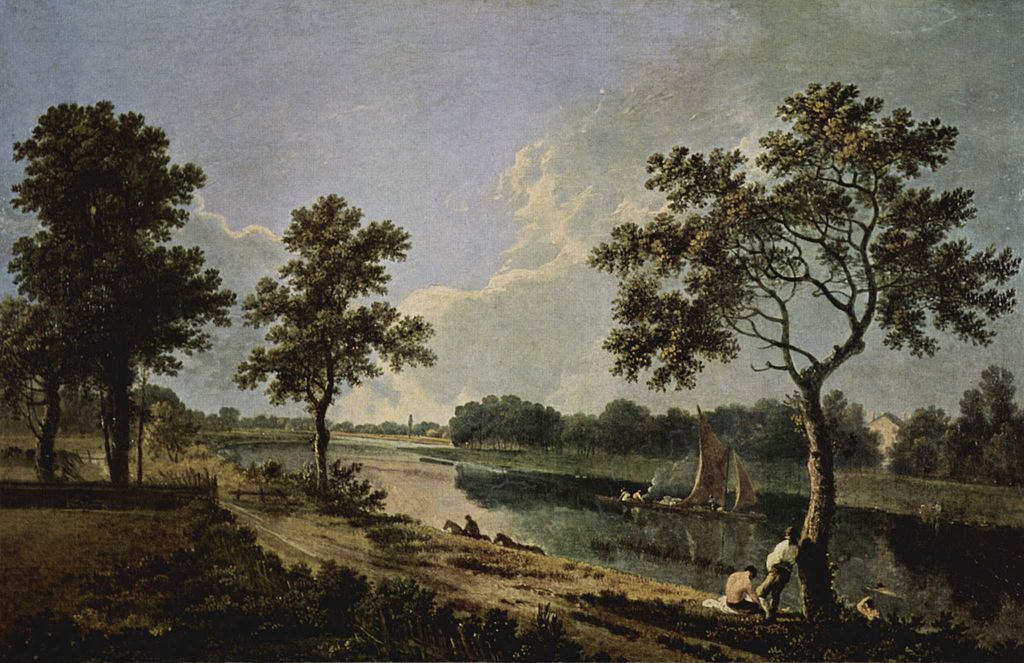
 

Richard Wilson, c. 1762 oil on canvas, 18 X 29 in The Tate  image in public domain from Wikimedia Commons

Richard Wilson, c. 1762
oil on canvas, 18 X 29 in
The Tate
image in public domain from Wikimedia Commons
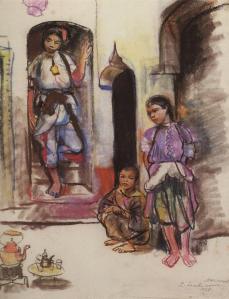
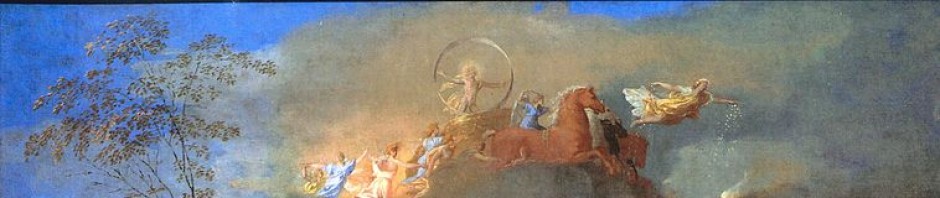
Zinaida Serebriakova. 1928 Art of the Russias  copyright status unknown

Zinaida Serebriakova, 1928
Art of the Russias
copyright status unknown

We have interspersed a Moroccan pastel of a courtyard in Marrakech, painted contemporary to the setting of ALM, to highlight the eclectic nature of the Jeavon’s collection.

L'accordée de village Jean-Baptise Greuze, 1761 oil on canvas, 36 X 42 in Musee de Louvre image  in public domain from Wikimedia Commons

L’accordée de village
Jean-Baptise Greuze, 1761
oil on canvas, 36 X 42 in
Musee de Louvre
image in public domain from Wikimedia Commons

Jean Baptiste Greuze (1725-1805) was a French painter who aspired to be known for his historical compositions but whose fame was primarily based on masterful “genre scenes,” riveting melodramas of bourgeois domestic life that embody moral lessons.  In spite of his vexed relationship with the French Royal Academy regarding the status of such subject matter in the traditional hierarchy of painting subjects, Greuze was immensely popular with a bourgeois audience during his own lifetime. By the time of his death, however, Greuze’s reputation had fallen precipitously, due to the sentimental nature of his domestic scenes, but in most recent times a renewed esteem for his draughtsmanship and formal mastery have kept his name in currency.   We aren’t told which Greuze hung in the Jeavons’s drawing room, but here is his “Village Wedding,” of 1761, now in the Louvre.


Posted in Uncategorized | 2 Comments

The Barbizon School

Chips Lovell’s father was a painter whose “insipid, Barbizonish little landscapes, not wholly devoid of merit,  never sold beyond his own circle of friends. ” [ALM 16/14 ]

Fontainebleau, Oak Trees at Bas-Breau Camille Corot, 1832-3 Oil on paper laid down on wood; 15 5/8 x 19 1/2 in. The Metropolitan Museum of Art

Fontainebleau, Oak Trees at Bas-Breau
Camille Corot, 1832-3
Oil on paper laid down on wood; 15 5/8 x 19 1/2 in.
The Metropolitan Museum of Art

The ‘Barbizon school‘ refers to a group of French nineteenth century landscape painters, including Jean-Francois Millet, Theodore Rousseau, and Camille Corot, who painted realistically  from nature, working outdoors in the Forest of Fontainbleau, and often meeting in the nearby village of Barbizon. Their work departed from the neoclassical landscapes of Poussin and Claude Lorraine.  Among their inspirations was Constable’s exhibit at the Paris Salon of 1824

Posted in Uncategorized | 1 Comment

Constable, Pepys, and Veronese at Dogdene

In his introduction to the Sleaford family at the beginning of At Lady Mollys, Nick evokes his image of Dogdene, the Sleaford great house:  “I also knew Constable’s picture in the National Gallery, which shows the mansion itself lying away in the middle distance, a faery place set among giant trees beyond the misty water-meadows of the foreground in which  the impastoed cattle browse . . . .” [ALM 13/10]

John Constable (1776-1837) was a British painter known for sweeping landscapes of his native Suffolk County, the Salsbury Plain and its famous cathedral, and views of the then-rural outskirts of London.  Constable was known for his impasto, paint applied thickly so that brush strokes were visible, which was not a fashionable technique in his day.  He paired painstaking attention to directly-observed detail with compositions that revealed his belief in a Nature endowed with sentiment.  Hence, he is identified as a Romantic painter, akin to his contemporary J. M. W. Turner.  While Constable’s work met with consistent critical esteem within his own lifetime, he struggled for commercial success and had to resort to commissioned portraits of affluent sitters in order to support his family.

Portraits of great houses were not common in Constable’s output, and the Constable Dogdene in the National Gallery is an invention of Powell’s, as is Dogdene itself.  Constable favored landscapes into which picturesque cottages or humble farmsteads were nestled, rather than those surrounding pretentious mansions.  Nevertheless, at least two or three paintings by Constable of Malvern Hall in Warwickshire exist, and suggest the sort of scene Nick has in mind when he remembers Dogdene.  The one shown here dates from 1809 and is now in the collection of the Tate Museum.

Malvern Hall John Constable, 1809 oil on canvas, 21 X 33 in Tate Museum image in public domain from Wikimedia Commons

Malvern Hall
John Constable, 1809
oil on canvas, 21 X 33 in
Tate Museum
image in public domain from Wikimedia Commons

Nick goes on to quote a (fictional) entry in the diary of the redoubtable Samuel Pepys (1633-1703), who recounts a visit to Dogdene and a typical sexual adventure there with a housekeeper in the Sleaford employ.  On her way to more secluded parts of the house, “The Housekeeper was mighty civil, and showed us the Great Hall and stately Galleries, and the picture by P. Veronese that my Lord’s grandfather did bring with him out of Italy, a most rare and noble thing.” (ALM 11)

Paolo Veronese’s (1528-1588) greatest commissions were for clients throughout the Veneto, but he is most readily identified with his huge Venetian paintings of Biblical and classical mythological and historical scenes (see Alexander receiving the Children of Darius after the Battle of Issus in QU).

The Allegory of Love -- Infidelity Paolo Veronese, ~ 1570 76 X 76 inches The National Gallery, London image in public domain from WikiMedia Commons

The Allegory of Love — Infidelity
Paolo Veronese, ~ 1570
76 X 76 inches
The National Gallery, London
image in public domain from WikiMedia Commons

Veronese took inspiration from the high Renaissance schools of both Titian and Raphael and emerged with a synthesis that is now usually dubbed Mannerism, alluding to a kind of exaggeration of qualities that take his paintings somewhere beyond the simpler naturalism that his forbears aspired to. Later in Dance [HSH 209/225] the Dogdene Veronese is identified as Iphigenia.  There is not a known Veronese Iphigenia, so we show this allegory called Infidelity, which seems appropriate to the tone of ALM.


Posted in Uncategorized | 6 Comments

Spy’s Caricature of Lord Vowchurch

Jenkins knows of Lord Vowchurch, Mrs. Conyers father, both from circulating stories about him, “one of those men oddly prevalent in Victorian times who sought personal power through buffoonery,” and from a caricature by Spy, which had appeared in Vanity Fair and now hung in the billiard-room at the Conyers’ home, Thrubworth [ALM 8/4].

Sir Leslie Ward (1851-1922) drew 1325 cartoons for Vanity Fair between 1873 and 1911, signing them as “Draw” or “Spy.” Ward began exhibiting his work in 1867 while at Eton. Lithographs of many of his portraits sold widely. Vanity Fair has been the title of at least 5 different magazines, but, of course, Jenkins need not specify that he is referring to the British Vanity Fair, which was published weekly from 1868 to 1914. A full page lithographic contemporary portrait was a central feature of most editions, and Ward did so many of these that they became know as ‘Spy cartoons.’

George Biddell Airy Spy Vanity Fair 13 Nov 1875 public domain from Wikimedia Commons

George Biddell Airy
Spy
Vanity Fair 13 Nov 1875
public domain from Wikimedia Commons

We display Spy’s caricature of George Biddel Airy because Airy, like Lord Vowchurch,  has a grey frock-coat, top hat, and side whiskers.  In the caricature, Jenkins sees “the bad temper for which he was as notorious at home as for his sparkle in Society, neatly suggested under the side whiskers by the lines of his mouth.”

Posted in Uncategorized | Leave a comment

Rodin’s Le Baiser

AW concludes with Jenkins musing on love as he rushes to meet Jean; in his pocket is a French postcard from her, showing  “a man and a woman sitting literally one on top of the other in an armchair upholstered with crimson plush.”

“The mere act of a woman sitting on a man’s knee, rather than a chair, certainly suggested the Templer milieu. A memorial to Templer himself, in marble or bronze, were public demand ever to arise for so unlikely a cenotaph, might suitably take the form of a couple so grouped. For some reason — perhaps a confused memory of Le Baiser — the style of Rodin came to mind. Templer’s own point of view seems to approximate to that earlier period of the plastic arts. Unrestrained emotion was the vogue then, treatment more in his line than some of the bleakly intellectual statuary of our own generation. ” [AW 222/213 ]

Le Baiser Auguste Rodin, 1889 marble 72 x 44 x 46 in Rodin Museum, Paris photo in public domain from Wikimedia Commons

Le Baiser
Auguste Rodin, 1889
marble 72 x 44 x 46 in
Rodin Museum, Paris
photo in public domain from Wikimedia Commons

Rodin first sculpted Le Baiser (The Kiss) in 1882 as a representation of Paolo and Francesca. The story, from Dante’s Divine Comedy, is that Francesca’s husband killed them when he surprised them in their first kiss. The French government commission an enlargement of the work in marble, which Rodin first displayed in 1898. He subsequently made other marble copies, and many bronzes casts have been made as well.

Auguste Rodin (1840 -1917) grew up in the Parisian working class and evolved his style through apprenticeship and travel in France, Belgium, and Italy, until he began to exhibit his own large figures in 1877.  Powell described Rodin [SPA 247-249] as inherently conservative, dedicated to Michelangelo, but having a revolutionary impact on the art of the late nineteenth and early twentieth century. He was a student of anatomy, in part from his friendship with the great neurologist Charcot. He was a compulsive womanizer, who viewed his depiction of women as homage to them, showing them as full partners with men in ardor.  When it was first exhibited, some viewed Le Baiser as inappropriate for display to the general public. Perhaps it is this erotic effect of Le Baiser that Jenkins refers to when he says, “unrestrained emotion was the vogue then.”

Reviewing AW when it was published in 1955, Kingsley Amis wrote:

“Though so firmly located in the sequence which includes it, The Acceptance World differs from its predecessors in some elements of presentation. There is a departure from the earlier practice whereby all manner of paintings and sculptures got brought in to provide decoration’ and imagery, the fictitious ones so vividly that one could hardly credit not having come across Mr. Deacon’s Boyhood of Cyrus, in particular, in some municipal gallery, and the real ones with such insistence that one wondered at times whether Mr. Powell might not have been intending finally to pass under review the entire corpus of Western visual art. ”

Looking back at our posts, we think that Amis seems to have overlooked the continued reflections on the growth of Modernism that Powell includes in AW.  Rodin, because of his central role at the turn of the century, is a fitting final reference to visual art in AW. Jenkins, complaining of the “bleakly intellectual statuary of our own generation” and including references to artists like Epstein, Zadkine, and Lipchitz, emphasizes the constant turmoil of artistic evolution.


Posted in Uncategorized | 2 Comments

Pictures in Stringham’s Flat

When Jenkins and Widermerpool bring the drunk Stringham back to his flat, Jenkins is reminded of Stringham’s room at school [AW 214/205]. On the walls hang the racehorse prints of The Pharisee and Trimalchio, pictures of Stringham’s parents, a drawing by Modigliani, an engraving in the style of Hollar, and “a set of coloured prints of a steeplechase ridden by monkeys mounted on dogs.”

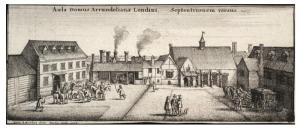
We have already discussed the racehorse prints.  The Modigliani will reappear later in Dance in more detail; we will explore it then. The engraving is of Glimber, the large seventeenth-century home, which Stringham’s mother owned as a life estate from her first husband.

Arundel House for the N. Wencelaus Hollar engraving, 9 X 20 cm The Wencelaus Hollar Digital Collection, The University of Toronto

Arundel House fromthe N.
Wencelaus Hollar
engraving, 9 X 20 cm
The Wencelaus Hollar Digital Collection, The University of Toronto

Wenceslaus Hollar (1607-1677) was a Bohemian artist, etcher, engraver, and cartographer who came to England in 1636 in the retinue of Lord Arundel, whom he had met that April in the Rhineland. Arundel was one of the greatest art collectors of the seventeenth century and became Hollar’s patron; for a time Hollar was drawing master to the Prince of Wales, later Charles II. John Aubrey, whom Powell wrote about in John Aubrey and His Friends (1948), described Hollar as a “very friendly good-natured man as could be, but Shiftless to the World, and dyed not rich.”  His etchings and engravings show a wide range of subjects in photographic detail; we agree with Powell, who regarded him as an “astonishingly accomplished” artist. [SPA… 182-184]

As for the comic steeplechase scene, we have actually found a Currier and Ives print that matches the description.  Currier and Ives were prolific popularizers of art during the Victorian era, producing nearly 7500 lithographs from their New York presses between 1834 and 1907.  They sold their work through diverse outlets, including a London office, where Stringham’s family might have bought the print shown below.

Steeplechase Cracks Currier and Ives Hand colored lithograph 14 X 9.75 inches photo from website of the Springfield Museum

Steeplechase Cracks
Currier and Ives
Hand colored lithograph
14 X 9.75 inches
photo from website of the Springfield Museum

Posted in Uncategorized | 3 Comments

Braque and Dufy

When Jenkins first met Lady Anne Stepney in the late 1920s, Botticelli seemed to be the limit of her knowledge of art. However, by 1933,  Stringham, speaking of his ex-sister-in-law, says: “I heard by the way, that Anne had got a painter of her own by now, so perhaps even Braque and Dufy are things of the past. ” [ AW 208/199]  However, Stringham did not know the latest: Anne had moved on from her affair with Barnby and was now married to Dicky Umfraville.

Boats in Martigues Raoul Dufy, 1908

Boats in Martigues
Raoul Dufy, 1908  
 27 X 22 in.
 Courtauld Institute of Art, London, UK
from Wikipainting.org  
This artwork may be protected by copyright.

Port of La Ciotat Georges Braque, 1907 26 x 32 in <br />private collection  <br />from Wikipainting.org <br />This artwork may be protected by copyright.
Port of La Ciotat
Georges Braque, 1907 26 x 32 in private collection from Wikipainting.org This artwork may be protected by copyright.

Anne came to Braque and Dufy a bit late. Both were renowned by the first decade of the twentieth century. Braque (1882-1963) exhibited with Fauvists in 1905 and beginning in 1909, worked closely with Picasso, developing Cubism; at times they painted side by side.

Dufy (1877-1953) was also influenced by the Fauvists and later by the Cubists on the way to developing his own richly colored style. Dufy and Braque were friends from their youth in Le Havre, and we have chosen these two examples from their extensive portfolios, because they were done around the time that they were painting together in l’Estaque, in the sixteenth arrondissement of Marseille, a time when their reputations were growing, long before Anne Stepney cared about them.

Posted in Uncategorized | 2 Comments

Chardin

When Nick meets the truculent, self-styled “art student” Anne Stepney at Foppa’s, Anne surveys Foppa and his card-playing companion and remarks, “‘I always think people playing cards make such a good pattern.’
‘Rather like a Chardin,’ I suggested.
‘Do you think so?’ she replied, implying contradiction rather than agreement.
‘The composition?’
‘You know I am really only interested in Chardin’s highlights,’ she said.” [AW 158/150]
Jean Baptiste Simeon Chardin (1699-1779) was a Parisian painter of humble origins who rose to become one of the most reliably esteemed exhibitors at the Salons of the Academy des Beaux Arts.  His work includes many scenes of bourgeois domestic life, notable for their rather stiff and hieratic figures, which contrast markedly with their relaxed pictorial forebears in 17th century Dutch domestic scenes.  Nick’s comment to Anne Stepney suggests that card players were favored subjects of Chardin, but they are few and solitary in his work.  Pictured here is Chardin’s painting of 1737 of a boy building a house of cards. There are other versions of his House of Cards theme at Waddesdon Manor, Buckinghamshire; in the Musée du Louvre, Paris;  and at the National Gallery of Art, Washington. There is also a version thought to be by a copyist from Chardin’s studio in the Uffizi in Florence.
The House of Card Jean-Baptiste-Siméon Chardin, 1737 oil on canvas, 24 x 28 in National Gallery, London photo public domain from Wikipaintings.org

The House of Card
Jean-Baptiste-Simeon Chardin, 1737
oil on canvas, 24 x 28 in
National Gallery, London
photo public domain from Wikipaintings.org

Actually, Chardin’s reputation is built on his still-life paintings, which also were also informed by his understanding of 17th century Dutch paintings, but unlike those inspirations are now widely considered the first truly modern still-lifes.  This is in part because they renounce all symbolism of their Dutch inspirations, and seem simply to revel in the beauty of quotidian stuff, and to interrogate the miracle of seeing.  Anne is being contrary when she professes interest only in Chardin’s highlights, but looking at the reproduction below of his 1728 still-life with a dead ray, one has to admit she has a point.

The Ray or The Kitchen Interior Jean-Baptiste-Simeon Chardin, 1728 58 x 45 in Musée du Louvre,, Paris photo public domain from Wikipaintings.org

The Ray or The Kitchen Interior
Jean-Baptiste-Simeon Chardin, 1728
58 x 45 in
Musée du Louvre,, Paris
photo public domain from Wikipaintings.org

Posted in Uncategorized | Leave a comment

Degas and Guys

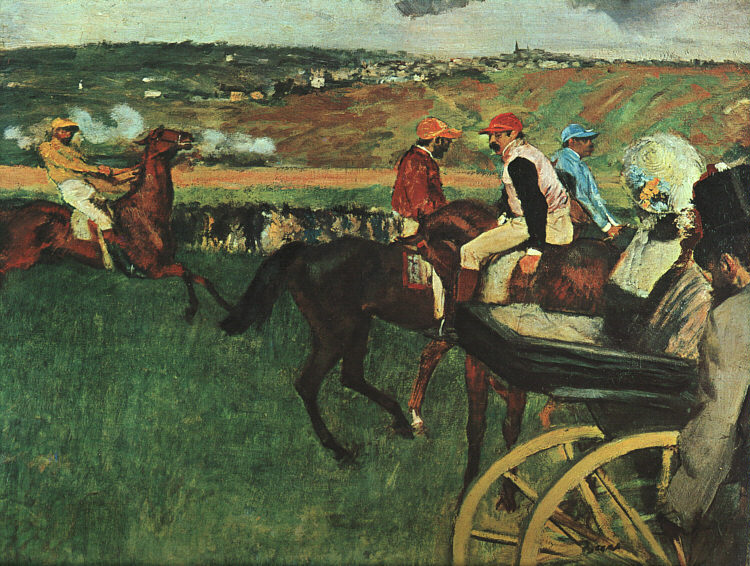
At Foppa’s club, Foppa himself is no less handsomely turned out than Victor Emmanuelle II, but in the finely tailored suit and shoes of an urban dandy.  Foppa is fond of trotting races and the gambling that attends them.  “Hanging behind the bar was a framed photograph of himself, competing in one of these trotting events, armed with a long whip, wearing a jockey cap, his small person almost hidden between the tail of his horse and the giant wheels of the sulky.  The snapshot recalled a design of Degas or Guys.”  [AW 154/146]
To our eyes, Nick’s allusion to Degas and Guys in the same breath seems an uncharacteristic  aesthetic imprecision on Powell’s part here, considering the vast differences in the compositions of those two artists.  Constantine Guys (1802-1892) was a Dutch-born reporter and illustrator, first of military campaigns, and later of fashionable Parisian society.  Baudelaire said of Guys, ” He has gone everywhere in quest of the ephemeral, the fleeting forms of beauty in the life of our day, the characteristic traits of which, with the reader’s permission, we have called ‘modernity.'” (Charles Baudelaire, The Painter of Modern Life , c.1860)  Insofar as Guys turned his attention to quotidian scenes of the city, he shared an agenda with many of his better-remembered contemporaries, Degas and Manet among them, known now as Impressionists.  But unlike the compositions of those other artists, those of Guys are somewhat slapdash affairs in pen-and-ink and watercolor, notable for their reportorial content, less so for their aesthetic appeal.  Pictured here is Guys’ “Carriage and Three Gentlemen on Horses,”  full of movement and interest,  but none too finely wrought.
Carriage and Three Gentlemen on Horses Constantin Guys, 1860 photo public domain from Wikimedia Commons

Carriage and Three Gentlemen on Horses
Constantin Guys, 1860
ink and wash with watercolor on paper photo public domain from Wikimedia Commons


Edgar Degas (1834-1917) is the universally admired painter of Parisian life, most memorably of the ballet theater and the lives of working women (dancers, laundresses, milliners).  Also among his primary subjects were jockeys, horses and scenes at the races.  These works are thought to be based on photographs Degas himself shot at the races, and they are among the earliest examples we have of such use of photography in painting.  What is so striking about these paintings of Degas is how they introduce us to the aesthetic of the snapshot, where the nominal subjects (famous horses, famous jockeys, the people who massed to see them; cf “The Pharisee”) are displaced or cropped arbitrarily, violating the hierarchical agenda of composition that Degas inherited from Ingres.  What replaces that agenda in Degas’ compositions is our enhanced ability to see arbitrary but beautiful shapes (a horse’s rear end, half a top hat) in dynamic relationships that only the painting can slow us down enough to appreciate.  Consider this reproduction of Degas’ “At the Races” of 1880, now at the Musee d’Orsay.  Nothing slapdash here.
At the Races Edgar Degas, ~1877-1880 oil on canvas, 26 x 32 in Musee d'Orsay, Paris photo in public domain from Wikimedia Commns

At the Races
Edgar Degas, ~1877-1880
oil on canvas, 26 x 32 in
Musee d’Orsay, Paris
photo in public domain from Wikimedia Commons

Posted in Uncategorized | Leave a comment

Bakst

At Foppa’s Club, Nick surveys the scene:  “The Walls were white and bare, the vermouth bottles above the little bar shining out in bright stripes of colour that seemed to form a kind of spectrum in red, white and green.  These patriotic colors linked the aperitifs and liqueurs with the portrait of Victor Emmanuel II which hung over the mantelpiece.  Surrounded by a wreath of laurel, the King of Sardinia and United Italy wore a wasp-waisted  military frock-coat swagged with coils of yellow aiguillette.  The bold treatment of his costume by the artist almost suggested a Bakst design for one of the early Russian ballets.” [AW 152/145]

Vittorio Emanuele II di Savoia artist unknown Museo nazionale del Risorgimento, Torino photo public domain from Wikimedia Commns

Vittorio Emanuele II di Savoia
artist unknown
Museo nazionale del Risorgimento, Torino
photo public domain from Wikimedia Commns

Victor Emmanuel II (1820-1878) succeeded his father as King of Sardinia-Piemonte during the tumultuous mid-19th century period of warfare among the many Italian states and their several non-Italian proxies. Victor Emmanuel was effective in the unification movement known as the Risorgimento, and became the first king of the united Italy in 1870. Universally venerated in modern Italy as the father of his country, Victor Emmanuel’s painted and photographed likeness adorns wall wherever Italians gather . This painted portrait, of unknown authorship, omits the laurel wreath but vividly depicts the uniform he is almost always shown wearing.

Léon Bakst (1866-1924), born Lev Samoilovitch Rosenberg, was a Russian Jewish painter whose latter-day fame derives primarily from his career as a set and costume designer for the Ballets Russes under Serge Diaghilev.  Bakst, in collaboration with Diaghilev and the choreographer Fokine, is credited with helping to bring ballet into the modern era, transforming it from a story-telling medium with mime and dance interludes into an integrated theatrical form.  Music, movement, story, and visual design were unified into an expressive whole, in which Bakst’s designs served to add emotional intensity to the language of the body.  Powell wrote of “the implications of irony, disillusionment, cruelty, that add force to Bakst’s Russian Ballet décor.” [TKBR 37] Bakst’s costumes were particularly admired for the lavishness of their color and ornamentation, and their exoticism.  This 1910 costume design for Stravinsky’s Firebird has nothing of Victor Emmanuel’s military air to it, but one can see why the latter’s “wasp-waisted  military frock-coat swagged with coils of yellow aiguillette” brings the Russian designer to Nick’s mind.

Ballet Costume for Firebird Suite Leon Bakst watercolor on paper, 10 X 7 inches The Yorck Project: 10.000 Meisterwerke der Malerei. DVD-ROM, 2002. ISBN 3936122202. Distributed by DIRECTMEDIA Publishing GmbH public domain via Wikimedia Commons

Ballet Costume for Firebird Suite
Leon Bakst
watercolor on paper, 10 X 7 inches
The Yorck Project: 10.000 Meisterwerke der Malerei. DVD-ROM, 2002. ISBN 3936122202. Distributed by DIRECTMEDIA Publishing GmbH
public domain via Wikimedia Commons

Posted in Uncategorized | 1 Comment