Vienna porcelain mixed up with the Meissen

Jenkins encounters Lord Huntercombe at Mrs. Foxe’s reception. They are in the libary where Jenkins had first seen the Romney years before.  Now the copy of Truth Unveiled by Time is on display. After Lord Huntercombe examines it, he “smiles wryly” at Jenkins and shakes his head “as if to imply that such worthless bric-à-brac should not be allowed to detain great connoissuers like ourselves.” [CCR164/168 ] Lord Huntercombe proceeds to inspect the china: “What nice china there is in this house. It looks as if there were some Vienna porcelain mixed up with the Meissen in this cabinet.” [CCR 165/ 169]  The cabinet contains both some Marcolini period and some Indianische Blumen pieces.

The Meissen factory became the first European manufacturer of hard paste porcelain in 1710. The Indianische Blumen or ‘Flowers of the Indies” were designs introduced in the early eighteenth century, adapted from the Kaikemon style of ceramics produced in Arita, Japan. From 1774 until1814 Count Camillo Marcolini, Prime Minister of Saxony, directed the Meissen works as it perfected Neo-Classical forms. The Vienna Porcelain Manufactory, founded in 1718, was the second oldest in Europe.  The company was started by Du Paquier, who ran it until 1744.

Meissen porcelain chocolate pot, cover and stand, c.1780, A Royal Wedding gift to Queen Elizabeth II, 1947 The Royal Collection © 2008, Her Majesty Queen Elizabeth II RCIN 19102

Meissen porcelain chocolate pot, cover and stand, c.1780 (Marcolini Period)
A Royal Wedding gift to Queen Elizabeth II, 1947
The Royal Collection © 2008,
Her Majesty Queen Elizabeth II
RCIN 19102


Meisen vase circa 1730 photographed at Musee des Arts Decoratifs, Paris by  Johann Gregorius Höroldt from Wikimedia.org by Creative Commons license

Meissen vase, Indianische Blumen
circa 1730
photographed at Musee des Arts Decoratifs, Paris by Johann Gregorius Höroldt
from Wikimedia.org by Creative Commons license

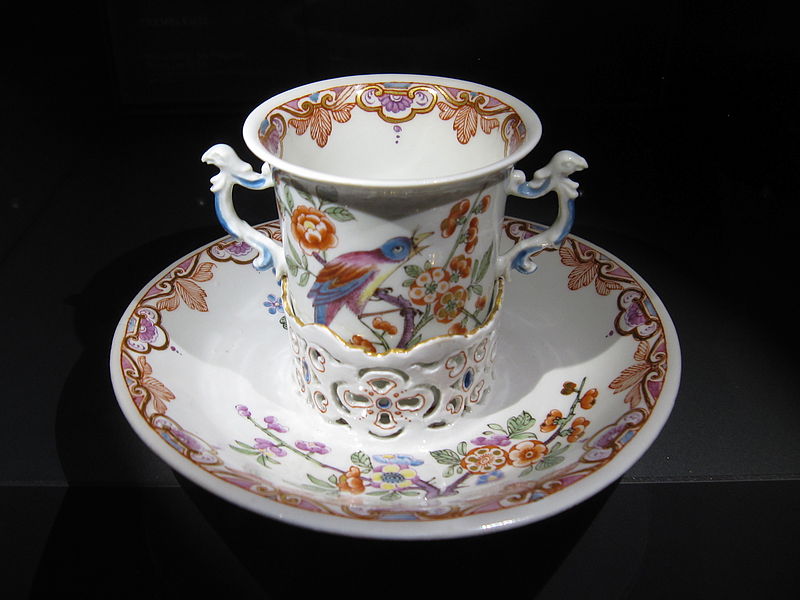
Trembleuse Manufactory of du Paquier. Vienna, around 1730. Collection of the Prince of Liechtenstein, Vaduz-Vienna. photo  by Griyfindor from Wikimedia.org by Creative Commons license

Trembleuse
Vienna Porcelian Manufactory , around 1730 (Du Paquier Period). Collection of the Prince of Liechtenstein, Vaduz-Vienna.
photo by Griyfindor from Wikimedia.org by Creative Commons license

The manufacturers of the porcelain can be determined by examining the trademarks on the bottoms of the pieces, like the crossed swords of Meisen, which is still in use today.  The marks for Vienna, introduced in 1744 and in use until the company closed in 1864, were variations on a shield, details of which allow dating the era of the manufacture. Distingushing real from forged marks is a task for experts. Undoubtedly, Lord Huntercombe was confident that he was up to the task.

Posted in Uncategorized | 1 Comment

Chabrier and the Impressionists

Moreland peruses a book while visiting the Maclintick’s apartment: “The life of Chabrier is enjoyable…. Why wasn’t one a nineteenth century composer living in Paris and hobnobbing with the Impressionist painters?” [CCR 108/]

The Orchestra at the Opera Edgar Degas Circa 1870 Oil on canvas 26 x 18 in  Paris, Musée d'Orsay photo in public domain from Wikimedia. org

The Orchestra at the Opera
Edgar Degas
Circa 1870
Oil on canvas
26 x 18 in
Paris, Musée d’Orsay
photo in public domain from Wikimedia. org

The French composer Alexis-Emannuel Chabrier (1841-1894) merits mention in our blog because of his close relationship to many of the Parisian Impressionists. Degas knew him well; in this picture of the orchestra at the Paris Opera, Chabrier is shown from the back, seated in his box.

Emmanuel Chabrier Edouard Manet, 1880 oil on canvas, 22 X 14 " Ordrupgaard Museum, Denmark photo public domain from Wikimedia.com

Emmanuel Chabrier
Edouard Manet, 1880
oil on canvas, 22 X 14 “
Ordrupgaard Museum, Denmark
photo in public domain from Wikimedia.org

Edouard Manet did at least two portraits of his friend Chabrier, who was with Manet when he died in 1883. When Chabrier’s art collection was sold in 1896, it included works by Cézanne, Manet, Monet, Renoir, and Sisley.

Posted in Uncategorized | Leave a comment

Images — Goya’s Winter

Jenkins is speaking with his brother-in-law, Robert Tolland, who says while playing a record, “I love Les Parfums de la Nuit. I think that really is the bit I like best.”

The passage continues with Jenkins asking, “‘ Do you adapt your music to the foreign news, Robert?’

‘Rather suitable isn’t it? Now the Alcazar has been relieved things seem to have become a bit static. I wonder who will win?’

He closed the lid of the gramophone, which began once more to diffuse the sombre menacing notes adumbrating their Spanish background: … ”  Jenkins proceeds with a concatentation of phrases evoking Spanish scenes [CCR 64/63].

Debussy’s Les Parfums de la Nuit is one of the sections of Iberia, which Debussy wrote between 1905 and 1908. He called this type of orchestral composition Images and intended to evoke a montage of visions of Spain.  Debussy made only a single brief visit to Spain, but he was able to use rhythm from Spanish dances and instruments like guitar and castanets to set the Iberian scene. We will present thumbnails to help envision just a few of the images that the music brought to Jenkins imagination. (If you want to listen to the piece while reading, it is available on YouTube, like this version conducted by Toscanini.)

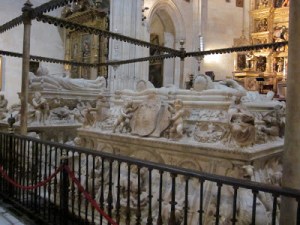
“marble sacrophagi of dead kings under arabesqued ceilings”

Sarcophagi of  King Ferdinand and Queen Isabella and King Philip I and Queen Joanna, Capilla Real, Alhambra, Granada, Spain,  photo from blog Seville Engineer

Sarcophagi of King Ferdinand and Queen Isabella and King Philip I and Queen Joanna, Capilla Real, Alhambra, Granada, Spain,
photo from blog Seville Engineer

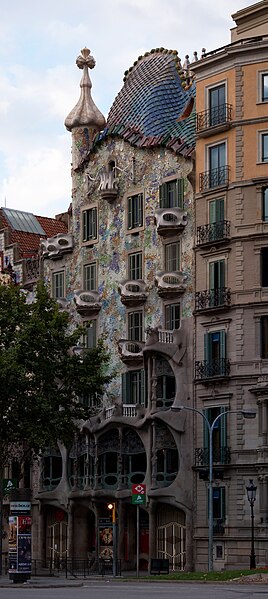
“art nouveau blocks of flats past which the squat trams rattled and clanged”

Casa Batllo, Barcelona Antoni Gaudi,  photo by Massimo Catarinella, 2010, from Wikimedia Commons by Creative Commons attribution

Casa Batllo, Barcelona
Antoni Gaudi, 1904
photo by Massimo Catarinella, 2010, from Wikimedia Commons by Creative Commons attribution

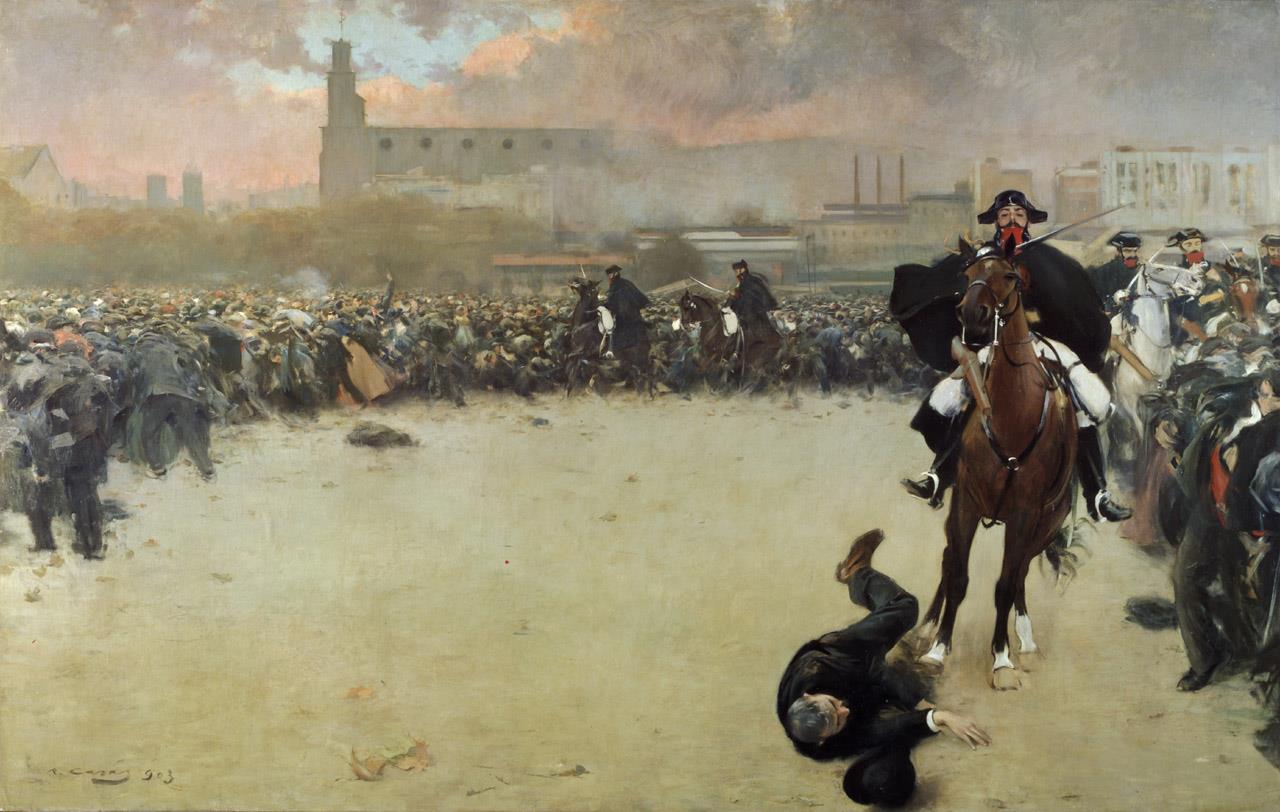
“patent-leather cocked hats of the Guardia Civil”

Charge or Barcelona, 1902 Ramon Casas, 1899 Museu Comarcal de la Garrotxa Olot, Catalunya photo public domain from Wikimedia Commons

Charge or Barcelona
Ramon Casas, 1899
Museu Comarcal de la Garrotxa
Olot, Catalunya
photo public domain from Wikimedia Commons

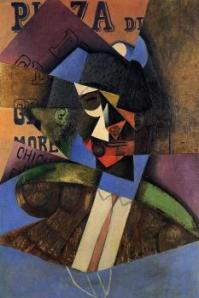
“a hundred other cubist abstractions , merging their visual elements with the hurdy-gurdy music of the bull-ring”

The Bull Fighter Juan Gris, 1913 oil on canvas, 36 X 24 in private collection photo in public domain from The Athenaeum.org

The Bull Fighter
Juan Gris, 1913
oil on canvas, 36 X 24 in
private collection
photo in public domain from The Athenaeum.org

“like the hooded trio in Goya’s Winter, …”

Winter or The Snowstorm Francisco Goya, 1787 oil on canvas, 110 x 117 in Museo del Prado, Madrid photo public domain  from WikiArt.org

Winter or The Snowstorm
Francisco Goya, 1787
oil on canvas, 110 x 117 in
Museo del Prado, Madrid
photo public domain from WikiArt.org

We have already looked at Goya’s Maya Desnuda. In Winter, a study for a tapestry in the royal palace, Goya shows poor peasants struggling through the snow; this is considered one of Goya’s more compassionate and less somber works; one reviewer even saw it as lighthearted.

In this passage, Powell writes rhythmically and lyrically to respond to Debussy, using words to recall the music, rather than music to recall the images. This scene is set during the bloody Spanish Civil war, between the  siege of the Alcazar of Toledo, which ended in September, 1936, and Erridge’s departure for Spain.  Powell hears ‘sombre menacing notes’ in the music, yet he chooses to avoid darker references like Goya’s Disasters of War or Picasso’s Guernica (1937).  Instead his words mingle hints of that menace with every day beauties of Spanish life.

Posted in Uncategorized | 1 Comment

Norman Chandler, if painted by Picasso

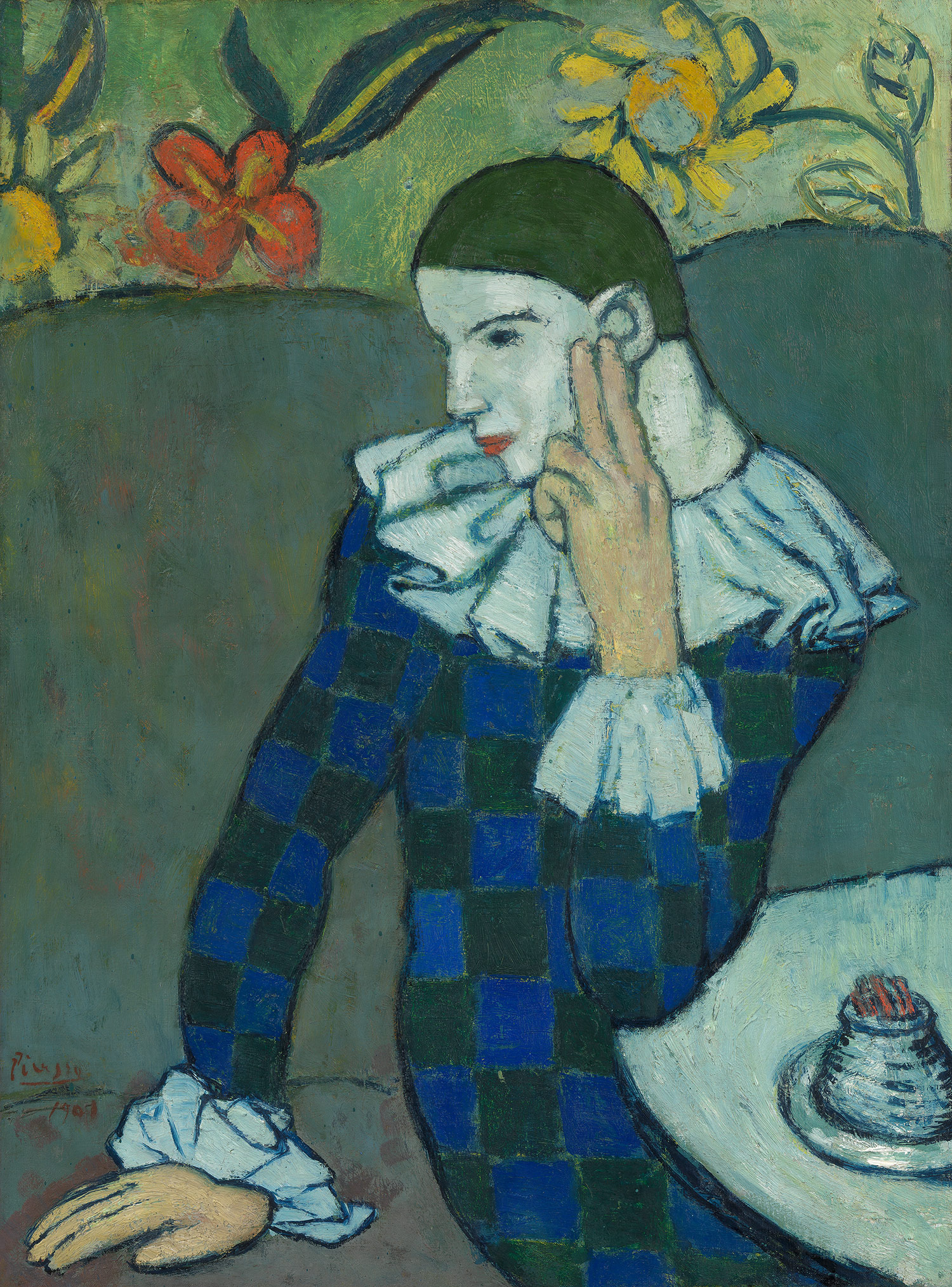
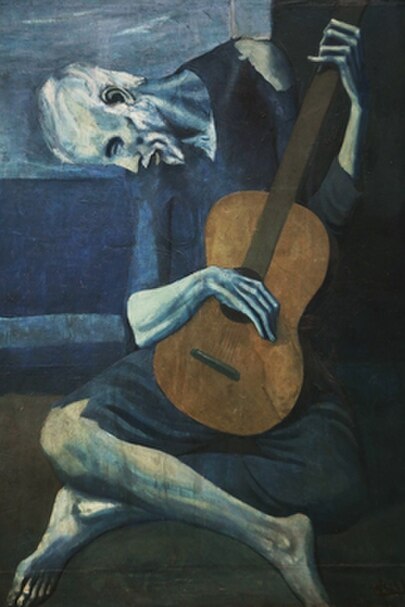
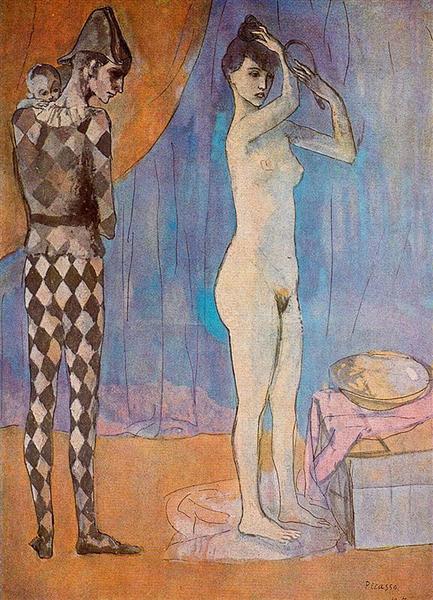
Moreland says of Norman Chandler, “The great artists have always decided beforehand what form looks are to take in the world, and Norman is pure Picasso — one of those attenuated, androgynous mountebanks of the Blue Period, who haven’t had a meal for weeks.” [CCR 55/52-53]  Earlier, Mr. Deacon had introduced him to Moreland and said, “This lad would have made a charming Harlequin.” [CCR 21/13-14]

Powell may have synthesized Norman Chandler from various dancers and actors like Billy Chappell, Frederick Ashton, and Robert Helpmann, all of whom could claim the undernourished appearance.  Similarly, the image that Moreland conjures recalls more than one Picasso painting.

Seated Harlequin Pablo Picasso, 1901 Oil on canvas, lined and mounted to a sheet of pressed cork; 32 3/4 x 24 1/8 in The Metropolitan Museum, New York © 2011 Estate of Pablo Picasso / Artists Rights Society (ARS), New York

Seated Harlequin
Pablo Picasso, 1901
Oil on canvas, lined and mounted to a sheet of pressed cork; 32 3/4 x 24 1/8 in
The Metropolitan Museum, New York
© 2011 Estate of Pablo Picasso / Artists Rights Society (ARS), New York

The Old Guitarist Pablo Picasso, 1903-1904 oil on panel, 48 x 32 in  The Art Institute of Chicago © 2014 Estate of Pablo Picasso / Artists Rights Society (ARS), New York photo public domain is US from Wikipedia

The Old Guitarist
Pablo Picasso, 1903-1904
oil on panel, 48 x 32 in
The Art Institute of Chicago
© 2014 Estate of Pablo Picasso / Artists Rights Society (ARS), New York
photo public domain in US from Wikipedia

During his Blue Period (1901-1905)  Pablo Picasso (1881-1973) often painted those on the edges of society. He had a great love of circuses and portrayed clowns, acrobats (saltimbanques), and other performers, including a number of versions of harlequin. The harlequin above from the Blue Period, his sad, thoughtful expression contrasting with his clown’s costume, catches the androgynous charm that Moreland and Deacon saw.  The Old Guitarist is a more striking example of the attenuated, malnourished look.

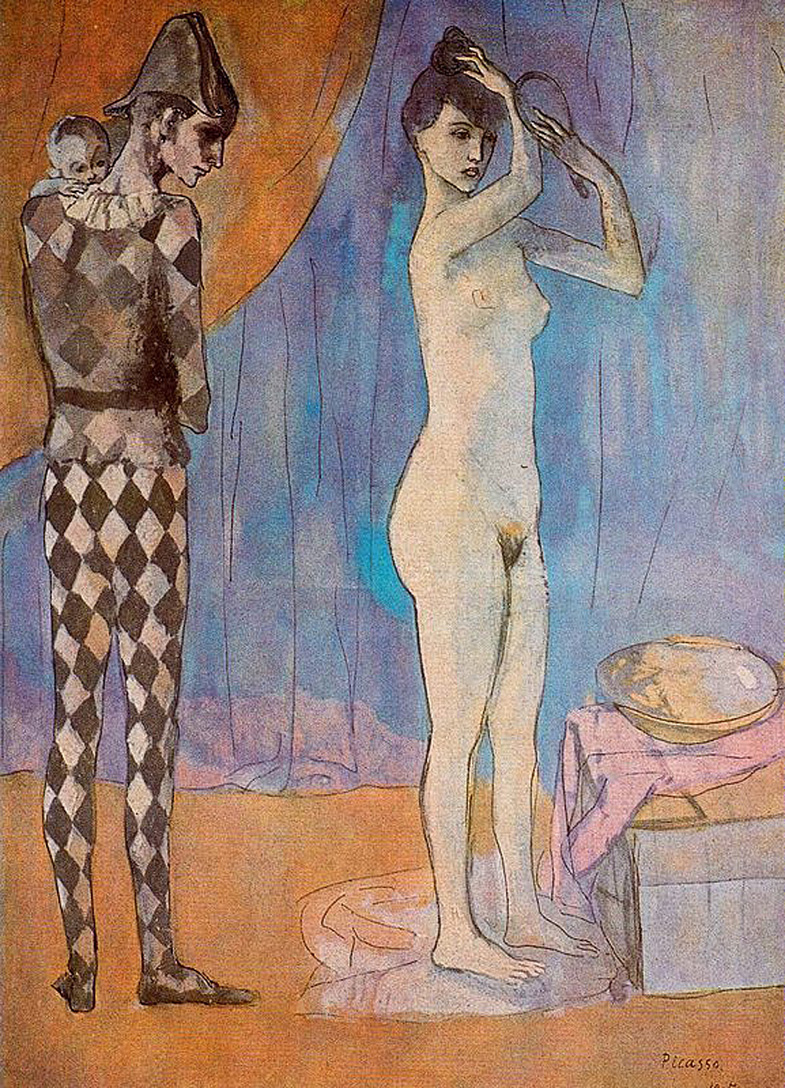
harlequin-s-family-1905.jpg!Large

Harlequin’s Family Pablo Picasso, 1905 India ink, watercolor, paper, 23 x 17 in private collection, photo in public domain in US from Wikiart.org https://uploads7.wikiart.org/images/pablo-picasso/harlequin-s-family-1905.jpg

In Album (p. 87), Lady Violet Powell shows another ‘attenuated, androdynous mounteback,’ selecting the left image from Harlequin’s Family of 1905.

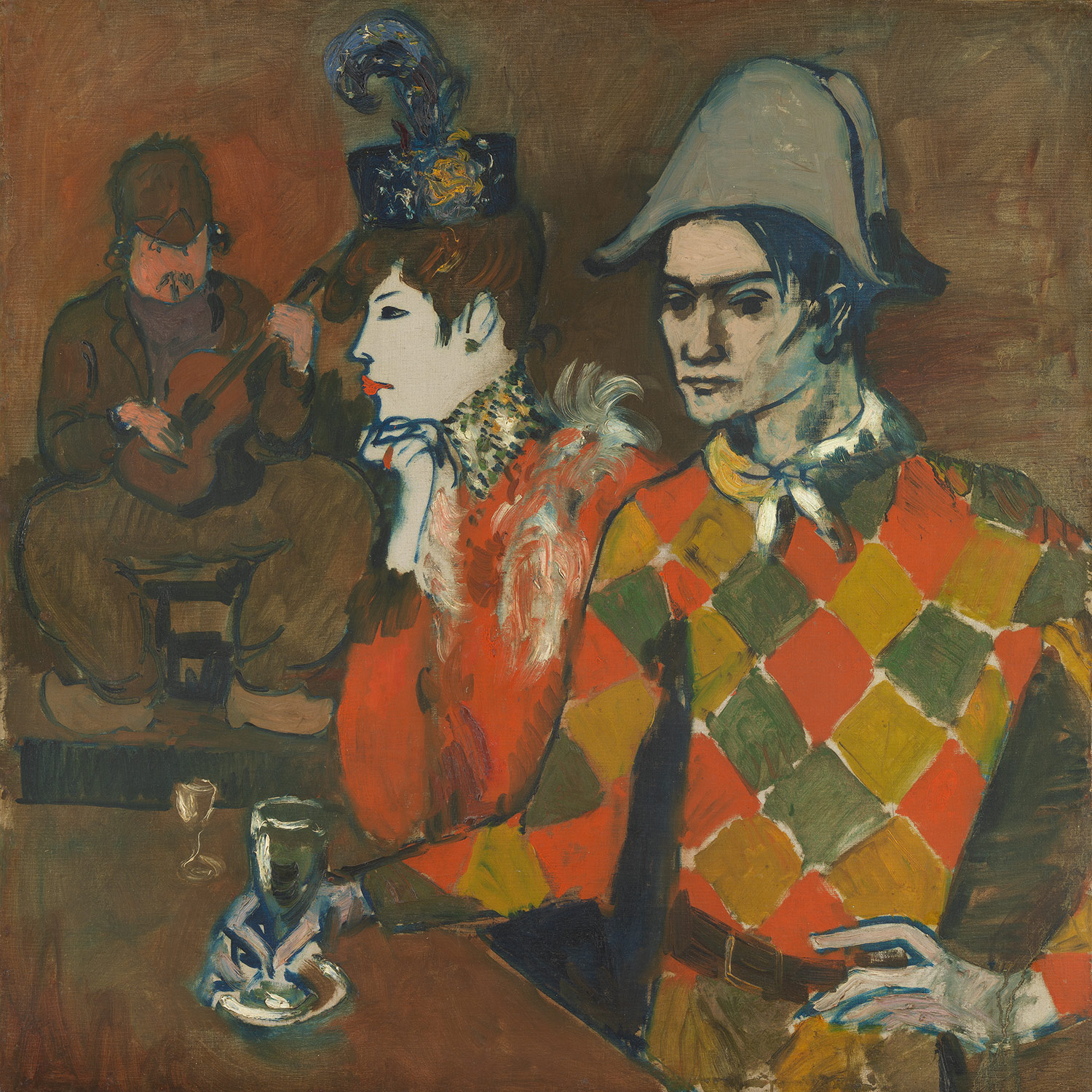
At the Lapin Agile Pablo Picasso, 1905 oil on canvas, 39 x 40 in The Metropolitan Museum, New York © 2011 Estate of Pablo Picasso / Artists Rights Society (ARS), New York

At the Lapin Agile
Pablo Picasso, 1905
oil on canvas, 39 x 40 in
The Metropolitan Museum, New York
© 2011 Estate of Pablo Picasso / Artists Rights Society (ARS), New York

By 1905, Picasso was transforming from his sad blues to the brighter Rose Period. The harlequin, standing at the bar of the Lapin Agile, is a self portrait. The Heilbrunn Timeline of Art History provides an explication of the other characters.

Later in life Picasso reputedly said, “But when I am alone, I do not have the effrontery to consider myself an artist at all, not in the grand old meaning of the word: Giotto, Titian, Rembrandt, Goya were great painters. I am only a public clown–a mountebank.”   The Italian author Giovanni Papini claimed that Picasso told him this in an interview in 1951; however, Picasso did not actually call himself a mountebank. The flamboyant deceiver was Papini; the interview never occurred.

Posted in Uncategorized | Leave a comment

French Eighteenth Century Engravings

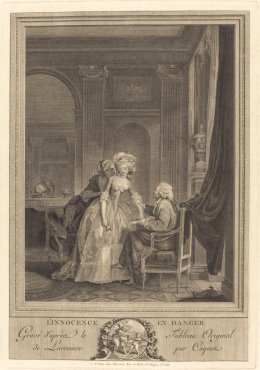
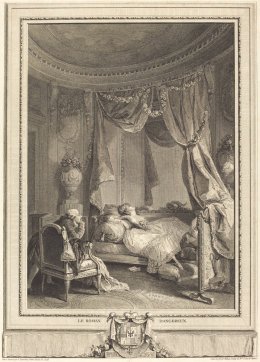
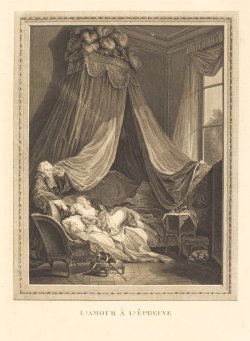
Backstage after The Duchess of Malfi, Moreland takes Nick to meet Matilda in her dressing room.  “The scene was a little like those depicted in French eighteenth-century engravings where propriety is archly threatened in the presence of an amorous abbé or two —powdered hair would have suited Matilda, I thought; Moreland, perhaps, too.” [CCR 52/48]

In eighteenth-century France engraved images occupied a place somewhere between so-called high and low art.  Many engravings were skillful copies of famous paintings, the originals of which were only to be seen in the palaces of the aristocracy.  Engraved copies could be printed in the hundreds and sold at prices that allowed the haute-bourgeoisie to benefit from familiarity with the cultural icons thus depicted, and also display their cultural literacy to visitors.  At the same time, other, less exalted images were created just for the engraving distribution network. These images, drawn, engraved and printed with equal technical finesse, tended toward the didactic and sentimental, and with equal frequency, toward the risqué.  In this way, popular engravings were the forerunner of television programming in their ability to entertain, educate, and titillate a middle-brow audience.


L'innocence en danger Jean Gabriel Caquet after Nicolas Lavreince, 1785 etching and engraving Courtesy of the National Gallery of Art, The Widener Collection

L’innocence en danger
Jean Gabriel Caquet after Nicolas Lavreince, 1785
etching and engraving
Courtesy of the National Gallery of Art, The Widener Collection

La Roman Dangereux Isidore-Stanislas Helman after Nicolas Lavreince, 1781 etching and engraving courtesy of the National Gallery of Art, The Widener Collection

La Roman Dangereux
Isidore-Stanislas Helman after Nicolas Lavreince, 1781
etching and engraving
Courtesy of the National Gallery of Art, The Widener Collection

Archly suggestive scenes of the sort Nick alludes to abound in eighteenth-century French engravings, but we were unable to locate any with the requisite “amorous abbe´ or two.”

L'amour a l'epreuve, Jacques-Firmin Beauvarlet after Pierre-Antoine Baudouin engraving Courtesy of the National Gallery of Art, The Widener Collection

L’amour a l’epreuve,
Jacques-Firmin Beauvarlet (1731-1797) after Pierre-Antoine Baudouin
engraving
Courtesy of the National Gallery of Art, The Widener Collection

Nicolas Delaunay after  L'Epouse indiscrete Pierre-Antoine Baudouin (French, 1739 - 1792 ),  1771, etching Courtesty of theWidener Collection

L’Epouse indiscrete
Nicolas Delaunay after
Pierre-Antoine Baudouin (French, 1739 – 1792 ), 1771, etching
Courtesty of The National Gallery of Art The Widener Collection

Nevertheless, the Widener Collection at the National Gallery of Art in Washington, D.C. has plenty on hand to flesh out our imagination of Matilda’s dressing room, and we reproduce four of them here.


Posted in Uncategorized | Leave a comment

Madonna and Child by Benozzo Gozzoli

In support of the artistic ambitions of her protege Norman Chandler, Mrs. Foxe has invited the Huntercombes to her party.  Lord Huntercombe is regarded as a connoisseur of paintings: “He had caught napping one of the best known Bond Street dealers in the matter of a Virgin and Child by Benozzo Gozzoli (acquired from the gallery as the work of a lesser master, later resoundingly identified) . . . . ” [CCR 140/143]

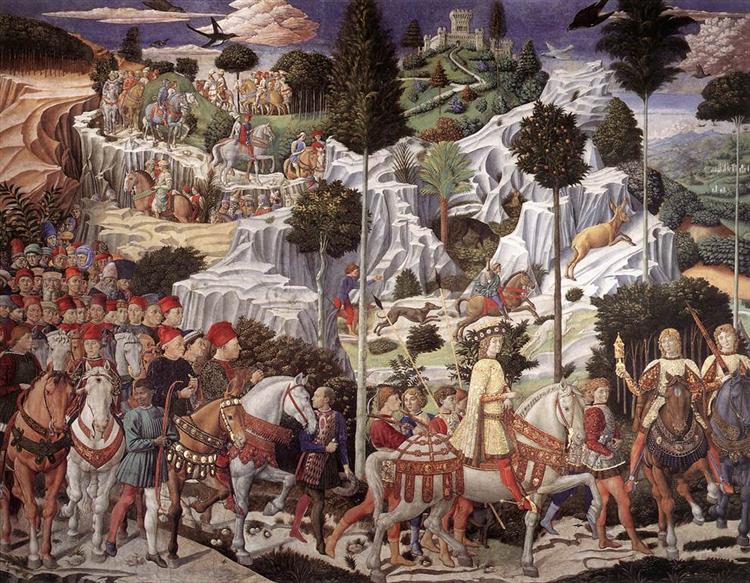
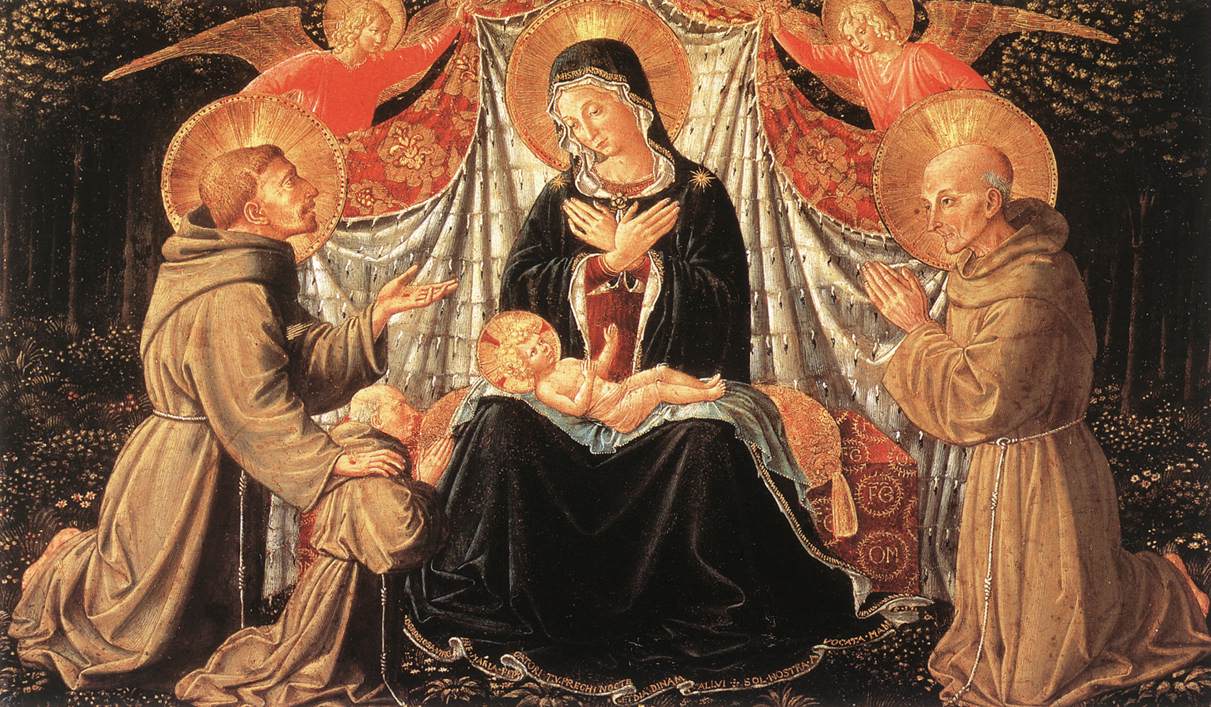
Benozzo Gozzoli (1421-1497) was a Florentine painter of immense output, whose work in fresco and panel painting was commissioned for churches throughout Tuscany,Umbria, Rome, and the Vatican.  Gozzoli was a student of Fra Angelico, whose manner Gozzoli’s early work resembles, but Gozzoli’s long and industrious career saw him though a variety of approaches to image-making, as the examples below suggest.

Procession of the Magus Benozzo Gozzoli, ~1459-1461 fresco, East wall Palazzo Medici – Riccardi, Florence photo public domain from Wikipedia.org

Scenes from the Life of St. Francis Benozzo Gozzolli, 1452 fresco Church of St. Francis Montefalco, Umbria photo public domain from Wikimedia.org

Scenes from the Life of St. Francis
Benozzo Gozzolli, 1452
fresco
Church of St. Francis
Montefalco, Umbria
photo public domain from Wikimedia.org

Madonna and Child with St. Francis and the donor Fra Jacopo da Montefalco and St. Bernardino of Siena  Benozzo Gozzoli, 1452 oil on panel, 13 x 22 in Kunsthistorisches Museum, Vienna, Austria photo public domain from WikiArt.org

Madonna and Child with St. Francis and the donor Fra Jacopo da Montefalco and St. Bernardino of Siena Benozzo Gozzoli, 1452 oil on panel, 13 x 22 in Kunsthistorisches Museum, Vienna, Austria photo public domain from WikiArt.org

Maddona and Child Benozzo Gozzoli, ~1460 tempera on panel, 33 x 20  in Detroit Institute of Art photo public domain from Wikimedia Commons

Maddona and Child
Benozzo Gozzoli, ~1460
tempera on panel, 33 x 20 in
Detroit Institute of Art
photo public domain from Wikimedia Commons


Perhaps it is this variety of styles that accounts for how a knowing amateur like Lord Huntercombe might be able to trump a Bond Street professional in the attribution of a painting by a master so highly regarded.  Two possible models for the Virgin and Child that Lord Huntercombe acquired from the “napping” dealer are small oil on panel (above left), now in the Vienna Kunsthistorisches Museum, or the entirely different different tempera painting on panel (above right), currently in the Detroit Institute of Arts (but for how long?).

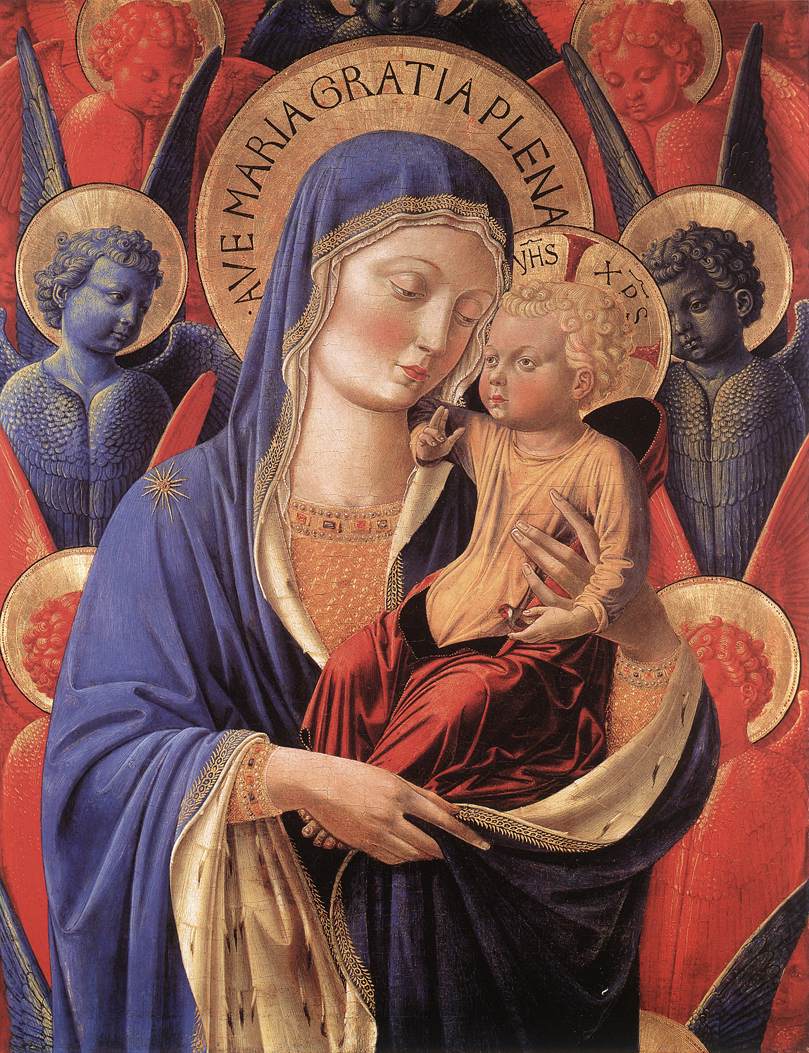
The Madonna and Child with Angels attributed to Benozzo Gozzoli, 1447-1450 Egg tempera on wood, 12 x 9 in National Gallery, London photo from c asa-in-italia.com

The Madonna and Child with Angels
attributed to Benozzo Gozzoli, 1447-1450
Egg tempera on wood, 12 x 9 in
National Gallery, London
photo from c
asa-in-italia.com

But the most likely candidate is the Madonna and Child with Angels in the National Gallery.  Its still slightly uncertain attribution might have been Powell’s inspiration for the Huntercombe anecdote, and its location in London since 1945 makes it the Gozzoli Madonna that Powell’s readers would find most familiar.

Posted in Uncategorized | 1 Comment

Moreland on Women: Lhote, Gleize, Rembrandt, Cézanne

Admiring a waitress at Casanova’s Chinese Restaurant, Barnby proposes to ask her to model for him. Moreland says: “I don’t quite see her in your medium, but that is obviously the painter’s own affair. If I have a passion for anyone, I prefer an academic, even pedestrian, naturalism of portraiture. It is a limitation I share with Edgar Deacon. Nothing I’d care for less than to have my girl painted by Lhote or Gleizes, however much I may admire those painters — literally–in the abstract.”[CCR 39/ ]

L'Escale André Lhote, 1913, oil on canvas, 84 x 74 in, Musée d’Art Moderne de la Ville de Paris public domain in the US from Wikipedia

L’Escale
André Lhote, 1913, oil on canvas, 84 x 74 in, Musée d’Art Moderne de la Ville de Paris
public domain in the US from Wikipedia

André Lhote (1885-1962) was a French artist who began his career as a woodworker and sculptor, experimented with Fauvism. and later adopted Cubism. We think that angularity of the intersecting planes in this work is what Moreland disliked for his women, and he was not necessarily thinking of other works in which Lhote could be more realitstic (see his Nude in the Glasgow Museum.)

Les Baigneuses Albert Gleizes, 1912 oil on canvas, 42 x 68 in Musée d'Art Moderne de la Ville de Paris. photo public domain in US from Wikipedia

Les Baigneuses
Albert Gleizes, 1912
oil on canvas, 42 x 68 in
Musée d’Art Moderne de la Ville de Paris.
photo public domain in US from Wikipedia

Albert Gleizes (1881-1953), like Lhote, was a French painter; his style evolved to Cubism after passing through Impressionist, Post-Impressionist, and Fauvist phases. His book  Du “Cubisme”(1912), written with Jean Metzinger, is now considered the first theoretical description of Cubism, but we do not need the literature on the geometrical explorations of the Cubists to understand Moreland’s love of the natural female form.

Many references to visual art in Dance show how different personalities react to the tension between older and avant-garde art.  Initially, we viewed Moreland’s reaction to Cubism only as another example of this motif; however, after learning Moreland’s views on Rembrandt, we venture an additional interpretation.

Moreland comes back to painterly views of women, which Jenkins reports when they go to meet the beautiful and intelligent Matilda Wilson backstage. “I don’t want what Rembrandt or Cézanne or Barnby or any other painter may happen to want….I simply cling to my own preferences. I don’t know what’s good, but I know what I like– not a lot of intellectual snobbery about fat peasant women, or technical talk about masses or planes. After all, painters have to contend professionally with pictorial aspects of the eternal feminine which are quite beside the point when a musician like myself is concerned. ” [CCR 48-49/ ]
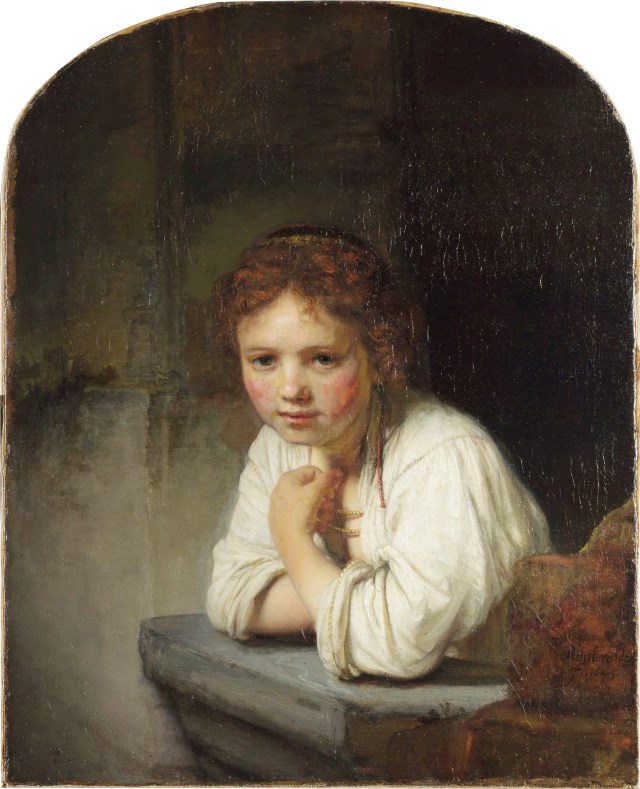
Girl at Window Rembrandt van Rijn, 1645 oil on canvas, 32 x 26 in Dulwich Picture Gallery, London photo public domain from Wikimedia Commons

We need not provide a brief bio of Rembrandt ( 1606-1669), but we do need to reexamine what Moreland is saying when he complains about painters’ depictions of woman. If he is dissatisfied with Rembrandt, his quarrel is not about distortions of woman’s bodies, but rather with the ability of the most talented, psychologically intense, and realistic visual artists to truly convey an understanding of women. The Girl in the Window is so realistic that passersby mistook her for a live woman when Rembrandt displayed her in his own window.  Furthermore, Cézanne, for all his emphasis on building his paintings from basic geometrical forms, painted a woman realistically enough that the viewer could spend hours speculating about her thoughts.

Paul Cézanne  French, about 1895 - 1900  Oil on canvas  36 1/8 x 28 7/8 in. The Getty Center, Los Angeles

Young Italian Woman at a Table
Paul Cézanne
about 1895 – 1900
Oil on canvas
36 1/8 x 28 7/8 in.
The Getty Center, Los Angeles

Moreland says, “With women I can afford to cut out the chiascuro…” Chiascuro refers to using strong contrasts of light and dark to achieve visual emphasis.  Rembrandt followed Carvaggio and DaVinci and did this superbly. The chiascuro in Girl at the Window is not as striking as in many other Rembrandt paintings, but the lighting emphasizes her face, making her both more visible and more enigmatic.

With Moreland’s views, Powell is returning to a theme in Dance, the ability of the writer to delineate personality by following the evolution of a lover (or any other character) over a lifetime. We wonder whether the ‘chiascuro’ should be read as a metaphor for seeing things from just one viewpoint, for highlighting an instant, like a camera would with a flash-lit snapshot; Moreland prefers the time-based dynamism of music.

In AW, Nick argued against Barnby’s contention that that great painters exceed writers as protrayers of women. We have already read that neither an Old Master, nor Rubens, nor Delacroix could capture the changing Jean Templar Duport.  Furthermore, neither the Romans nor the best contemporary sculptors could really get Mona.

We are well aware of the danger of assuming that characters speak for their author. We cannot put Nick’s arguments into Powell’s mouth; however, do we believe that Moreland’s preference for music resonates with The Music of Time, in which the way people change over time is more important than how they seem at a single encounter.

Powell loved visual art. He was a painter before he was a writer (see sidebar Anthony Powell — The Artist as a Young Man ).  His reviews in Some Poets, Artists & ‘A Reference for Mellors’ admire many artists, ranging from Classical to Modern.  In our blog we are emphasizing how references to works of art enrich the work; however, Moreland reminds us that single portraits are only one facet of Dance.
Posted in Uncategorized | Tagged , | 6 Comments

Frescoes at Casanova’s Chinese Restaurant after Watteau

Moreland is explaining the name of Casanova’s Chinese Restaurant:  “There used to be the New Casanova . . . where the cooking was Italian and the decoration French eighteenth century —some way, some considerable way, after Watteau.  Further up the street was . . .Sam’s Chinese Restaurant.  The New Casanova went into liquidation.  Sam’s bought it up . . . so now you can eat eight treasure rice . . . under panels depicting scenes from the career of the Great Lover.” [CCR 32/28]

Of course, the Great Lover whom Moreland mentions is Giacomo Casanova (1725-1798), the Venetian-born adventurer and womanizer whose name is now an eponym for an irresistible, if unreliable, lover.  Casanova’s amorous schemes and intrigues brought him entree to the courts of aristocrats across Europe.  His twelve-volume memoir in French is a prime first-person account of the mores of his time, at least among certain of the higher social strata.

The decorations at the New Casanova in the style of Watteau seem fitting, for though Casanova was born a Venetian, many of his exploits took place in the salons of patrician Paris.  Jean-Antoine Watteau (1684-1721), though he died before Casanova was born, studied painting in Venice and returned to his native France to create an oeuvre that set the tone for virtually all of French painting for the rest of the 18th century.  His work is generally thought of as Rococo, a lighter and more cheerfully decorative evolution of the more ponderous and writhing forms of the Baroque epoch that preceded it.

Watteau is credited with introducing a new subject in serious painting, dubbed  the “fete gallante,” in which elegantly dressed young people disport themselves in beautiful sylvan settings.   Actors, musicians, courtesans and young socialites populate his paintings, engaged in flirtations, assignations, reveries and mutual admiration.  But Watteau’s attitude toward his subjects is rarely satirical, and often sympathetic and affectionate.  He would have been the perfect documenter of the escapades of the irresistible Casanova, had they been contemporaries.

The Scale of Love Jean-Antoine Watteau 1715-1718 The National Gallery, London oil on canvas, 20 x 23 in photo public domain from Wikimedia Commons

The Scale of Love
Jean-Antoine Watteau 1715-1718
The National Gallery, London
oil on canvas, 20 x 23 in
photo public domain from Wikimedia Commons

The painting by Watteau we present here is in the National Gallery in London and is entitled The Scale of Love.  It may look like a scene from ”the career of the Great Lover” that Moreland had in mind, though it is doubtful the proprietors of the New Casanova employed a muralist as talented as Watteau, one of the greatest French painters and draughtsmen of the eighteenth century.


Posted in Uncategorized | Leave a comment

Moreland and Barnby talk Art

About 1928,  Huge Moreland and Ralph Barnby talk about art when they meet at the Mortimer [CCR 30-31].  Moreland said of Barnby: “I can see Ralph has talent…but why use combinations of colour that make you think he is a Frenchman or Catalan?”

Moreland is based on Powell’s close friend, the composer Constant Lambert. Like Moreland, “Lambert loved discussing painters, Böcklin to Braque, Breughel to Brangwyn,…” [TKBR 147]. Powell wrote: “If I have been skillful enough to pass on any echo of Lambert’s incomparable wit, then Moreland is like him;” [TKBR 148] However, Powell also says that although Moreland and Lambert share Bronzino-like features, they are far from identical.

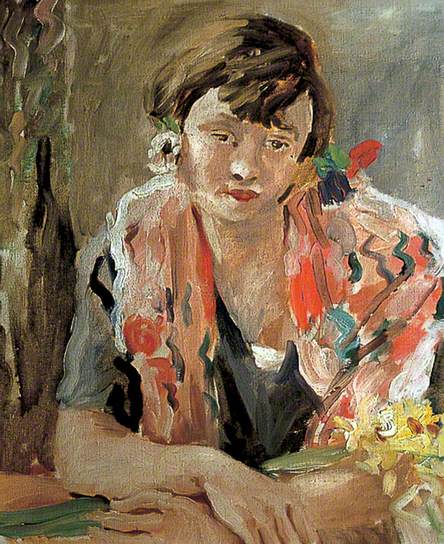
Susan Adrian Daintrey oil on canvas, 22 x 19 in given to the Leeds Art Gallery by Sir J Duveen, 1927 © the artist's estate photo credit: Leeds Museums and Galleries from BBC Your Paintings

Susan
Adrian Daintrey
oil on canvas, 22 x 19 in
given to the Leeds Art Gallery by Sir J Duveen, 1927
© the artist’s estate
photo credit: Leeds Museums and Galleries
from BBC Your Paintings

We have already mentioned that many of Barnby’s characteristics are similar to those of another good friend of Powell, Adrian Daintrey (1902-1988). Daintrey’s first major exhibition was in 1928. His modern heroes were Utrillo, Manet, Derain, and Matisse. As this portrait Susan shows, he did not hesitate to use bright colors.

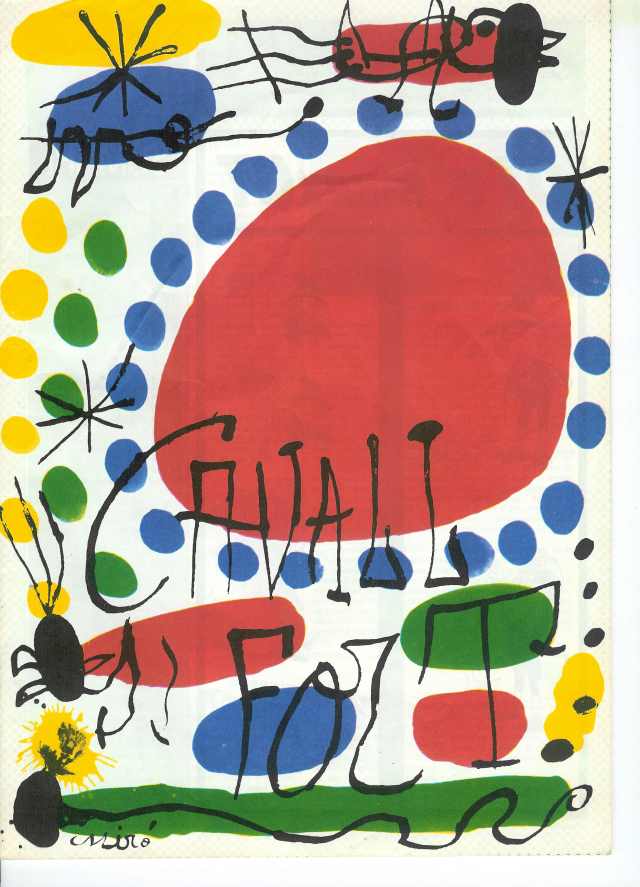
We are guessing that Moreland was thinking of the Frenchman Matisse and the Catalan Miro. When Moreland chides Barnby about his colors, he may be echoing Lambert’s anger about Miro, who was asked to paint the sets for a ballet that Lambert was writing, while Lambert favored his friend Chistopher Wood for the job. [TKBR 146-147]

Miro

Illustration for Cavall Fort, a children’s magazine in Catalan, Joan Miro, photo by Mireia Tremoleda [Public domain], via Wikimedia Commons

Woman with a Hat Henri Matisse, 1905 oil on canvas, 31 x 24 in San Francisco Museum of Art,  ©Succession H. Matisse, Paris / Artist Rights Society (ARS), New York.[1] photo from Wikipedia.org, public domain in US

Woman with a Hat
Henri Matisse, 1905
oil on canvas, 31 x 24 in
San Francisco Museum of Art, ©Succession H. Matisse, Paris / Artist Rights Society (ARS), New York.
photo from Wikipedia.org, public domain in US

Joan Miro (1893-1983) was born in Barcelona, the capital of the Catalan region of Spain, and maintained close ties with his native city. His work is noted for its bright colors, whether in his Fauvist or Surrealist phases or in his more realistic work. In Masaccio to Matisse, we did not show a colorful piece, so to the right is a portrait that illustrates Matisse’s  use of color. Miro and Matisse, as colorists, can be seen as descendants of Van Gogh and Cézanne and ancestors of the Color Field style of abstraction that developed, mostly in the US, in the 1950’s.

Barnby sits down and says he has just been to see ‘the London group;’ he and Moreland proceed to discuss English and, later, Parisian painting.

Rupert Doone (1903–1923), Dancer Nina Hamnett, 1922-1923 oil on canvas, 18 x 12 in Doncaster Museum and Art Gallery © the artist's estate / Bridgeman Images photo credit: Doncaster Museum Service from BBC Your Paintings

Rupert Doone , Dancer
Nina Hamnett, 1922-1923
oil on canvas, 18 x 12 in
Doncaster Museum and Art Gallery
© the artist’s estate / Bridgeman Images
photo credit: Doncaster Museum Service from BBC Your Paintings

The London Group was organized in 1913 by artists, such as the Camden Town Group and the English Cubists, who rebelled against the Royal Academy. The organization is now over a century old, with a constitution and officers, and continues to encourage and exhibit young artists. In their early years, they were champions of Post-Impressionism in Britain. In April and May, 1928 they presented The London Group Retrospective Exhibition at the New Burlington Galleries. A few copies of the exhibit catalog, written by Roger Fry and others, still exist. A number of the London Group artists who showed in that exhibition, such as  Epstein, Sickert, Lewis, and John, are mentioned in Dance and have appeared or will appear elsewhere in our blog.

Nina Hamnett showed a Head of Rupert Doone in the London Group Retrospective of 1928. We have chosen to show her work as an example of what Barnby saw because she also did a portrait of Powell and introduced him to her next door neighbor, Adrain Daintrey (TKBR 137).  The details of her bohemian adventures in the artistic milieus of Paris and London are beyond our scope but are accessible in her memoir Laughing Torso (1932).


Posted in Uncategorized | 1 Comment

Caricatures of Thackery or President Thiers

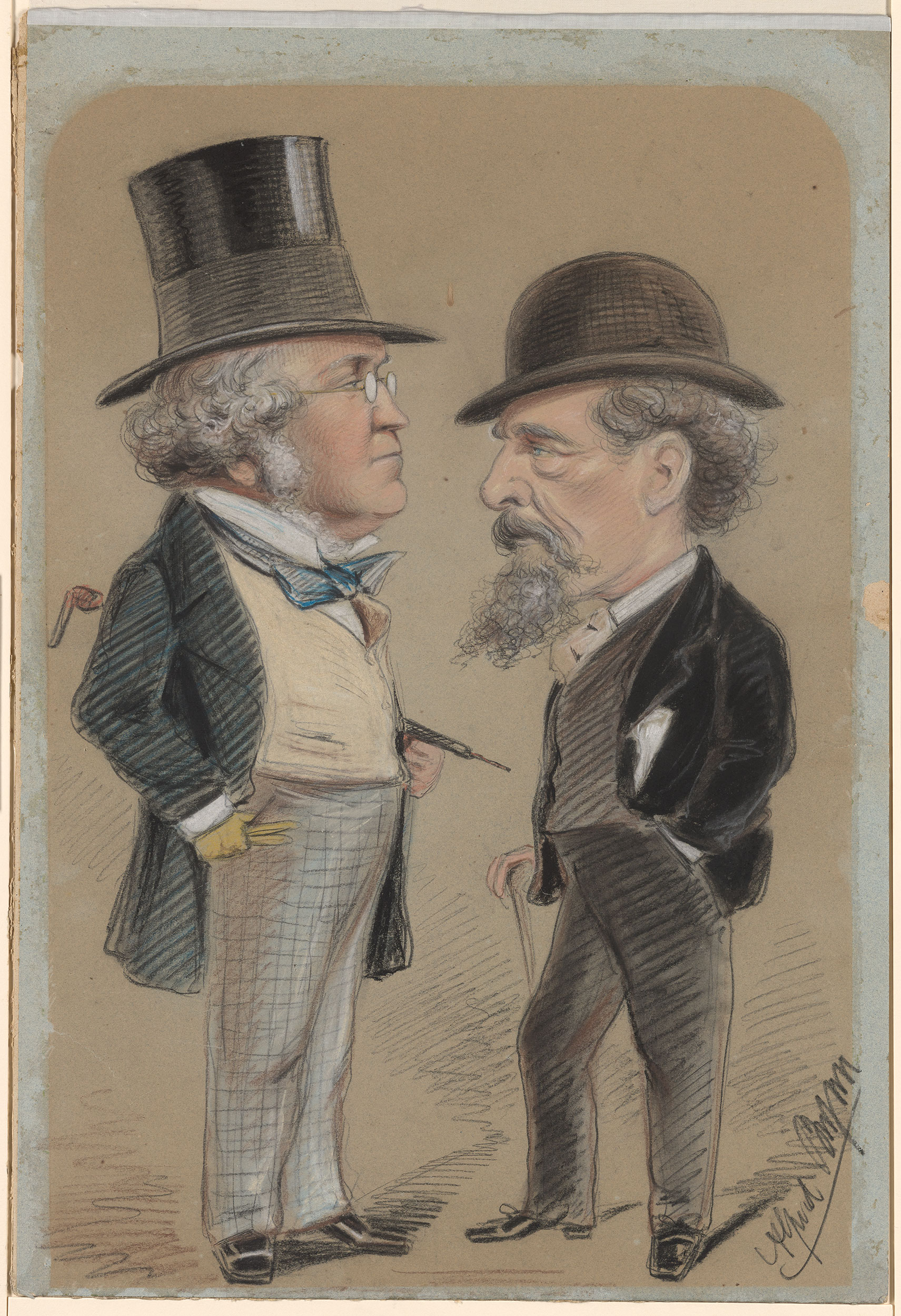
Mingling with the artsy drinkers at the Mortimer, Jenkins describes Maclintick, whose “calculatedly humdrum appearance, although shabby, seemed aimed at concealing bohemian affiliations. The minute circular lens of his gold-rimmed spectacles, set across the nose of a pug dog, made one think of caricatures of Thackery or President Thiers, imposing upon him the air of a bad-tempered doctor. ”  [CCR 22/14]


Caricature of William Makepeace Thackeray and Charles Dickens Alfred Bryan (1852-1899) Charcoal and colored chalks, on blue paper, now faded, mounted on cardboard. 21 3/4 x 14 13/16 in The Morgan Library, New York

Caricature of William Makepeace Thackeray and Charles Dickens
Alfred Bryan (1852-1899)
Charcoal and colored chalks, on blue paper, now faded, mounted on cardboard.
21 3/4 x 14 13/16 in
The Morgan Library, New York

President Thiers Newpaper cover Le Fils  du Pere Duchene Illustre May 3, 1871 from Wikimedia Commons

President Thiers
Newpaper cover
Fils du Père Duchêne Illustré, May 3, 1871
from Wikimedia Commons

Here Maclintick’s bohemianism is contrasted with two establishment figures. Adolphe Thiers ruled France as Prime Minister in 1836, 1840, and 1848 and then as Head of State during the Commune in 1871-3. In this caricature he is shown in an unflattering light, mounted on a snail on his way to Paris, a city in the midst of revolt. The caricature of the great novelists, Thackery and Dickens, contrasts Thackery wearing a top hat, befitting his public school and Cambridge education, to Dickens in a bowler, the hat of the common man.

Posted in Uncategorized | Tagged , | Leave a comment