Veronese at Villa Barbaro

Jenkins recalls his first meeting of Russell Gwinnett: “These banquets were usually linked with some national treasure, or place of historic interest, occasions to some extent justifying the promise of Members that we should ‘live like kings’. . . . Through the medium of one of these jaunts, which took place at a villa on the Brenta, famous for its frescoes by Veronese, Gwinnett and I had met. [TK 24/20]”

The villa in question is the Villa Barbaro, often called Villa di Maser for the village of its location in the Veneto mainland northwest of Venice.  Villa Barbaro is one of the finest creations of the architect and builder Andrea Palladio (Italian 1508-1580), whose masterpieces distinguish the Veneto region.  The originality, beauty, and efficiency of Palladio’s designs, which adopted classical Greek and Roman building vocabulary into a refined Italianate elegance, is hard to appreciate today , simply because Palladio’s influence has so thoroughly permeated the centuries of architecture that followed them.  For example, in America, Thomas Jefferson’s veneration of Palladian design is responsible for the adoption in the 18th century of a neo-Palladian building vocabulary as the official style of the young United States.

Villa Barbaro, front view Andrea Palladio, architect, 1554-1560 Maser, Treviso, Italy photo from Marcok/wikipedia.it.org via Wikimedia Commons

Villa Barbaro, front view
Andrea Palladio, architect, 1554-1560
Maser, Treviso, Italy
photo from Marcok/wikipedia.it.org via Wikimedia Commons


The site of Jenkins’ first meeting with Gwinnett is a villa commissioned of Palladio by the patriarchs of the Barbaro family in the 16th century.  Palladio in turn commissioned the young Paolo Veronese (Italian 1528-1588) to paint a series of frescoes around which six rooms on the piano nobile were designed.  We last read about Paolo Veronese when his name was attached to “the Dogdene Veronese” , a fictitious version of  “The Sacrifice of Iphigenia”.  Veronese’s frescoes at Villa Barbaro are no fiction, however, and proved influential throughout the Veneto for centuries to come.  The various panels wed classical humanist themes with those of Christian devotion,  plus there are portraits of the two Barbaro patriarchs and charming trompe-l’oiel effects of architecture and park-like vistas.

The Cruciform Sala a Crocieta frescos by Paolo Veronese, Villa B photo in public domain from Wikimedia Commons

The Sala a Crociera
frescoes by Paolo Veronese, 1560-1
Villa Barbaro
photo in public domain from Wikimedia Commons

Pictured here are several wall panels in the Sala a Crociera, where Veronese’s sense of invention is evident, as well as his mastery of trompe-l’oiel perspective in both architecture and human figures.
Posted in Uncategorized | Leave a comment

Tiepolo I: Iphigenia

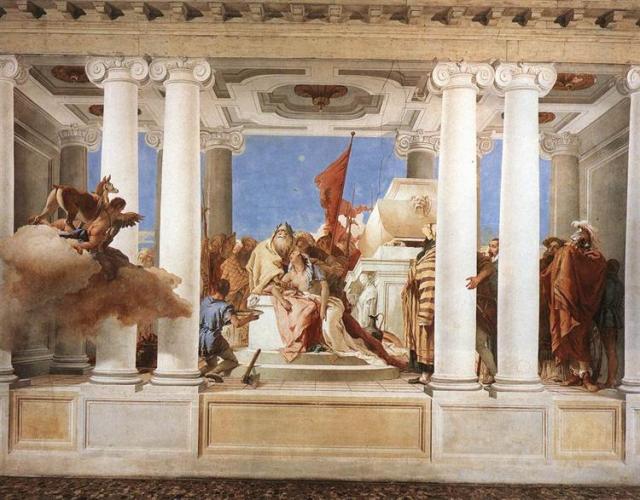
Gwinnett is musing on Iphigenia in Veronese’s depiction of her sacrifice:  “Tiepolo painted an Iphigenia too, more than once, though I’ve only seen the one at Villa Valmarana.” [TK 26-7/23]

This is not the only time that Powell refers to this fictional Veronese (see Constable, Pepys, and Veronese at Dogdene); the Tiepolo, however, is real.

As this is the first of many references to Tiepolo in Temporary Kings, it is worth taking a moment to get acquainted with this pillar of 18th century Venetian painting.  Giovanni Battista Tiepolo (Italian, 1696-1770, also known as Gian Battista or Giambattista) was the son of a middle-class Venetian family and trained from an early age to become a painter in the workshop of Gregorio Lazzarini.  Tiepolo’s early mastery of drawing, design and paint craftsmanship enabled him to strike out on his own and win commissions from the Doge, the church and private aristocratic patrons not only in Venice but throughout the Veneto.

Tiepolo’s subjects include both Old and New Testament scenes, the lives of saints, both Roman and Greek mythology and allegories of the virtues. Though he is not known as a portraitist, he famously included portraits of himself and other notables among the throngs that populate his paintings. Visitors to Venice (including Powell at the 1958 literary conference that gave him the setting for TK [TKBR 419]) marvel at Tiepolo’s majestic and fantastic ceiling frescoes: apotheoses and allegories that transform roofs into celestial panoramas.  His prodigious command of perspective and pictorial organization make his name synonymous with this spectacular Roccoco form.

By the middle of the 18th century Tiepolo’s fame was such that he won commissions for royal residences beyond the Veneto, first in Germany and then in Spain, where he died in 1770.  Among Tiepolo’s nine children, his sons Gian Domenico and Gian Lorenzo also won acclaim as painters and printmakers, but their names are not to be confused with that of Gian Battista Tiepolo, a giant of the age.

Gian Battista may have been the most prolific painter of the sacrifice of Iphegenia. His second best known painting of the sacrifice was for the Palazzo Giustiniani Recanti in Vicenza. One painting of the sacrifice that was once attributed to him is now credited to Gian Domenico.

The Sacrifice of Iphigenia Giovanni Tiepolo, 1757 fresco, 140 x 280 inches Villa Val photo in public domain from WikiArt.org

The Sacrifice of Iphigenia
Giovanni Battista Tiepolo, 1757
fresco, 140 x 280 inches
Villa Valmarana, Vicenza, Italy
photo in public domain from WikiArt.org


Gwinnett recalls Tiepolo’s fresco at Villa Valmarana in Vicenza, west of Venice.  Tiepolo’s Greek classicism here is Roman-flavored in costume and architecture, much favored by Italians of the 18th century. In this depiction, Iphigenia’s father, Agamemnon, stands behind the alter on which his daughter is to be sacrificed to Artemis. That goddess must be placated if winds favorable to Greek ships will blow, allowing them to retrieve the beautiful Helen from her Trojan in-laws.  Iphigenia was said to agree to her own sacrifice for the good of Greek unity, and is revered as a heroine for her courage.  In Tiepolo’s depiction, a putto flutters at the left with a deer in tow, which Artemis will substitute for Iphigenia at the last minute, whisking the girl off to become a priestess of Artemis’ cult.

Tiepolo’s painting of this drama is tightly fitted into an orange and blue complimentary scheme in pale values, filling it with sunlight and delicate breezes wafting in off the Adriatic. Though the moral weight of Greek tragedy is certainly in evidence here, Tiepolo’s set design is more of a piece with Greek mythology’s incorporation into Italian opera and its sensuous delights.

Posted in Uncategorized | 1 Comment

The Bucentaur

Jenkins listens to a Venetian singer with Dr. Emily Brightman and reflects:

At the beginning of the century, Marinetti and the Futurists had wanted to make a fresh start — whatever that might mean — advocating, among other projects, filling up the Venetian canals with the rubble of the Venetian palaces. Now, the Futurists, with their sentimentality about the future, primitive machinery, vintage motor-cars, seemed as antiquely picturesque as the Doge in the Bucentaur, wedding his bride the Sea, almost as distant in time; … [TK 8/4]

Zang Tumb Tumb Filippo Tomasso Marinetti, 1914 book cover in public domain from Wikimedia Commons

Zang Tumb Tumb
Filippo Tomasso Marinetti, 1914
book cover
in public domain from Wikimedia Commons

Filippo Tommaso Marinetti (1876-1944) was an Italian poet, editor, and prose author, best known as one of the founders of Futurism.  In 1923, he married the painter Benedetta Cappa. Although he himself was not primarily a visual artist, he wrote poems using “words in freedom (parole in liberta)” to add a second dimension to the power of his work. We have previously quoted the Manifesto of the Futurist Painters. In the passage above, Jenkins is referring to Marinetti’s “Manifesto Against Past-Loving Venice” (1910) in which he advocated “fill(ing) the small, stinking canals with the rubble from the old, collapsing and leprous palaces.

The bucentaur (bucintoro, after a mythical beast half man and half bull) was the Doge’s galley on which he would sail on Ascension Day, leading a procession of boats to a ceremony in which he would wed Venice to the sea by dropping a ring in the water. The last bucentaur was completed in 1729  and pillaged by the French about 1798.

The Departure of the Bucenator for the Lido on Ascension Day Francesco Guardi, ~1776-1780 The Louvre photo in public domain from the Torck projection via Wikimedia Commons

The Departure of the Bucentaur for the Lido on Ascension Day
Francesco Guardi, ~1776-1780
The Louvre
photo in public domain from the Yorck projection via Wikimedia Commons

Francesco Lazzaro Guardi (1712-1793) was a Venetian painter known for his vedute or vistas, large scale cityscapes or seascapes. He created a series of 12 paintings of the bucentaur, ten of which are now in The Louvre.  Guardi rivaled  Canaletto, who also painted the bucentaur, in his portrayals of Venice. Canaletto is known for his accurate, formal and precise depictions of the city. Guardi brought more energy, color, and imagination to his scenes.

Bucentaur's Return to the Pier by the Palazzo Ducale Canaletto, 1727-1729 The Pushkin Museum photo in public domain from the Google Art Project via Wikimedia Commons

Bucentaur’s Return to the Pier by the Palazzo Ducale
Canaletto, 1727-1729
The Pushkin Museum, Moskow
photo in public domain from the Google Art Project via Wikimedia Commons

Of course, Marinetti’s vision of the future has not been fulfilled, and Jenkins could still enjoy the pleasures of Venice. By italicizing the bucentaur, referring us to art works and not just the ship, Powell foreshadows that eighteenth century Venetian painting is an important part of the pleasure of Temporary Kings.

Posted in Uncategorized | 1 Comment

King Cophetua and the Beggar Maid

Jenkins visits Trapnel and Pamela Fitton in their apartment:

He [Trapnel] gave her one of those ‘adoring looks’ that Lermontov says means so little to women. Pamela stared back at him with an expression of complete detachment. I thought of King Cophetua and the Beggar Maid, though Pamela was far from a Pre-Raphaelite type or a maid, and, socially speaking, the boot was, in anything, on the other foot. … All the same, he sitting on the divan, she standing above him, the somehow recalled the picture. [BDFR 205/193]

King Cophetua and the Beggar Maid Edward Burne-Jones, 1884 oil on canvas 1155 x 535 in Tate Britain, London photo in public domain from Google Cultural Institute via Wikimedia Commons

King Cophetua and the Beggar Maid
Edward Burne-Jones, 1884
oil on canvas 116 x 54 in
Tate Britain, London
photo in public domain from Google Cultural Institute via Wikimedia Commons

The painting of King Cophetua and the Beggar Maid by Edward Burne-Jones shows the pose that Jenkins describes.  The painting portrays the myth of an African King choosing a poor girl as his true love.

Her arms across her breast she laid;
She was more fair than words can say;
Barefooted came the beggar maid
Before the king Cophetua.
In robe and crown the king stept down,
To meet and greet her on her way;
‘It is no wonder,’ said the lords,
‘She is more beautiful than day.’

As shines the moon in clouded skies,
She in her poor attire was seen;
One praised her ancles, one her eyes,
One her dark hair and lovesome mien.
So sweet a face, such angel grace,
In all that land had never been.
Cophetua sware a royal oath:
‘This beggar maid shall be my queen!’ (Alfred, Lord Tennyson)

The Beggar Maid of the story, retold by Alfred, Lord Tennyson,  portrayed by other Victorian artists, and referenced in many other novels, is a clear contrast to the fickle and moneyed Miss Flitton.

Posted in Uncategorized | Leave a comment

The Modigliani Drawing

Jenkins and Roddy Cutts return with Widmerpool to his flat. Pamela Fitton is not up and about yet.

Widmerpool glanced around the room and made a gesture of simulated exasperation.

‘She’s been altering the pictures again. Pam loves doing that — especially shifting around that drawing that her uncle Charles Stringham left her.  I can never remember the artist’s name. An Italian.’

‘Modigliani.’ [BDFR 188/176]

We will learn about the travels of this drawing as it accompanies Pamela in her escapades, but in BDFR Jenkins describes it in no more detail [ BDFR  192/180,   204/191,  241/227].  We know the provenance of this drawing back only to the summer of 1933, when Jenkins saw it in Stringham’s flat. Provenance here is not trivial since Modigliani counterfeits are common. The drawing seems incongruous with Stringham’s collection of family memorablia and aristocratic sporting prints.

Modigliani (1884-1920) initially studied in Rome, Florence, and Venice, then moved to Paris in 1906. He reportedly could produce a hundred sketches a day but destroyed or lost many of them. No one knows what became of many that he gave to girl friends.

From 1910 t0 1912 his great love was Anna Akhmatova, a famous Russian ballerina. He drew her at least 16 times, but most of the drawings have been lost. Three, including Kneeling Blue Caryatid,  were shown in 2015 at the Estorick Collection of Italian art in London.

Kneeling Blue Caryatid Modigliani, c. 1911 Blue Crayon, 17 x 11 from www.modigliani_drawings.com

Kneeling Blue Caryatid
Modigliani, c. 1911
Blue Crayon, 17 x 11 in
from http://www.modigliani_drawings.com

photo of poster for Modigliani's only one-man exhibition, 1917 ©Archives Berthe Weill, in public domain from Wikimedia.org

photo of poster for Modigliani’s only one-man exhibition, 1917
©Archives Berthe Weill, in public domain from Wikimedia.org

Modigliani had a remarkable visual memory.  He and Akhamatova visited the Louvre together; then he returned to his studio to draw her, modeled on an Egyptian sculpture of a kneeling Isis.  Modigliani gave this drawing to his friend Dr. Paul Alexandre and its subsequent provenance is well documented, so we know that it was never in Stringham’s possession.

Modigliani’s  only one-man exhibition opened in Paris in December, 1917, but was shut down within in days by the police, who found his nudes obscene.

Modigliani was known for depicting elongated torsos and faces, as shown in the drawing below, which belonged to Sir Jacob Epstein.

Caryatid Modigliani, 1913-14 pencil and blue crayon on paper, 22 x 16 in Garman Ryan Collecrtion, The New Art Gallery, Walsall photo in public domain from Wikimedia.org

Caryatid
Modigliani, 1913-14
pencil and blue crayon on paper, 22 x 16 in
Garman Ryan Collection, The New Art Gallery, Walsall
photo in public domain from Wikimedia.org

Like Toulouse Lautrec, who influenced him artistically, Modigliani abused hashish, alcohol and absinthe; he died penniless of tuberculous meningitis in 1920.  His pregnant mistress, Jeanne Hebuterne, committed suicide a few days later.

Modigliani’s reputation when Stringham would have acquired the work was more for his flamboyant bohemian life style than for his art; however, early in his career his genius was appreciated by British artists of Powell’s set, like Sir Jacob Epstein and Nina Hamnett, whose relationship with Modigliani is the source of many anecdotes.(TKBR 137,  161-2).  Maybe it is these sexy bits that attach Pamela Fitton to the drawing.

Posted in Uncategorized | 1 Comment

The Roosevelt Statue

In the House of Commons, Jenkins and Cutts happen upon Widmerpool, who says:

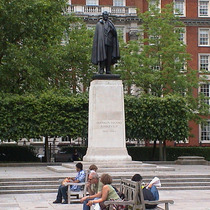
I’m glad to come on you both. First of all, my dear Cutts, I wanted to approach you regarding a little non-party project I have on hand — no, no, not the Roosevelt statue — it is connected with an Eastern European cultural organisation in which I am interested. [BDFR 182-183/171 ]

Franklin Roosevelt SIr William Reid DIck, 1947 photo from londonremembers.com

Franklin Roosevelt
SIr William Reid DIck, 1947
photo from londonremembers.com

There is more than one memorial to President Franklin Roosevelt ( 1882 -1945) in London, but here Widmerpool is undoubtedly referring to the statue in Grosvenor Square, near the American Embassy, that shows Roosevelt standing with a cane.  The memorial was funded in 1946, just about the time of this encounter with Widmerpool, by public subscription. Over six days, 160,000 memorial booklets were sold at five shillings each. The sculptor was Sir William Reid Dick, whom we have previously mentioned as the designer of a memorial to Kitchener. The architect B.W.L. Gallanaugh redesigned Grosvenor Square for the siting.  The work was dedicated December 4, 1948 by Eleanor Roosevelt and King George VI.

Posted in Uncategorized | Leave a comment

Callot-like figures

Jenkins visits his brother-in-law Roddy Cutts at the House of Commons:

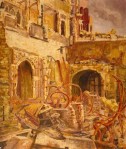
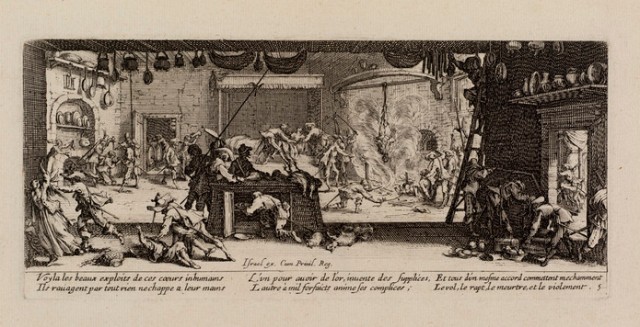
Callot-like figures pervaded labyrinthine corridors. Cavernous alcoves were littered with paraphernalia of scaffolding and ropes, Piranesian frameworks hinting of torture and execution, but devised only to repair bomb damage to structure and interior ornaments. [BDFR 181-2/170 ]

Houses of Parliament Debating Chamber Looking South West, Bomb Damage, 1941 Vivian Charles Hardingham, 1941 oil on hardboard 24 x 20 in Parliamentary Art Collection (c) Palace of Westminster; Supplied by The Public Catalogue Foundation photo from BBC Your Paintings

Houses of Parliament Debating Chamber Looking South West, Bomb Damage, 1941
Vivian Charles Hardingham, 1941
oil on hardboard 24 x 20 in
Parliamentary Art Collection
(c) Palace of Westminster; Supplied by The Public Catalogue Foundation
photo from BBC Your Paintings

The Houses of Parliament were damaged by German bombs on 14 occasions, the worst destroying the Chamber of the House of Commons on the night of May 10-11 1941. When Jenkins visits in 1946, repairs are still in progress.  The architect of the restoration was Sir Giles Gilbert Scott, who also designed the classic British red telephone kiosk. The Chamber did not reopen until October, 1950.

Jacques Callot (1592 -1635) was a printmaker and engraver from the Duchy of Lorraine. He studied in Florence and Rome and made a number of important technical contributions to the art of etching. He produced thousands of preparatory drawings and more than 1,400 etchings, most no more than six inches in greatest dimension.  His precisely drawn figures were rarely more than two inches tall. Among his best known works is a series of 18 etchings, Les Grandes Misères de la Guerre, published in 1633, showing the effect of the Thirty Years War on the populace. We show Le Pilage, plate 5 from this series, even though it shows destruction rather than construction; it is a fine example of Callot’s small, detailed men and women busy in a chamber of horrors.

Le Pillage, Les Misères et les Malheurs de la Guerre (Miseries and Misfortunes of War) Jacques Callot, 1633 etching, plate 3 5/16 x 7 3/8 inches from an Isreali edition shown at the RISD Museum

Le Pillage, Les Misères et les Malheurs de la Guerre (Miseries and Misfortunes of War)
Jacques Callot, 1633
etching, plate 3 5/16 x 7 3/8 inches
printer: Israel Henriet
images from RISD Museum website

Speaking of scaffolding and ropes, pull the image close to study the human carcass suspended over the fire in the background right. Each etching is accompanied by a verse, attributed to Abbé Marolles, describing the abhorent acts.

The Pier of Chains
Plate XVI from Le Carceri d’Invenzione
Giovanni Piranesi, 1761
etching, Sheet- 20 x 30in. ; Plate- 16 x 22in.
image from Los Angeles County Museum of Art via Wikimedia.org

Jenkins has previously evoked Piranesi’s masterful depiction of ruins when he described the rundown precincts of Shepherd  Market.  Here, in the House of Commons, hints of “torture and execution” direct us to another portion of Piranesi’s work,  Le Carceri d’Invenzione. Piranesi published two series of etchings, illustrating his fantasies of prisons (carceri), 14 in 1750 and a reworked series of 16 in 1761.

Here Powell is using visual art at his best. He directs us to powerful, but not universally known, works by Old Masters to create new tropes for contemporary calamity.

Posted in Uncategorized | Leave a comment

Gauguin and Rimbaud

The critic Bernard Shernmaker is teasing Quiggen about his mercenary considerations as editor of Fission:  “Gauguin abandoned business for art, JG, you’re like Rimbaud, who abandoned art for business.” [BDFR 148/138]

Readers probably need no introduction to the painter Paul Gauguin (French 1948-1903), who abandoned his job as a stockbroker (not to mention his failed marriage and five children, abandoned even earlier) in order to pursue his fabled career in painting and printmaking.  Nor is there any work of art to cite here, but it is probably worth mentioning that Gauguin seemed to live prominently in Powell’s imagination.  On the opening page of his memoir, To Keep the Ball Rolling, Powell ponders his own unpromising beginnings thus:  “Why, one wonders, did it all come about?  Like Gauguin’s picture: D’ou´ venon-nous? Que sommes-nous?  Ou´ venons nous?; a journey in my own case, tackled under the momentum of a slow pulse, lowish blood pressure, slightly subnormal temperature.”

Where do we come from? Who are we? Where are we going? Paul Gaugin, 1897 oil on canvas, 55 x 148 in Museum of Fine Arts, Boston photo in public domain from Wikimedia Commons

Where do we come from? Who are we? Where are we going?
Paul Gaugin, 1897
oil on canvas, 55 x 148 in
Museum of Fine Arts, Boston
photo in public domain from Wikimedia Commons

In Gauguin’s masterpiece, now in the Boston Museum of Fine Arts, a slow pulse and lowish blood pressure seem to be the perks of an idyllic island existence that Gauguin helped mythologize.

Arthur Rimbaud (French 1854-1891) began his career as a precocious poet wunderkind and precursor of Symbolism and Surrealism, and ended it as a coffee merchant in the Middle East.  His name also appears in Powell’s memoir, but perhaps only as a reminder of Powell’s omniverous reading habits and deep cultural literacy.

Posted in Uncategorized | 2 Comments

Toulouse Lautrec

Jenkins, talking with Rosie Manasch about the sale of Donners’ pictures by his widow, observes, “If I’d been Matilda, I’d have kept the Toulouse Lautrec.” [BDFR 109/ 101]

Rosie replies:

Do you realize that a relation of mine — Isadore Manasch — was painted by Lautrec? A café scene, in the gallery at Albi. Isadore’s slumped on the chair in the background. [BDFR 110/ 101]

Portrait of Monsieur Delaporte in the Jardin de Paris Henri de Toulouse-Lautrec, 1893 painting Ny Carlsberg Glyptotek - Copenhagen photo in public domain from Wikimedia Commons

Portrait of Monsieur Delaporte in the Jardin de Paris
Henri de Toulouse-Lautrec, 1893
painting
Ny Carlsberg Glyptotek – Copenhagen
photo in public domain from Wikimedia Commons

Henri de Toulouse-Lautrec (1864-1901) was born in Albi in southern France. He broke both legs as a teenager due to a bone disease and grew to only 5’1″ with a full sized trunk on pathologically shortened legs. He painted in brothels,  nightclubs like the Moulin Rouge, and other parts of Montmarte. Jenkins’ admiration for Toulouse-Lautrec was shared by Powell, who described “his power to impart, by wit, flourish, a sense of design, beauty and universality to themes in themselves sinister and tawdry.” [TKBR 363]

We have not been able to fully explore the collection of the Musée Toulouse Lautrec, founded in Albi in 1922; the man whom we show slumped in a chair is Monsieur Delaporte rather than Isadore Manasch.

Jenkins imagines Rosie as a model for Lautrec:

At forty or so, she herself was not unthinkable in terms of Lautrec’s brush, more alluring certainly than the ladies awaiting custom on the banquettes of the Rue des Moulins, though with something of their resignation. A hint of the seraglio, and its secrets, that attached to her suggested oriental custume in one of the masked ball scenes. [BDFR 110/ 101]

Au Salon de la Rue des Moulins Toulouse-Lqutrec, 1894 oil on canvas, 44 x 52 in Musee Toulouse-Lautrec, Albi photo in the public domain via the Yorck Project and Wikimedia Commons

Au Salon de la Rue des Moulins
Toulouse-Lautrec, 1894
oil on canvas, 45 x 53 in
Musee Toulouse-Lautrec, Albi
photo in the public domain via the Yorck Project and Wikimedia Commons

Respite during the Masked Ball Toulouse-Lautrec, 1894 gouache and oil on cardboard, 56 x 39 in Denver Museum of Art photo from National Gallery of Australia

Respite during the Masked Ball
Toulouse-Lautrec, 1894
gouache and oil on cardboard, 22 x 16 in
Denver Museum of Art
photo from National Gallery of Australia

The scene above left probably actually shows a brothel, with interior design perhaps evoking a harem room, at Rue d’Ambroise, not Rue des Moulins. Lautrec favored Mireille, the prostitute in the foreground.

Jenkins describes Rosie as having plump little hands, so perhaps he purposefully chose to compare her to the woman with ample buttocks, shown above right at the masked ball.  The man in the painting, ogling her bottom, is modeled on Lautrec’s cousin. With this caricature, Lautrec is teasing his cousin for behavior much more staid than this own. Powell classed Toulouse-Lautrec among the famous men “whose lives are so picturesque that legend obscures any balanced picture of them…” [SPA 262]. Toulouse-Lautrec died before this thirty-seventh birthday of alcoholism and syphilis, which he purportedly contracted from one of his favorites, prostitute and model Carmen Gaudin, also known as Rosa La Rouge .

Posted in Uncategorized | Leave a comment

Two Tall Oriental Vessels

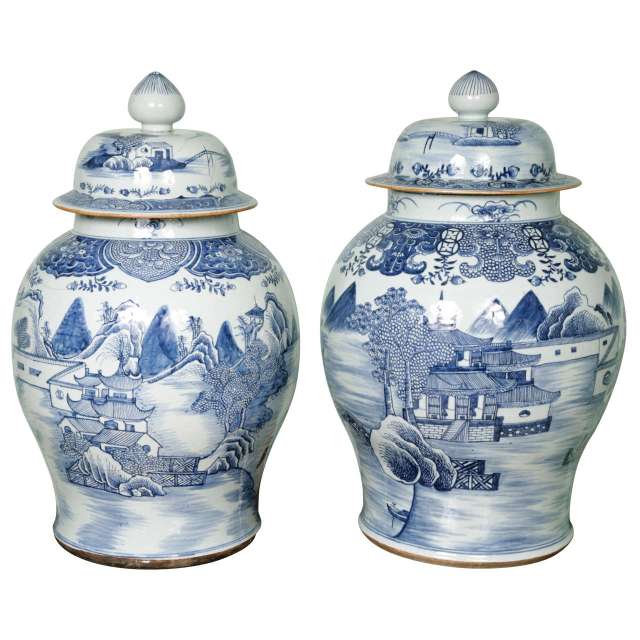
At Thrubworth, after Erridge’s funeral, Pamela Widmerpool is going to be sick and looks about her:  “She glanced round about, her eyes coming to rest on the two tall oriental vessels, which Lord Huntercomb had disparaged as nineteenth-century copies.  Standing about five foot high, patterned in blue, boats sailed across their surface on calm sheets of water out of which rose houses on stilts, in the distance a range of jagged mountain peaks.  It was a peaceful scene, very different from the emergency in the passage . . . .” [BDFR 90/83]

We cannot know the true identity or provenance of these ill-fated vessels, one of which is to become the victim of Pamela’s malevolent malaise, but their type is not hard to imagine.  Since the sixteenth century, the refinement of Chinese porcelain was prized by European collectors and its popularity stimulated the production of decorative styles in China meant for export to Europe.  Among these was the blue and white pictorial style made with hand-painted cobalt oxide pigments in floral/geometric patterns and landscape motifs of the sort Nick describes at Thrubworth.  By the eighteenth century these Chinese exports were so valued by Europeans that several European imitations were introduced, most notably Meissen, Delft and Worcester.

Today, these eighteenth-century European homages to Chinese artistry are themselves highly valued antiques, to be distinguished from successively degraded versions of Chinoiserie that followed from them, ultimately to the ubiquitous willow pattern china to be found in every Chinese restaurant in the land.

Chinese porcelain vases ~ 1760 Height 27" Diameter 16" sold by Horneman Antiques, Ltd.

Chinese porcelain vases
~ 1760
Height 27″ Diameter 16″
sold by Horneman Antiques, Ltd.

No doubt Erridge’s huge urns were distinguished enough in design and manufacture to be taken as eighteenth-century Chinese by all but the eagle eyes of Lord Huntercomb on his visit to Thrubworth [BDFR 74/67]. The vases that we show above are neither floor standing nor as huge as those at Thrubworth, but their landscape decoration nearly matches Nick’s description. Whether they are authentically eighteen-century Chinese as described, or lesser knock-offs of a later era, we leave to the Lord Huntercombs among our readership.

Posted in Uncategorized | Leave a comment