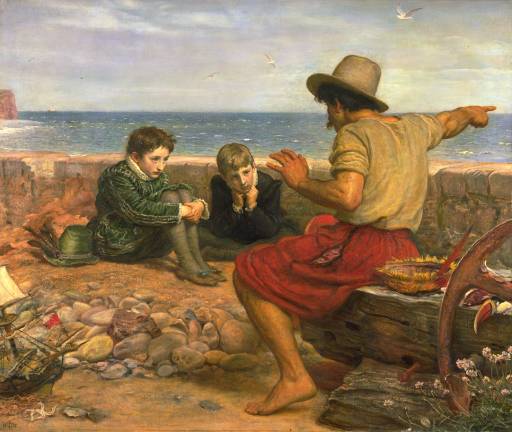
The Boyhood of Raleigh

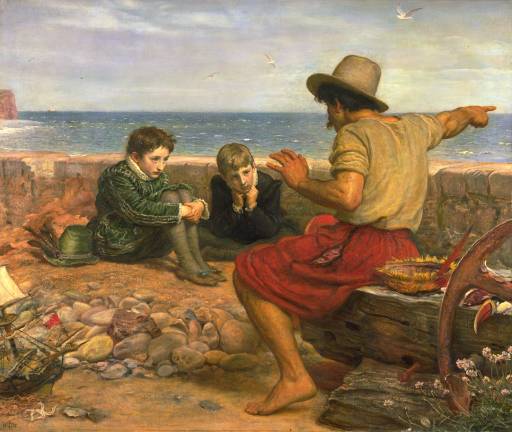
The Boyhood of Raleigh Sir John Everett Millais (1871) Tate Gallery photo from Wikimedia Commons

The Boyhood of Raleigh
Sir John Everett Millais (1871)
Tate Gallery
photo from Wikimedia Commons

When Quiggins arrives at Sillery’s party, the host asks Mark Members to make room for him on the sofa. Members “drew away his legs, hitherto stretched the length of the sofa, and brought his knees right up to his chin, clasping his hands around them in the position shown in …The Boyhood of Raleigh. (QU 174/179)” This picture by Sir John Everett Millais (1829-1896) was a Victorian reminiscence of the great age of British discovery. Supposedly, sailors’ tales that Raleigh heard as a boy inspired him to undertake his famous voyages. The other young boy in the picture is his brother.  Millais’ painting was widely reproduced; a copy hung in the nursery of a furnished house where Jenkins once lived with his parents. The young Raleigh in the picture is wide-eyed, absorbed in the tale; Members, on the other hand, “regarded Quiggins with misgiving.”

Millais was a founding member of the Pre-Raphaelite movement. but by the time he painted The Boyhood of Raleigh, he was more influenced by Old Masters. He painted The Boyhood on location at Budleigh Salterton, near Raleigh’s birthplace, using his sons as models. Millais was a member of the Royal Academy, serving as its president briefly in the year of his death.

Posted in Uncategorized | 2 Comments

St. Laurence and his Gridiron

Jenkins room at Madame Leroy’s had “a picture in cheerful color’s of St. Laurence and his gridiron (QU 110)

Martyrdom of Saint Lawrence, Girolamo da Santacroce, Venice, 1550-1555 - Nelson-Atkins Museum of Art photo by Daderot from Wikimedia Commons

The sole adornment of Nick’s austere apartment at Madame Leroy’s boarding house is “a picture, in cheerful colours, of St. Laurence and his gridiron; intended, perhaps, in jocular allusion to the springs of the bed.”

St. Laurence was a third century A.D. scholar of Spanish origin, appointed deacon of the Church of Rome by Pope Sixtus II. Laurence’s was martyred by being cooked alive on a gridiron, and legend has it that the good-natured saint said, “I’m done on this side, turn me over.” Powell’s choice of St Laurence for Nick’s cell is apt, since Nick immediately cooks a bit on his own grill in an apparent bout of food poisoning.

St. Laurence, the patron saint of cooks, is widely venerated, and many images of his martyrdom have been painted. This particularly cheerfully-colored one by Girolamo da Santacroce of Venice, dates from the mid- sixteenth century.

Posted in Uncategorized | 1 Comment

An Elderly Grognard

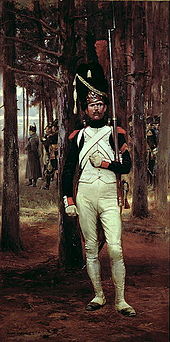
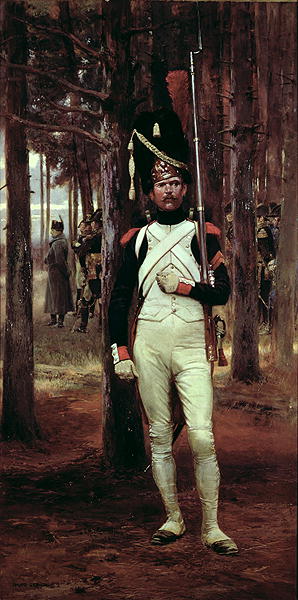
Jenkins, in France for a summer of language study, rides with a taxi driver, who looks like “a Napoleanic grenadier, an elderly grognard … depicted in some academic canvas of patriotic intent” (QU 108).

To envision this French taxi driver, we tried to understand ‘Napoleanic grenadier,’ ‘grognard,’ and ‘academic canvas of patriotic intent.’

Napoleon’s Grenadiers were his Imperial Guard, his most elite troops, and the Grognards were the Old Guard, creme de la creme. There are abundant paintings and prints of these famous troops, but which qualify as academic?

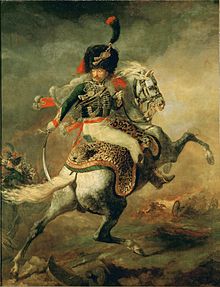
The French Academy of Beaux Artes could trace its orgins to 1646.  Like the Royal Academy in London. it was a bastion of establishment art. In the Napoleonic era it was dominated by the Neoclassicism of artists like Jacques Louis David or Ingres, but more romantic painters like Gericault were also exhibited at the Academy’s Salon.

The Charging Chassuer by Théodore Géricault (1812) Musée du Louvre photo from Wikimedia Commons

The Charging Chasseur
by Théodore Géricault (1812)
Musée du Louvre
photo from Wikimedia Commons

Napleon Crossing the Alps Jacques Louis David (1800) Kunsthistorisches Museum, Vienna photo from Wikimedia Commons

Napleon Crossing the Alps
 byJacques Louis David (1800)
Kunsthistorisches Museum, Vienna
photo from Wikimedia Commons


We can well imagine this Grenadier of the Old Guard, painted by Jean-Baptiste Édouard Detaille (1848 – 1912), spending his older years as a grizzled taxi driver. Detaille had many connections with the French military, growing up in a military family, enlisting during the Franco-Prussian war, painting many  realistic portraits of his compatriots, eventually becoming an official painter of battles, and later designing army uniforms. He earned his academic credentials, exhibiting some of his military paintings in the Salon of the Academy. He actually makes a cameo appearance at a party in In Search of Lost Time, where Marcel identifies him as the painter of Le Reve (The Dream), which shows soldiers encamped and asleep (Karpeles, pp 194-5)

Posted in Uncategorized | 1 Comment

Horace Isbister, R.A.

The fashionable Horace Isbister, R.A., painted Templer’s father:

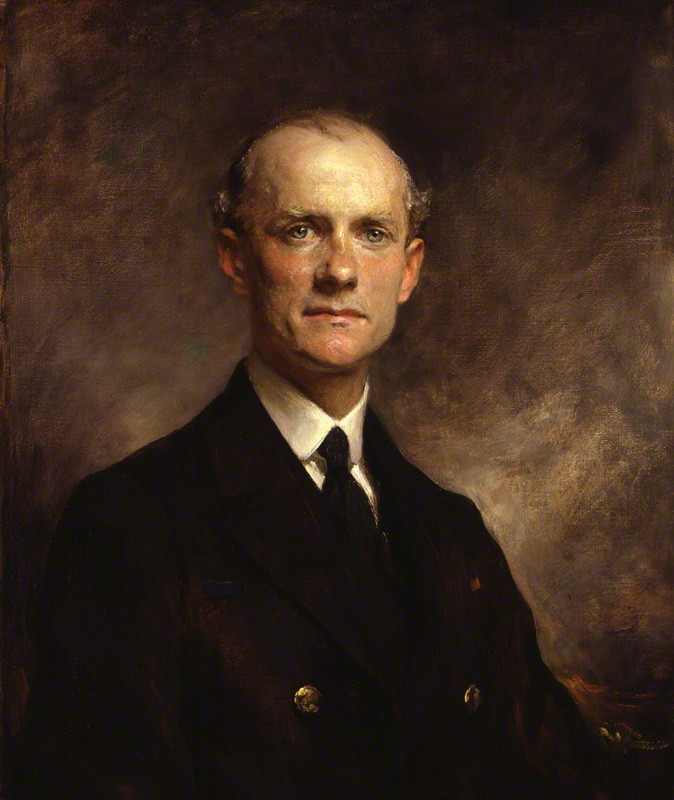
“a portrait of himself hanging on the wall above him –the only picture in the room– representing its subject in a blue suit and hard white collar. The canvas, from the hand of  Isbister,  the R.A., had been tackled in a style of decidedly painful realism, the aggressive nature of the pigment intensified by the fact that each feature had been made a little larger than life. [QU 76/76]”

Alfred Francis Blakeney Carpenter by Sir Arthur Stockdale Cope, oil on canvas, 1918 Bequeathed by the sitter's father, Alfred Carpenter, 1956 NPG 3971 courtesy of the National Portrait Gallery by Creative Commons License

Alfred Francis Blakeney Carpenter by Sir Arthur Stockdale Cope, oil on canvas, 1918
Bequeathed by the sitter’s father, Alfred Carpenter, 1956
NPG 3971
courtesy of the National Portrait Gallery by Creative Commons License

When we first saw the name Isbister, Powell’s first fictional artist, it stirred memories of Elstir, Proust’s paradigm artist among his contemporaries, yet there is no evidence that Powell had Elstir in mind. Others have also speculated about the name: that it derives from a location on Shetland or Orkney; that it memorializes the first British victim of a bomb in World War I; that it recalls another artist Isbister in a story by HG Wells. When asked about this name game during an interview for the Paris Review, Powell just laughed.

Isbister is an olio of artists, but we are not sure of which. One clue is the R.A. that closely accompanies his name. The Royal Academy of Arts in London is an independent group of artists and architects, founded in 1768 by George III, with a self perpetuating membership, currently numbering 80.

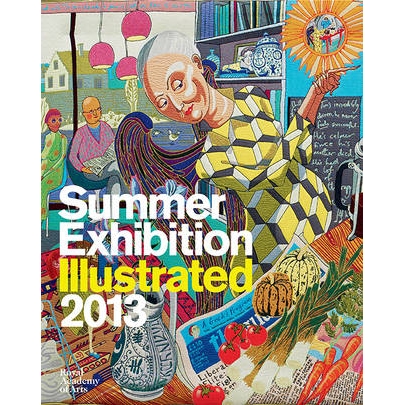
Catalog of the Royal Academy 2013 Summer Exhibition

Catalog of the Royal Academy 2013 Summer Exhibition

The Royal Academy of Arts Collections website lists all current and former members. We have reviewed RA painters born before 1900 and elected to the Royal Academy by 1920 looking for possible models of Isbister. The Royal Academy at that time was known for its inclusion of conservative academicians, occasionally even hacks , but never, by any means, untalented amateurs. However, in the twenty-first century Royal Academy exhibitions are hardly drab or old fashioned.

We suggest that the portrait of Alfred Carpenter by Sir Arthur Stockdale Cope shares characteristics with Isbister’s portrait of Templer. Cope,  like Isbister, was an extremely successful portrait painter. He started exhibiting at the Royal Academy and the Royal Society of Portrait Painters by age 19 and by 1935 had shown 288 works at these institutions. He painted Kings Edward VII, George V, and Edward VIII and many of the rich and aristocratic.

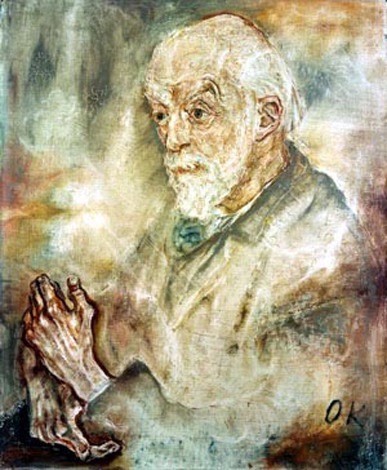
Auguste Henri Foral by Oscar Kokoschka (1910) © Stadtarchiv Mannheim

Auguste Henri Forel
by Oscar Kokoschka (1910)
© Stadtarchiv Mannheim

Some of the issues related to portraiture and the advent of Modernism are explored by Eric Kandel in The Age of Insight.  Kandel claims that the primate brain prefers facial images when the features are exaggerated, even when carried to the point of caricature.  Isbister painted Templer’s feature “a little larger than life. ” Some of his contemporaries, like the Austrian Expressionist Oscar Kokoschka, used this attenuation of physical characteristics to give their portraits strong psychological power, but the price of this power could be the displeasure of the sitter. The famous neuroanatomist Auguste Henri Forel refused to buy this portrait that Kokoschka painted of him in 1910. Society painters like Isbister may maintain their popularity by using only just enough emphasis and exaggeration to please their clients.

The introduction of the work of the immensely successful Horace Isbister, R.A. described by Nick with undisguised derision, is the first sighting of a recurrent theme in Dance, the way in which the advent of Modernism in the arts forced the reappraisal of practitioners past and present.  Isbister is one of many characters (e.g., Deacon, Barnby, Tokenhouse, St-Jean Clark, X. Trapnel, Moreland, etc.) whom Powell challenges the reader to locate in the categories of master, amateur, charlatan, or genius–recognized or unappreciated.

Posted in Uncategorized | 2 Comments

Jean Templer recalls Old Master drawings.

The Narrator recalls his first glimpse of Peter Templer’s sister Jean: “her face was thin and attenuated, the whole appearance given the effect of a much simplified — and somewhat self-conscious — arrangement of lines and planes, such as might be found in an Old Master drawing, Flemish or German perhaps, depicting some young and virginal saint; the raquet, held awkwardly at an angle to her body, suggesting at the same time an obscure implement associated with martyrdom.” (QU 75)

Jean’s appearance is more of a mystery than Stringham’s, who begins from a model of an actual friend of Powell’s, likened to a specifically identified portrait by Veronese.  But Powell’s memoir is much less forthright about any romantic interest beyond his wife, and his evocation of Jean Templer is suitably and deliberately elusive. It would be a fool’s errand to try to nail down Jean’s image in art, but we tried to identify the class of images that Nick imagines when he first meets Jean.

Saint Barbara by Master FVB (fl. between 1475 and 1500) [Public domain], via Wikimedia Commons

Saint Barbara
by Master FVB (fl. between 1475 and 1500) [Public domain], via Wikimedia Commons

The Narrator seems to be recalling a Northern Mannerist work with long bodies derived from the gothic tradition. We chose this late-15th century Flemish wood engraving of Saint Barbara to illustrate the simplified lines and planes to which he alludes.  Saint Barbara herself—whose muddled story of doubtful authenticity dates from about the 7th c. AD—bears no resemblance to Jean’s story.  But her bodily proportions are at once child-like and elegant, her pose both charming and slightly awkward. 

The Narrator goes on to say: “The expression of her face, although sad and a trifle ironical, was not altogether in keeping with this air of belonging to another and better world.  I felt suddenly uneasy and also interested:  a desire to be with her, and at the same time, and almost paralyzing  disquiet at her presence.”

Saint Barbara

Saint Barbara Jan Van Eyck, 1437 oil on panel, 12 x 7 in Royal Museum of Fine Arts, Antwerp


In Album, Lady Violet Powell shows one of Jan Van Eyck’s versions of Saint Barbara, but we think that our choice by Master FVB better captures the look of sadness and irony.

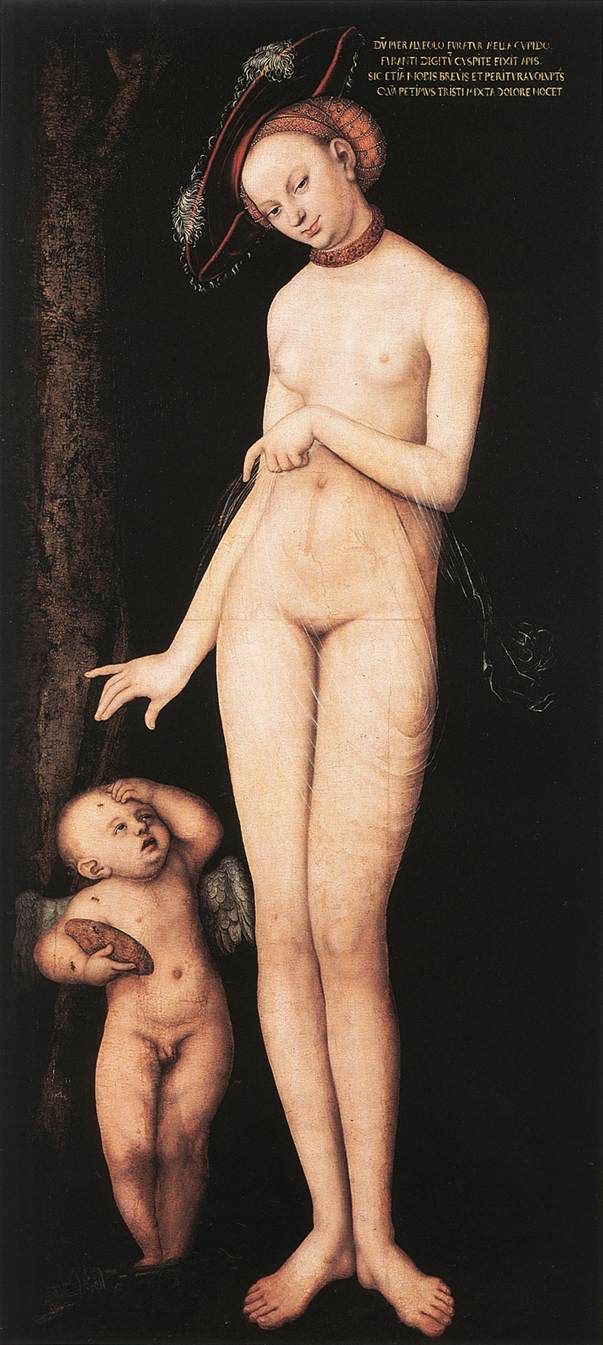
Venus with Cupid Lucas Cranach the Elder, 1531 Royal Museum of Fine Arts of Belgium photo from Wikimedia Commons

Venus with Cupid
Lucas Cranach the Elder, 1531
Royal Museum of Fine Arts of Belgium
photo from Wikimedia Commons

This evocation of the mysterious ambiguity of Jean’s appearance put us in mind of  this well-known painting by Lucas Cranach the Elder (1472-1553) of Venus with Cupid, from about a half-century later than the Saint Barbara engraving. Here is no virginal saint, but her physical proportions recall her gothic origins and her facial expression goes a long way to help readers imagine what Powell might have had in mind.


Posted in Uncategorized | 2 Comments

Embarkation Scenes from Claude Lorraine

Claude Lorraine The National Gallery, London

The Embarkation of the Queen of Sheba
Claude Lorraine
The National Gallery, London
wikimedia commons

Jenkins goes with his friend Peter Templer to visit the Templer home, set on a cliff above the sea. Jenkins first sees the enormous villa with a backdrop of clouds and olive green waves as “a sea-palace for a version of one of those embarkation scenes of Claude Lorraine– the Queen of Sheba, St. Ursula, or perhaps The Enchanted Castle.” [QU 73/74].

Claude Lorraine (c.1604-1682), born Claude Gellée, is often called simply Claude. The Lorraine or Lorrain is added for his native French province. Like his good friend Poussin, he spent most of his artistic career in Rome, where he became a master of the ideal landscape.  By the eighteenth century, many of his works had been imported to Britain, souvenirs of aristocrats from their Grand Tours. Lorraine is still in vogue, or at least in vogue again, highlighted with shows at the Ashmolean Museum in 2011 and the National Gallery in 2012. Reviewers have been enthusiasts: “The 17th-century landscape artist, Claude Lorrain, painted trees as other artists might paint mistresses.” (Alastair Sooke, The Telegraph, October 18,2011)  “Turner worshipped him, Gainsborough argued that there was no need to paint real landscapes when you had him as an inspiration, and Constable declared him quite simply ‘the most perfect landscape painter the world has ever seen'”. (Adrian Hamilton, The Independent, October 24,2011). For a thorough view of his oeuvre visit Claude Lorraine — The Complete Works.

Seaport with the Embarkation of St. Ursula The National Gallery wikipaintings.org

Seaport with the Embarkation of St. Ursula
The National Gallery
wikipaintings.org

Claude painted many Embarkation and Disembarkation seascapes. Seaport with the Embarkation of the Queen of Sheba (1648) and Port Scene with Embarkation of St. Ursula (1641) share dramatically lit sky and waves with classical waterside mansions, probably not quite like the Templer house, built of brick in the late nineteenth century and set back from the water in a forested park.

The Enchanged Castle Claude Lorraine The National Gallery  image for The Anthaneum

The Enchanged Castle
Claude Lorraine
The National Gallery
image from The Anthaneum

When he adds The Enchanted Castle to the list, the narrator progresses from Jenkins hyperbolic impressions of Templer’s home to foreshadowing Jenkins’ enchantment by Templer’s sister, Jean.  Perhaps the power of the landscape adds to her bewitching powers. The  National Gallery bought The Enchanted Castle  in 1981,  but Lord Wantage owned the canvas in the nineteenth century, when it was one of the best known and widely reproduced paintings in Britain, in part because of the homage Keats paid it in “Ode to a Nightingale.”

Another reviewer of the 2011 Ashmolean exhibit considered “The Enchanted Castle” the highlight of the show (Robin Lane Fox, The Financial Times, October 18, 2011) He recalled that when he was at Eton, the painting had belonged to his family for over a century; while home from school on holiday, he would gaze at the figure in the foreground, looking for strength to survive his return to school.

The reviewer Fox, in his schoolboy days, saw the figure as another young boy pondering the power of an institution. However, the figure is actually the beautiful young girl Psyche; only in retrospect could the narrator Jenkins know how Psyche’s tumultuous relationship with Cupid might have warned him about the girl he is soon to meet.

Posted in Uncategorized | 3 Comments

Mrs. Foxe’s Apartment

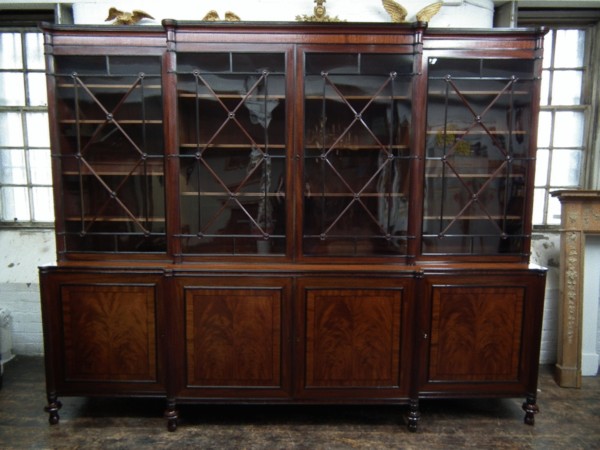
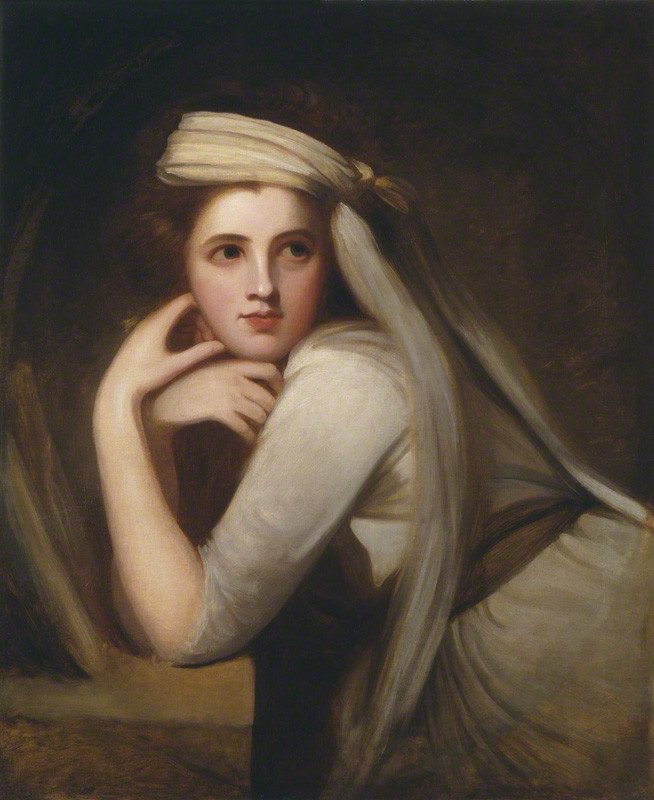
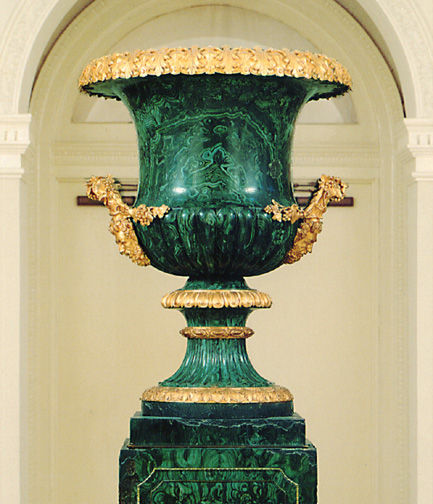
In about 1921 Jenkins visits Stringham’s mother, Mrs. Foxe, and stepfather, Buster, at their Berkeley Square apartment, whose opulence takes Nicholas back a century.  He enters the library,  “generally crimson in effect, containing a couple of large Regency bookcases. A female portrait, by appearance a Romney, hung over the fireplace, and there was a malachite urn of immense size on a marble topped table by the window…” [QU 55/57].

Regency bookcaseThis setting illustrates the opulence of the apartment, but at first we do not know how long these objects have been in the family. Regency antiques are easily purchased nowadays on the Internet. This mahogany book case (circa 1815) was for sale in May, 2013, for 65,000 pounds sterling (www.georgianantiques.net). Prince George was Regent from 1811-1820, but the Regency furniture period in Great Britain encompasses about 1800 to 1830. The style features mahogany, rosewood, and ebony, sometimes supplemented by brass inlays or metal grills, and incorporating classical Greek or Roman motifs.

Emmy, Lady Hamilton, oil on canvas, circa 1875, on display at the National Portrait Gallery, London

Emmy, Lady Hamilton, oil on canvas, circa 1875, on display at the National Portrait Gallery, London

George Romney (1734-1802) (a distant cousin of the American family of politicians) was a prolific and acclaimed British portraitist. He struggled early in his career and was never a member of the Royal Academy but won prizes and developed a fashionable aristocratic following. Romney painted Emma, married to Lord Hamilton, and later mistress of  Lord Nelson, over 60 times.  “George Romney specialized in capturing the qualities valued by aristocratic society — health, youth, good looks, and an air of breeding. His refined works are distinguished by easy poses, flowing curves, and an overall elegance of design (Boston Museum of Fine Arts)” For a fuller portfolio of his portraits see the George Romney entry at museumsyndicate.com. Romney was a contemporary of Gainsborough and Reynolds, maintaining a particular rivalry with the latter. We later will accompany Jenkins when he references these other eighteenth century luminaries.

Mrs. Foxe, heiress to a South African gold fortune, might have purchased the bookcase or the painting. However, the urn, of good Russian malachite from the Ural mountains, had been given to an ancestor of Mrs. Foxe’s first husband, Lord Warrington, by the Tsar early in the nineteenth century.  Mrs. Foxe’s urn, though “immense,” might not have been quite so imposing as this one from the Tsar’s palace of about 1830, which was displayed at the Chicago Exposition of 1893 and is now a focal point of the Lightner Museum in St. Augustine, Florida.

Lightner Museum, St. Augustine, FL http://www.lightnermuseum.org/main_lightner.html

Lightner Museum, St. Augustine, FL
http://www.lightnermuseum.org/main_lightner.html

Posted in Uncategorized | 2 Comments

The Race Horse Prints

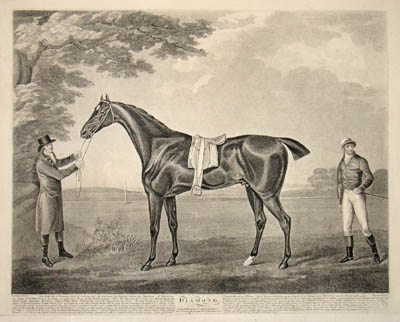
The narrator, describing Stringham’s room at school, notes hanging on the wall “two late eighteenth- century coloured prints of racehorses (Trimalchio and The Pharisee), with blue chinned jockeys” (QU 9/13 ).  The sport of horse racing was led by the royal, rich, or aristocratic. Queen Anne founded the racecourse at Ascot in 1711 . The word “derby” credits the twelfth Earl of Derby who sponsored the races at Epsom about 1780. In the eighteenth century, rich owners would commission oil portraits of their horses, often also showing the owner, sometimes with a jockey. Engravings could  be made based on the paintings. The transition from hand coloring of engravings to printing with multicolored inks was an eighteenth century innovation.  During his career, John Whessel, whose engravings are shown below, moved from painting and engraving into the potentially more lucrative publishing business.

Hambletonian aquatint, 15.5 x 19.25 inches Published by John Harris, London, 1799 Engraver, John Whessel (1760 - c.1797) After painting by John Nost Sartorius (1759-828) Courtesy of www.georgeglazer.com, George Glazer Gallery, New York City."

Hambletonian
aquatint, 15.5 x 19.25 inches
Published by John Harris, London, 1799
Engraver, John Whessel (1760 – 1823)
After painting by John Nost Sartorius (1759-1828)
Courtesy of http://www.georgeglazer.com, George Glazer Gallery, New York City.

Diamond
aquatint, 15.5 x 19.25 inches
Published by John Harris, London, 1799
Engraver, John Whessel (1760 – 1823)
After painting by John Nost Sartorius (1759-1828)
Courtesy of http://www.georgeglazer.com, George Glazer Gallery, New York City.

These colored prints became collectors’ items in the nineteenth century. It is very true to type for Stringham, whose mother, as we shall soon see, was a devotee of  decor that perpetuated past grandeur, to bring these from home to school.

We are entranced  by the names of the horses. Animal names can be playful or personal.  The eighteenth century British often used classical or historical references. Whessel’s horse prints include images of Trumpator, Parasol, Bobtail, Eleanor, Meteora, Penelope, and Violante. All of these horses are listed in the Pedigree Online Thoroughbred Database, but Trimalchio and The Pharisee are not in the database.  Petronius’ Satyricon celebrates the Roman Trimalchio  for his debauchery, extravagance, and rudeness.  The Pharisees were a devout sect, predecessors of modern Jewish orthodoxy, but  many remember the Pharisees only because the New Testament Apostles report Christ’s criticisms of them. We speculate that by using names with negative connotations, Powell is offering a comic signal that these are the first of many instances  of imagined works of art in Dance.

Posted in Uncategorized | Tagged | 1 Comment

Elizabethan Miniatures

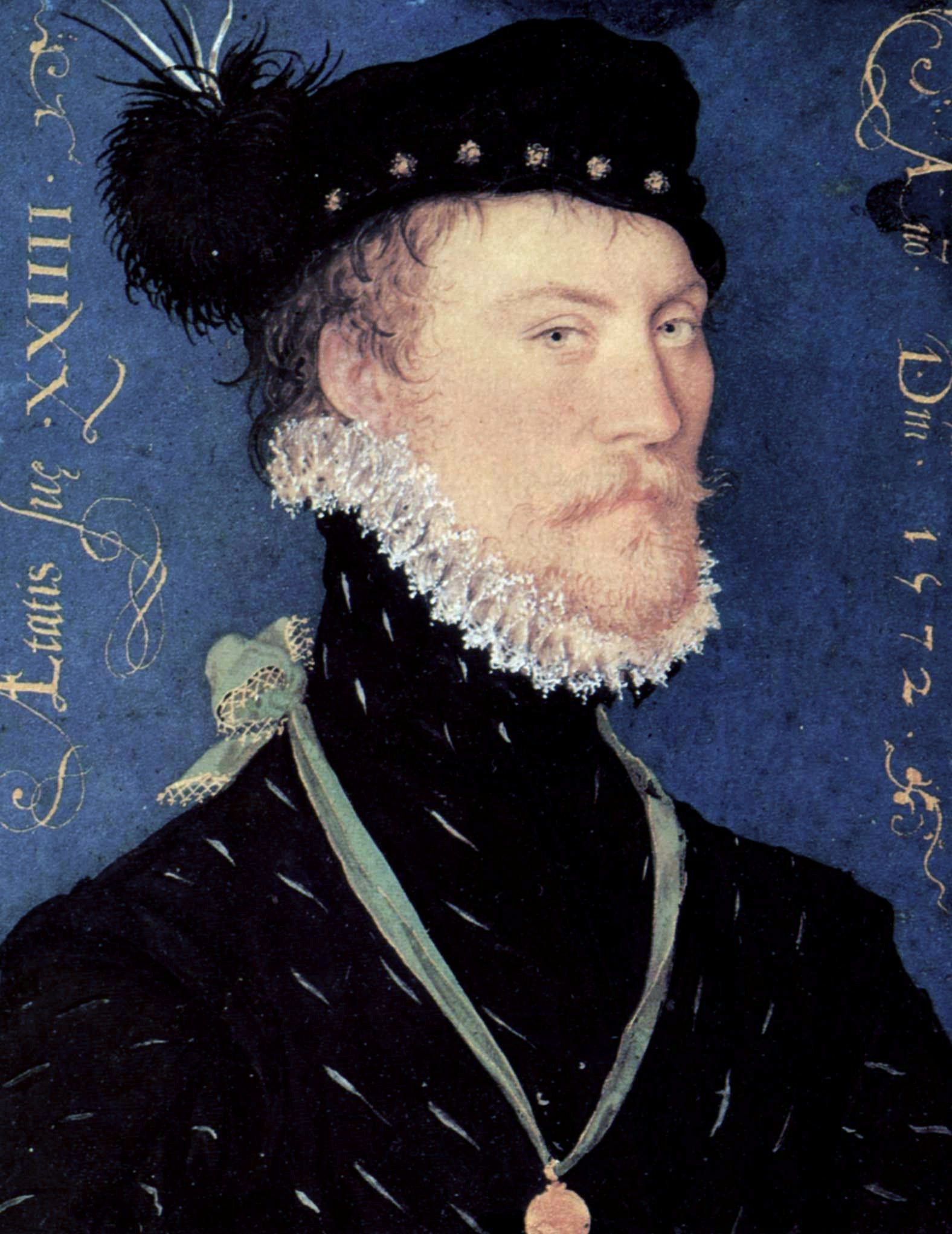
With his characteristic reference of individual to type, Powell elaborates his evocation of Stringham, moving directly from Veronese to the style of Elizabethan miniatures: “His features certainly seemed to belong to that epoch of painting:  the faces in Elizabethan miniatures, lively, obstinate, generous, not very happy, and quite relentless.” (QU 4/12)

Portrait of an Unknown Man

Nicholas Hilliard
The Victoria and Albert Museum
Photo from the Yorck Project

This portrait by Nicolas Hilliard, one of the most accomplished English miniaturists of the Elizabethan period, exemplifies the attributes Powell connects to Stringham’s type.  The vivid enlargement of the digital reproduction belies the portrait’s actual size, barely two and a half inches tall.  Miniatures such as this, typically painted with watercolor on vellum mounted on card, served the purpose in the Renaissance that wallet-sized photos of loved ones do today.


Posted in Uncategorized | Leave a comment

Alexander receiving the Children of Darius after the Battle of Issus

The Family of Darius before Alexander Paolo Veronese National Gallery London image for wikimedia commons.

The Family of Darius before Alexander
Paolo Veronese
National Gallery London
image from wikimedia commons.

The narrator introduces and describes Jenkins’ schoolboy friend Stringham: “He was tall and dark, and looked like one of the stiff, sad young men in ruffs, whose long legs take up much room in sixteenth-century portraits: or perhaps a younger – and far slighter – version of Veronese’s  Alexander receiving the children of Darius after the battle of Issus: with the same high forehead and suggestion of hair thinning a bit at the temple” (QU  4/12) This picture by Paolo Veronese (1522-1588) is displayed in the National Gallery in London.  Alexander and Hephaestion are received by Darius’ mother, who is unsure which is the conquerer. This confusion is echoed by modern interpreters of the picture, who still debated which image is that of Alexander. In TKBR (p. 45), Powell clarifies that he was referring to the figure in crimson.  In doing so, he was thinking of his school friend Hubert Duggan, and he cites a photo of Duggan that appears in Harold Nicholson’s Curzon: the Last Phase to prove the aptness of his comparison. Often in Dance, Powell  enhances the reader’s visualization of a character with a reference to a classic portrait; his anecdote from TKBR documents the care he takes with these descriptions.  Not only do Powell’s classical references strengthen the reader’s image of the characters in question, they condition our understanding of Powell’s interest in his characters, which is not so much for their unique psyches as for their embodiment of types.  And for the erudite Powell, the innumerable characters of classical literature and art, and their reinterpretation in the art of later Europeans, represent the vast library of  types to which his imagination makes reference

Hubert Duggan (1904–1943), MP for Acton by Joseph William Topham Vinall, 1935
Ealing Central Library

A portrait of Duggan is visible at BBC Your Paintings.  In TKBR (p.17) Powell writes: ” The ‘real person who sets going the idea of a major ‘character’ in a novelist’s mind always requires change, addition, modification, development, before he (or she) can acquire enough substance to exist as a convincing fictional figure.” Although Stringham looked like Duggan, and they may have had some similar escapades in their youth, Stringham’s adult life in Dance does not parallel Duggan’s.

Posted in Uncategorized | Tagged , , | 1 Comment