Bolton Abbey in the Olden Times

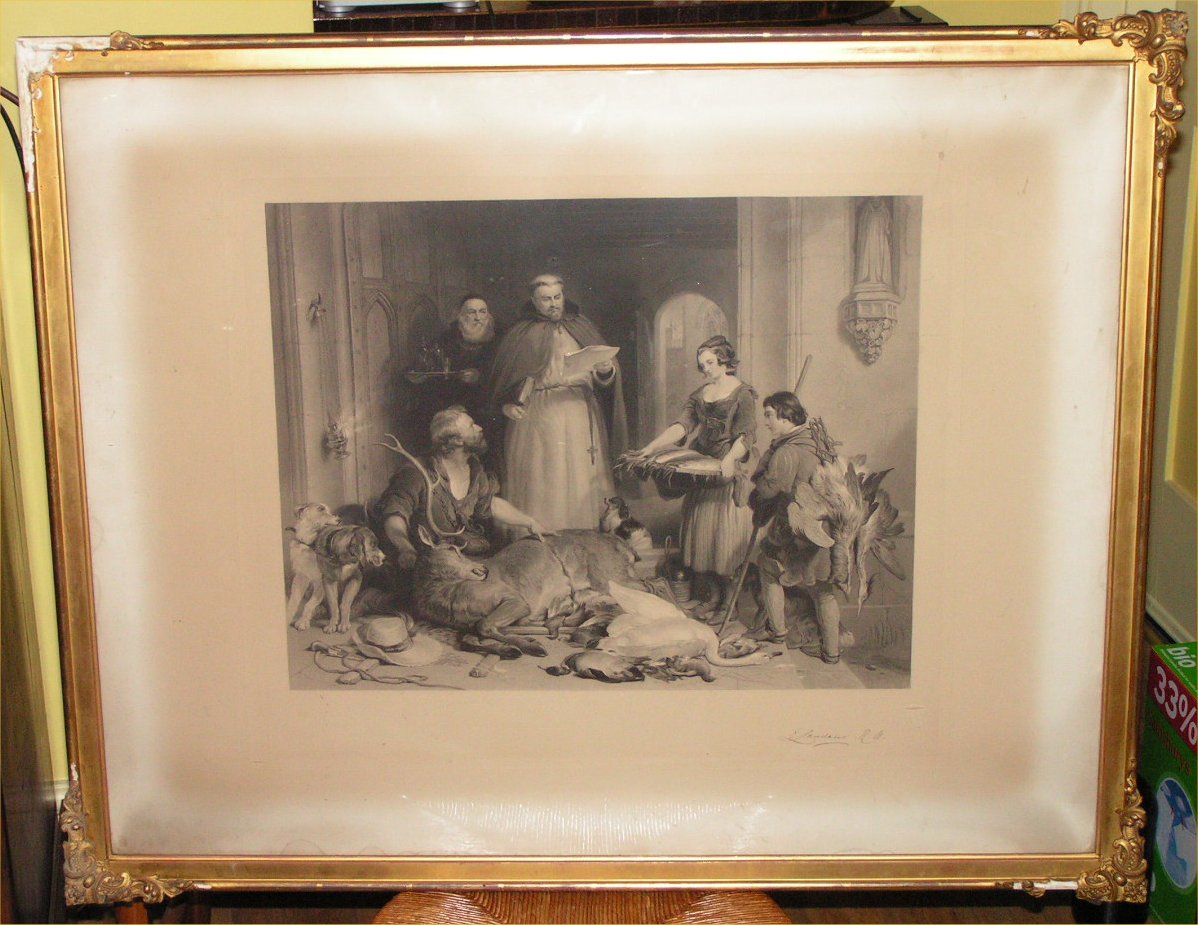
Jenkins meets his Uncle Giles in the lounge of the Ufford Hotel. Among the bleak, faded decor, he notes “an engraving, placed over the fireplace, of Landseer’s Bolton Abbey in the Olden Times.” [AW 10/4]

Bolton Abbey in the Olden Time Mezzotint Edwin Landseer Engraver: T. Landseer  19 x 22 in

Bolton Abbey in the Olden Time
Mezzotint
Edwin Landseer
Engraver: Thomas Landseer
19 x 22 in

Sir Edwin Henry Landseer, RA (1802-1973) was famous for his animal paintings and sculptures. He taught Queen Victoria and Prince Albert etching and was a favorite of the artistocracy and of the Royal Academy. Much of his income, however, came from sale of his engravings to the middle class. He was the son of an engraver and many of this paintings were distributed widely as engravings by his brother Thomas.

Bolton Abbey is one of Landseer’s most popular paintings and has been engraved at least three times. We display this sample (available as of January 18, 2013, at www.oldrareprints.com) because its damaged frame and browning center make it possible to imagine that this very piece is the one that once decorated the Ufford.  Landseer’s talent for depicting animals is evident here in the dogs and game, which Jenkins describe as “a crowded scene of medieval plenty…”

Posted in Uncategorized | Leave a comment

Doors of the Temple of Janus

The Ufford hotel had a large double drawing room, divided by a pair of doors, apparently permanently closed,  into a lounge and a writing room. Jenkins surmises: “Perhaps, like the doors of the Temple of Janus, they are closed only in time of Peace; because years later, when I the saw the Ufford in war-time these particular doors had been thrown wide open.” [AW 9/3]

Roman coin from Nero's reign showing the Gates of the Temple of Janus picture from Classical Numismatic Group, Inc. http://www.cngcoins.com via Wikimedia  Commons

Roman coin from Nero’s reign showing the Doors of the Temple of Janus
picture from Classical Numismatic Group, Inc. http://www.cngcoins.com via Wikimedia Commons

The story of these doors, closed in only in time of peace, is recorded in Plutarch’s Lives. (Life of Numa, XIX-XX, translation of the Greek edition ~1517) In Rome, the doors were rarely closed, because some part of the Empire was almost always at war.  Jenkins, looking back from the 1950s, is reminding us how much life in Britain in the 1930s was about to change.  Janus was shown as having two faces because as a king he turned men from barbary to civilization; January was named for him in honor of good government.  The original temple, adjacent to the Roman Forum, no longer exists, and the best images are from old coins.

Posted in Uncategorized | Leave a comment

The Mad Hatter

We have recently discovered that we failed to note this reference to the works of John Tenniel when we first went through QU. With this addition, we have now assembled all of our QU posts into a single page so that they can be read in the order in which the art works appear in the book. We will prepare similar pages for the other volumes as we proceeed.

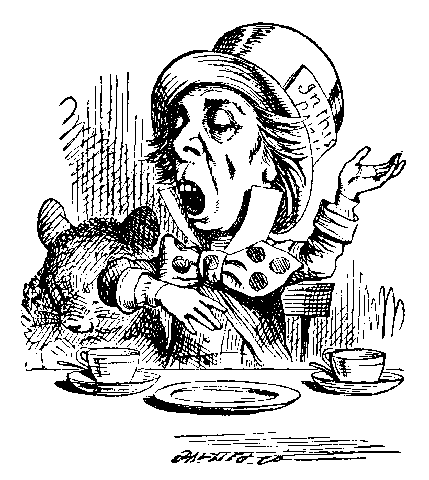
Mad Hatter Engaging in Rhetoric Sir John Tenniel Illustrations for Carroll's Alice in Wonderland The Project Gutenberg EBook

Mad Hatter Engaging in Rhetoric
Sir John Tenniel, 1865
Illustrations for Carroll’s Alice in Wonderland
The Project Gutenberg EBook


Jenkins describes M. Dubuisson: “His upper lip and general carriage made me think of a French version of the Mad Hatter.” [QU 114 /116]. This is the first of many references in Dance to Alice in Wonderland by Lewis Carrroll.

John Tenniel’s (1820-1914) original illustrations for Alice in Wonderland are so well-known and closely linked to the book, that that the image above of the Mad Hatter must have  been what Jenkins had in mind.

Tenniel studied art at the Royal Academy and was already a famous cartoonist for Punch when Carroll approached him to illustrate Alice. Carroll initially planned to illustrate it himself, and Tenniel worked closely with him in planning the ninety-two drawings for Alice and for Through the Looking Glass, which are now among the best known book illustrations.  For the book, Tenniel’s drawings were engraved on wood blocks by the Brothers Dalziel; the blocks, now at the Bodleian Library at Oxford, were masters for electrotypes in the book.

The phrase ‘mad as hatter’ was in use in the eigthteenth century, preceding Carroll’ s work. Hat makers often became psychotic because of the toxic effects of the mercury solution that they used to process fur.  However, H.A. Waldron, in an essay in the British Medical Journal, argues that The Hatter’s personality was not typical of mercury toxicity and that Carroll actually based the character on an eccentric furniture dealer who always wore a top hat.

In this illustration from chapter seven,  A Mad Tea-Party, The Hatter is reciting the poem parody, Twinkle, Twinkle, Little Bat.  Is Jenkins referring only to M. Dubuisson’s appearance or implying that his French host was a constant source of nonsense, like The Hatter, who spouts non sequiturs and unanswerable riddles to our delight?

Posted in Uncategorized | 2 Comments

The Omnipresent

The Omnipresent Avild Rosenkrantz, 1904 mezzotint publisher Charles Hanff, London offered for live auction 2/13/13 www.liveauctioneers.com

The Omnipresent
Arild Rosenkrantz, 1904
mezzotint
publisher Charles Hanff, London
offered for live auction 2/13/13
http://www.liveauctioneers.com

The Omnipresent is the last art work mentioned in BM. The reference is brief:  as he is admitted to the Widmerpools’ apartment for the first time, Jenkins sees Widmerpool sitting reading The Times.  In Jenkins’ first glance around the apartment he “was dimly aware of a picture called The Omnipresent hanging on one of the walls, in which three figures in bluish robes stand or kneel on the edge of a precipice.” [BM 272/261]

The Omnipresent is one of the better known works of the Danish artist Arild Rosenkrantz  (1870-1964).  Jenkins recognizes the work in passing, because Rosenkrantz was well known in London, where he lived from 1898 to 1912 and again after 1925.  Rosenkrantz, who was influenced artistically by the Pre-Raphaelites, William Blake, and JMW Turner, did many public works, including ceiling panels for Claridge’s Hotel and stained glass for St. Paul’s cathedral, and had frequent exhibitions in London galleries.

To grasp the meaning of The Omnipresent it is probably important to know that Rosenkrantz was strongly influenced  philosophically by Rudolf Steiner. Rosenkrantz helped decorate Steiner’s anthroposophical center in Switzerland.  He learned from Steiner that  “colours are the soul of nature and the entire cosmos – and we become part of that soul when we live with the colours” and wrote that Steiner taught “a new  art which springs from Spiritual Science.”

The art hanging in great houses may signify status, wealth, and lineage; a reproduction hanging in a modest apartment reflects personal tastes and interests. Knowing Kenneth Widmerpool’s lack of interest in art, we assume that it was his mother’s decision to display The Omnipresent.  Mrs. Widmerpool had some bookish pretensions, but we have no clue whether her choice of art for her home was aesthetic  or philosophical.

Posted in Uncategorized | 5 Comments

Goya’s Maja Desnuda and Manet’s Olympia

Maya Desnuda Francisco Goya, ~1795-1800 oil on canvas, 39x72 in. Prado Museum photo from Wikimedia.org

Maya Desnuda
Francisco Goya, ~1795-1800
oil on canvas, 39×72 in.
Prado Museum
photo from Wikimedia.org

After Mr. Deacon’s funeral, Nick finds himself behind Mr. Deacon’s shop with Gypsy Jones and is more or less seduced into sleeping with her. In the aftermath of that most abstractly described liason, Nick is bewildered by Gypsy’s apparent indifference to him and absorption with herself. “. . . Gypsy lay upon the divan, her hands before her, looking, perhaps rather self-consciously, a little like Goya’s Maja nude––or possibly it would be nearer the mark to cite that picture’s derivative, Manet’s Olympia . . . .” [BM 269/258]

Francisco Goya (1746-1828) was the greatest Spanish painter and printmaker of his age, the more remarkable for his artistic journey from painter of romantic frivolities of aristocratic life, to court painter of portraits for Charles IV, to embittered satirist of social folly and the atrocities of war, and finally to fantasist of monstrous demons of the soul. His Maja Desnuda (Naked Mistress) is thought to be a product of his court-painter period, and its subject may be Goya’s own mistress, or an aristocratic woman of whom he was enamored, or a composite of several subjects. Regardless of the identity of its subject, the painting is startling for the frankness of her nudity and the confidence of her gaze at the viewer.

Not surprisingly, the resurgent Spanish Inquisition under Ferdinand VII was not amused by Goya’s composition, though both Goya and the Maja desnuda survived the inquisitors’ wrath, and the offending painting hangs today in the Prado next to its companion, the Maja vestida.

Edward Manet (1832-1883) occupies a station in French painting of the 19th century equal to that of Goya’s in Spain a century earlier.  Manet is frequently identified as an Impressionist because of his close ties to Renoir, Degas, Pissarro, Monet, and the other painters who showed together in the expositions subsequently dubbed Impressionist by critics.  But it is not any great similarity of painting technique that links him to his contemporaries, but the revolutionary subjects of his paintings, which focused on the texture of daily life in the city and its suburbs, and on current events rather than on historical re-enactments.  Manet’s repertoire of actual painting styles is so varied as to make him uncategorizable, but his wide-ranging visual curiosity has caused him to be identified with almost every subsequent development of Modernism.

Nick regards Manet’s Olympia as the Maja’s derivative, and it has been identified as such by more than one art historian, but a more compelling claim can be made that Manet’s main models were the much earlier nudes of Titian, particularly his Venus of Urbino of 1538.  As it happens, Manet was an omnivorous consumer of ideas gleaned from his artistic forebears, Goya and Velasquez among them (see our prior post of Murillo’s school) , and his Olympia has proved to be an endless target of historical and critical speculation.  What is not speculative is how Olympia’s brazen gaze conveys a complacent self-confidence that is at once alluring and off-putting, not unlike Gypsy Jones herself.

Olympia Edouard Manet, 1863 oil on canvas, 51 x 75 in. Musee Orsay photo from Google Art Project via Wikipedia

Olympia
Edouard Manet, 1863
oil on canvas, 51 x 75 in.
Musee Orsay
photo from Google Art Project via Wikipedia
Posted in Uncategorized | 3 Comments

Mona

As he recalls Mr. Deacon’s birthday party, Nick remembers meeting Quiggin arriving uninvited, brought along by “a strapping black-haired model called Mona.”  A bit later, Quiggin “looked across the room to where Mona was talking to Barnby and said: ‘It is a very unsual figure, isn’t it?  Epstein would treat it too sentimentally, don’t you think?  Something more angular is required, in the manner of Lipchitz or Zadkine.’” [BM 253-4/243]

Sir Jacob Epstein (1880-1959) was a British sculptor associated with Vorticism and various other shades of bold modernism.  His work, nearly always figurative in subject, though quite varied in both medium and appearance, was often greeted with shock and outrage by the English public for its frank sexuality and modernist distortions.  For Quiggin to suggest that Epstein’s take on Mona would be too sentimental is a joke that points in two directions:  Quiggin in the 1920’s must have been quite a whopping avant-gardist to find Epstein sentimental, and Mona must have been quite severe of figure to leave Epstein not up to the task of representing her.  These photos of Epstein’s carved figures for the London Underground headquarters suggest why we say so. The were unveiled in 1928, around the time that BM takes place, to great public furor.

Day and Night Jacob Epsteim 1928 Portland Stone, carved for London Underground's Headquarters at 55Broadway, London. photos  by Andrew Dunn  from Wikimedia Commons

Day and Night
Jacob Epstein 1928 Portland Stone, carved for London Underground’s Headquarters at 55Broadway, London.
photos by Andrew Dunn
from Wikimedia Commons

Seated Figure Jacques Lipchitz, 1917 Limestone The Art Institute of Chicage photo courtesy of

Seated Figure
Jacques Lipchitz, 1917
Limestone
The Art Institute of Chicage
photo courtesy of Jyoti Srivastava

Chaim Jacob Lipchitz (1891-1973) was born of Jewish parents in Lithuania, moved to France and became known as Jacques, and finally moved to the United States in 1940 to escape the German occupation. In the period just before A Buyer’s Market, Lipchitz had made his reputation as a Cubist figurative sculptor, working in the company and shadow of Picasso and Juan Gris. Later, Lipchitz softened his forms in favor of a more organic vocabulary, but this limestone figure of his from 1917 gives a sense of what Quiggin thinks might be necessary to capture Mona’s type.

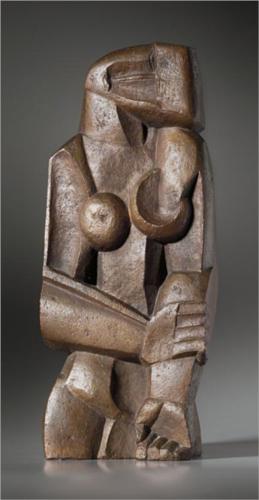
Femme Debout Ossip Zadkine, 1922 sculpture, Susse Foundry, Paris photo from Wikipaintings .org This artwork may be protected by copyright.

Femme Debout
Ossip Zadkine, 1922
sculpture, Susse Foundry, Paris
photo from Wikipaintings .org
This artwork may be protected by copyright.

Lipchitz’s contemporary, Ossip Zadkine (1890-1967) was an immigrant to France from Belorussia.  Though Jewish as well, Zadkine managed to survive the war in France and lived there till his death.  Zadkine’s sculpture and painting was a little less orthodox in its Cubism.  But this example of a female figure from 1922, taken together with the Lipchitz, suggests that Quiggin has not underestimated a certain angular hardness that Mona will exhibit in the pages to come.

Artists models are one of many recurring topics in Dance. Mona is reputedly based on Sonia Brownell, who eventually married George Orwell. In TKBR (pp 161-162) Powell recounts his adventures publishing the autobiography of another model, Bette May, of whom Epstein did a bronze head.  In a book review on artists’ models in SPA… (p251), Powell discusses the role of sexism and eroticism in our perceptions of models, and based on his own experiences sitting for portraits, says: “Certainly, few persons who have ever sat for a portrait can have felt anything but inferior while the process is going on…”

Posted in Uncategorized | 3 Comments

Holbein’s portrait of Erasmus

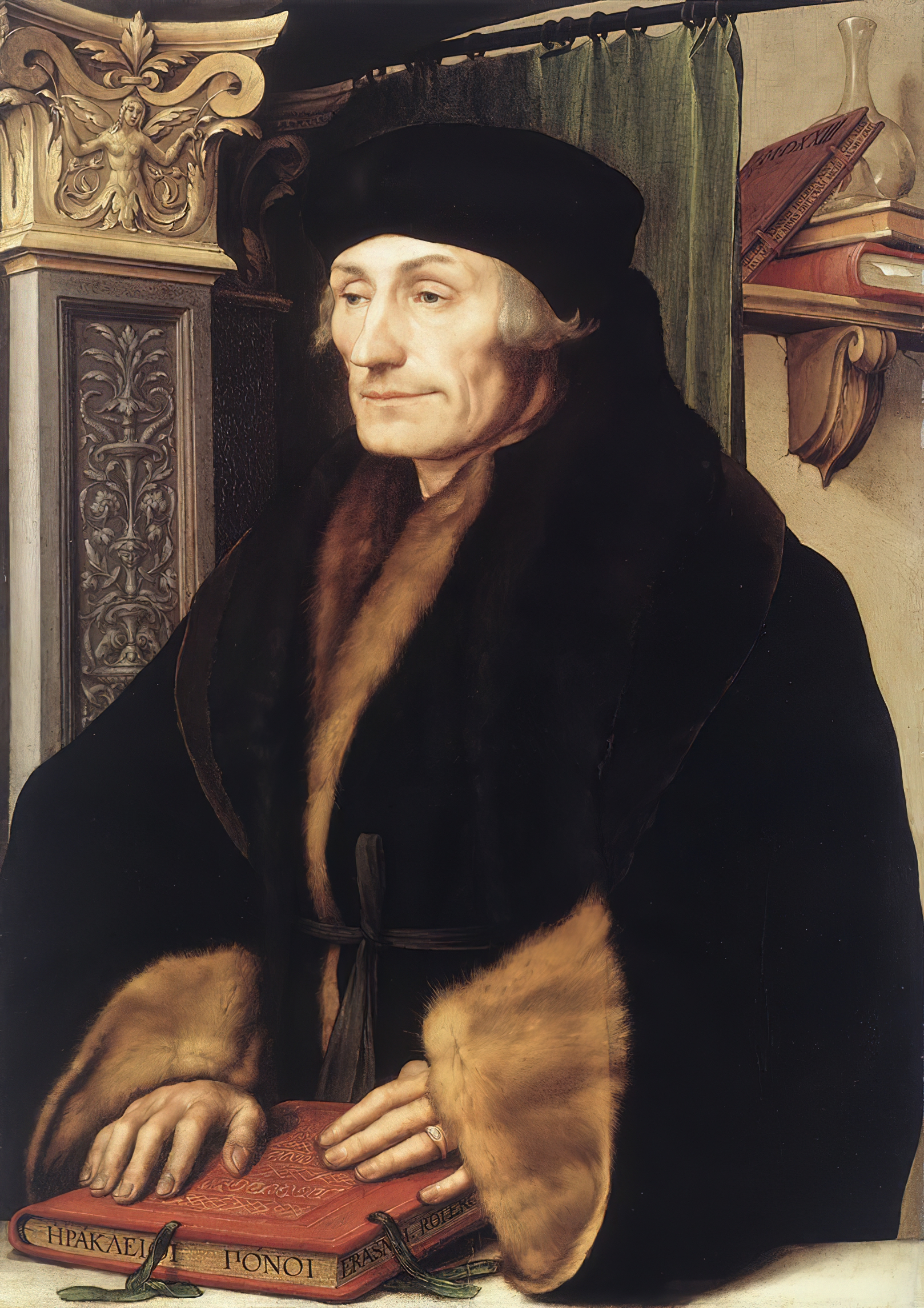
Erasmus Hans Holbein the Younger, 1523 The National Gallery On loan from Longford Castle collection,  photo public domain from Wikipedia Commons

Erasmus
Hans Holbein the Younger, 1523
The National Gallery On loan from the Longford Castle collection,
photo public domain from Wikipedia Commons

Holbein’s Portrait of Erasmus [BM 193,196/183,186]) hangs at the far end of the Long Gallery at Stourwater. Hans Holbein the Younger (1497-1547) was born in Augsburg, in what is now Germany.  Holbein arrived in London in 1523 with a recommendation to Thomas More from Erasmus. Holbein’s portraits of Henry VIII,  More, and other court figure like Anne Boleyn established his preeminence in British portraiture.  He painted at least 3 portraits of the humanist scholar Erasmus of Rotterdam and probably brought 2 of these to England; he gave the portrait currently hanging in the National Gallery as gift to the Archbishop of Canterbury.

Powell’s conceit, that a national treasure  such as the Holbein Erasmus could be displayed in the private castle of a rich magnate, is culturally accurate. The Fifth Earl of Radnor, who owned Longford Castle, sold Holbein’s The Ambassadors to the National Gallery in 1890. Litigation ensued about the right of the Earl to sell this painting, possibly to the detriment of his heirs. The court in allowing the sale, noted that twelve other Holbeins, including Erasmus, remained at Longford Castle, which has now lent Erasmus to the National Gallery.

Powell was married to Lady Violet Pakenham, of the celebrated Anglo-Irish Longford-Fraser writing dynasty. We do not know whether this Irish Longford family is related to the Earls of Radnor who own Longford Castle in Britain, but we are sure that Powell’s aristocratic connections made him very familiar with great private art collections.


Posted in Uncategorized | 1 Comment

The Sea Giving Up the Dead That Were In It

Mark Members looked around the room at Mr. Deacon’s birthday party and said: “You must admit it looks rather like that picture in the Tate of the Sea giving up the Dead that were in it.” [BM 253/243]

And the Sea Gave Up the Dead Which Were in It Frederic Lord Leighton, 1892 Oil on canvas, support 90 X 90 inches Tate Britain

And the Sea Gave Up the Dead Which Were in It
Frederic Lord Leighton, 1892
Oil on canvas, support 90 X 90 inches
Tate Britain

Lord Frederic Leighton (1830-1898) was one of the most famous Victorian painters, president of the royal academy, and the first British artist to have been ennobled. During much of his career, he was strongly influenced  by Greek and Roman mythological themes. He was not particularly sympathetic to his contemporaries, the Impressionists, and modeled his later work on Michelangelo.

Leighton originally designed The Sea Gave Up the Dead as one of eight roundels intended for the dome of St. Paul’s Cathedral; however, the proposed commission was rejected as “unsuitable for a Christian church.” Leighton painted this version for Sir Henry Tate about the time that Tate founded his museum of British art in the 1890’s.

The dramatic scene is based on a passage from the Book of Revelations. Members is brilliant, supercilious, and never quite lives up to his promise; here he uses the painting as a hyperbolic metaphor; by doing so, he says more about his personality than about the party.

Posted in Uncategorized | Leave a comment

Daguerreotypes on Mr. Deacon’s Mantle

Daguerreotype, 1850s

Daguerreotype, 1850s

Walt Whitman daguerreotype, New Orleans, 1948 The Walt Whitman Archive

Walt Whitman
daguerreotype, New Orleans, 1948
The Walt Whitman Archive

Daguerreotypes of Deacon’s mother and of Walt Whitman in oval frames stood on Mr. Deacon’s mantlepiece. The features of his mother “so much resembled her son’s as for the picture, at first sight, almost to create the illusion that he had himself posed, as a jeu d’esprit in crinoline and pork pie hat. Juxtaposition of the portraits was intended, I suppose, to suggest that the American poet, morally and intellectually speaking represented the true source of Mr. Deacon’s otherwise ignored paternal origins. ” [BM 246/236 ]

Daguerreotypes, introduced in 1839, were the first widespread photographic method.  The images  were made directly on a silver plate; there was no photographic negative. Small daguerreotypes, about 2.75 by 3.25 inches, were widely available by the mid 1840s without great expense.  However, the images were heavy and hard to view due to reflections from the silver, and by the early 1860s, daguerreotypes had been superceeded by other processes such as ambrotype and tintype, and sometimes images with these later techniques are mistakenly identified as daguerreotypes.

 Woman in Pork Pie Hat daguerreotype, 1860s uploaded to Pinterest by Lisa Ward

Woman in Pork Pie Hat
1860s
uploaded to Pinterest by Lisa Ward

The pork pie hat also dates the photo. The pork pie hat was popular among women in the US and Britain from about the 1830s to mid 1860s; it was small and round with low flat crown and narrow turned up brim.

Posted in Uncategorized | 2 Comments

Rubens’ Chapeau de Paille

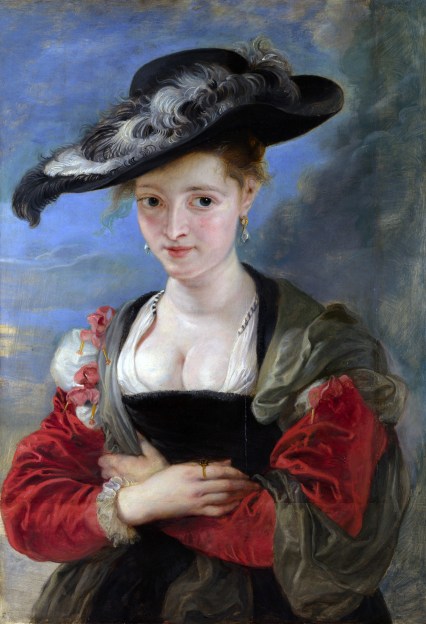
As Nick is leaving Stourwater, Jean Duport somewhat awkwardly invites Nick to “dinner, or something,” with her husband Bob Duport.  Nick reflects on Jean’s manner: “she reminded me of some picture.  Was it Rubens and Le Chapeau de Paille: his second wife or her sister?  There was that same suggestion, though only for an instant, of shyness and submission.” [BM 226/216]

Le Chapeau de Paille is the title given to the 1625 portrait by Peter Paul Rubens (1577-1640) of Susanna Lunden, the older sister of Helena Fourment, Rubens’ second wife.  Some historians have posited that the painting may in fact be a portrait of Helena herself, though if so, it would have been painted before they were married. In any case, Rubens has created the image of a beguiling beauty who peers out at the viewer from under the shade of her chapeau with a shy but unremitting gaze.  This beloved portrait, now in the National Gallery in London, is by no means the kind of complex composition for which Rubens is esteemed, but it exemplifies his uncanny ability to whip up a Baroque fantasy of swirling costume, clouds and sky that nevertheless maintains its still center in his sitter’s enigmatic personality.

Le Chapeau de Paille Peter Paul Rubens, ~1623 oil on oak, 31 by 21.5 inches The National Gallery, London photo from Wikimedia Commons

Le Chapeau de Paille
Peter Paul Rubens, ~1625
oil on oak, 31 by 21.5 inches
The National Gallery, London
photo from Wikimedia Commons

Rubens is the pre-eminent artist of the Flemish Baroque, or indeed of the whole of European art of the period, since he accomplished a synthesis of the Northern tradition with that of the Italian Renaissance masters whom he studied closely. Based in Antwerp during his maturity, Rubens headed a school there, what we might call a factory, where he produced not only portraits but religious altar pieces. history paintings, scenes from classical mythology, and allegorical landscapes. His work was largely produced in the service of the royal houses of Europe, and his prodigious output now graces the museums and private collections of every European capital. In his “spare” time, Rubens served as private diplomat for Isabella, the sovereign of the Netherlands, in her elaborately complex dealings with Spain, England, and France.

Isabel Brandt Peter Paul Rubens, 1621 drawing The British Museum photo editted and cropped with photoshop from Wikimedia Commons

Isabel Brandt
Peter Paul Rubens, 1621
drawing
The British Museum
photo editted and cropped with photoshop from Wikimedia Commons

Nick allows that “Perhaps it was the painter’s first wife that Jean resembled, though slighter in build. After all, I recalled, they were aunt and nieces.” Here he is referring to Isabella Brandt, Rubens’ beloved first wife, who died in 1626. There are several portraits of Isabella Brandt, but no doubt Nick is thinking of this superb drawing in the British Museum. Here Isabella’s resemblance to her niece Susanna is apparent, but the younger woman’s shyness is replaced by Isabella’s confidence, strengthened by Rubens’ remarkable ability to virtually project the head out from the weave of the paper on which it is drawn.

Posted in Uncategorized | 5 Comments