Murillo’s School

In the supper room at the Huntercombes’ ball, Nick finds himself at a table with Barbara Goring and Widmerpool, “in the corner underneath a picture of Murillo’s school in which peasant boys played with a calf.”  (BM 73/67)  The Murillo in question is Bartolome Esteban Murillo (1617-1682), one of the most influential painters of the Spanish Baroque period.

The Immaculate Conception of the Venerable Ones Bartolome Esteban Murillo  ~1678 oil on canvas Museo del Prado photo in public domain from Wikimedia Commons

The Immaculate Conception of the Venerable Ones
Bartolome Esteban Murillo ~1678
oil on canvas
Museo del Prado
photo in public domain from Wikimedia Commons

Murillo is a favorite son of Seville, and the term “school of Seville” is virtually synonomous with “school of Murillo.” He is most often identified with the dreamy, ornate religiosity of his most famous paintings, such as this “Immaculate Conception of the Venerable Ones” of 1678, now in the Prado. 

Somewhat less well-known than Murillo’s religious paintings are his many scenes contemporary peasants, largely done early in his career.  These are unsentimental, non-judgemental windows into the life of the streets in 17th century Seville, and they are part of a social realist strain of Spanish painting famously found in the work of Velasquez and later in that of Goya.  In the last half of the 19th century that social realism was rediscovered and repurposed by Eduard Manet and other French modernists, who rekindled widespread interest in the masters of the Spanish Baroque, Murillo included.

Beggar Boys Eating Grapes and Melon Bartolome Esteban Murillo ~1650 oil on canvas Alte Pinakothek, Munich photo in public domain from Wikimedia Commons

Beggar Boys Eating Grapes and Melon
Bartolome Esteban Murillo ~1650
oil on canvas
Alte Pinakothek, Munich
photo in public domain from Wikimedia Commons

We can find no specific examples of a painting of boys playing with a calf by Murillo or a painter in the school of Murillo, but this reproduction of Murillo’s “Beggar Boys Eating Grapes and Melon” might give an idea of the unromantic character of these genre paintings.  Perhaps this is another of Powell’s inventions of a fictitious work by an historical artist, of which several examples exist in Dance. In any case, we couldn’t help noticing that Powell’s phrase “boys playing with a calf” prefigures the imminent fate of that calf Widmerpool in the hands of Barbara Goring.

Posted in Uncategorized | Leave a comment

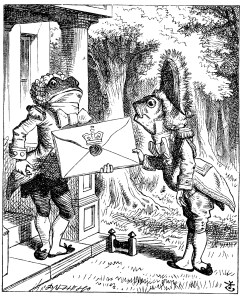
The Frog Footman

Rosy Manasch is talking to Jenkins, while sitting out a dance. Suddenly, Widermerpool stumbles over her foot on his way upstairs.

“‘I know who he is!’ She said, when he had apologized and disappeared from sight with his partner. ‘He’s the Frog Footman.'” [BM 67/61]

The Frog Footman and the Fish Footman Illustration by Sir John Tenniel ~1865 from Lewis Carrol Alice's Adventures in Wonderland public domain from Wikimedia Commons

The Frog Footman and the Fish Footman
Illustration by Sir John Tenniel ~1865 from Lewis Carrol Alice’s Adventures in Wonderland
public domain from Wikimedia Commons

This allusion in the casual conversation of twenty-somethings in the later 1920s needed no citation, anymore than a gen-Xer would need to footnote a reference to Elmo or Papa Smurf. Everyone at the party would be familiar with Sir John Tenniel’s illustrations for the first edition of Lewis Carroll’s Alice’s Adventures in Wonderland (1865). This is only one of many Tenniel drawings mentioned in Dance.

John Tenniel (1820-1914) studied art at the Royal Academy and was already a famous cartoonist for Punch when Carroll approached him to illustrate Alice. Carroll initially planned to illustrate it himself, and Tenniel worked closely with him in planning the ninety-two drawings for Alice and for Through the Looking Glass, which are now among the best known book illustrations.  For the book, Tenniel’s drawings were engraved on wood blocks by the Brothers Dalziel; the blocks, now at the Bodleian Library at Oxford, were masters for electrotypes in the book.

What frog-footman traits did Rosy see in Widermerpool — the arrogant upraised chin, the bulging eyes, the failure to look directly at his interlocuter, the preposterus formal dress? Like the frog footman, he certainly jumps out from the human crowd.

Posted in Uncategorized | 2 Comments

Van Dyck

Nick travels with the Walpole-Wilsons to a ball at the London home of the Huntercombes.  “Hanging at the far end of the ballroom was a Van Dyck––the only picture of any interest the Huntercombes kept in London––representing Prince Rupert conversing with a herald, the latter being, I believe, the personage from whom the surviving branch of the family was directly descended.”  (BM 58)

Anthony Van Dyck (1599-1641) was the Flemish protégé of Peter Paul Rubens (1577-1640), to whom he was apprenticed as a young painter in Antwerp, and who recommended the promising Van Dyck to Charles I of England, a discerning patron of the arts.  Six years in Italy afforded Van Dyck the exposure to Veronese and Titian that fueled his unique synthesis of draughtsmanship, color and Baroque composition.  In 1632 Charles I lured Van Dyck to London and retained him as court painter, in which role he enjoyed immense success as a portraitist and painter of religious and allegorical scenes.  Van Dyck’s elegant and flattering portraits are often credited with forming the foundation of the great age of British portraiture of the later seventeenth and eighteenth centuries.

The Prince Rupert portrayed in the Huntercombe’s Van Dyck is Prince Rupert, Count Palatinate of the Rhine (1619-1682), the nephew of Charles I, who also made Rupert the first Duke of Cumberland.  There is a Van Dyck portrait of Rupert in the National Gallery in London, but we can find no painting of Rupert conversing with a herald.  Powell’s apparent invention here suggests the eagerness of the Huntercombs and other old families, not otherwise in possession of distinguished art, to display for company the distinguished antiquity of their lineage.

Princes Palatins Van Dyck, 1637 Louvre Museum public domain photo from Wikimedia Commons

Princes Palatins
Van Dyck, 1637
Louvre Museum
public domain photo from Wikimedia Commons

Reproduced here is Van Dyck’s double portrait of Rupert (on the right) with his brother Charles, with whom he is most decidedly not conversing.  This painting exemplifies many of Van Dyck’s hallmark portrait characteristics:  extreme, almost witty, elegance in the pose of the faces and hands; exquisite attention to the textures and colors of the costumes, interior architecture churned with a Baroque sense of movement in the draperies and shadows (as contrasted with the stasis and solidity of High Renaissance interiors), and a view to a brooding, proto-Romantic landscape.

Posted in Uncategorized | 4 Comments

Talk of Botticelli

Adoriation of the Magi Sandro Botticelli ca. 1478-1482 tempera and oil on panel  framed 39 X 52 inches The Andrew W. Mellon Collection The National Gallery of Art photo public domain from Wikimedia Commons

Adoriation of the Magi
Sandro Botticelli ca. 1478-1482
tempera and oil on panel
framed 39 X 52 inches
The Andrew W. Mellon Collection
The National Gallery of Art
photo public domain from Wikimedia Commons

At the dinner party at the Walpole-Wilson’s, Nick first meets Lady Anne Stepney, the unruly younger sister of Peggy Stepney, Stringham’s sometimes-wife. Pressed for conversational gambits, Nick reports “We talked for a time of Botticelli, the only painter in whom she appeared to feel any keen interest . . . . [BM 52/46]”

Sandro Botticelli (1445-1510) was a hugely successful Florentine painter, the student of Fra Fillipo Lippi, but perhaps more widely known by today’s audience than is his teacher. Botticelli’s The Birth of Venus and Primavera are among the most familiar icons in the Western canon of painting, recognizable even to viewers with little knowledge of art history. Somewhat less well-known are the beautiful religious scenes from his later career, represented here by The Adoration of the Magi, now in the National Gallery in Washington D.C.

Botticelli’s fame declined after his death, and he was largely ignored until the Pre-Raphaelites took him up, at the end of the 19th century, as an exemplar of the lyrical realism they championed. By the time of the Walpole-Wilson’s dinner party between the World Wars, Botticelli’s paintings in the Uffizi were once again necessary stops on anyone’s grand tour of Europe. Hence, Lady Anne Stepney’s unwillingness to venture beyond Botticelli in her conversation with an art book publisher speaks less of her connoisseurship than of her truculence as a dinner partner.

Posted in Uncategorized | Leave a comment

The Haig Statue

Earl Haig Memorial Whitehall, London Alfred Hardiman, 1936 photo by R. Sones from Wikimedia Commons by Creative Commons Attribution-ShareAlike 2.0 license

Earl Haig Memorial
Whitehall, London
Alfred Hardiman, 1936
photo by R. Sones from Wikimedia Commons by Creative Commons Attribution-ShareAlike 2.0 license

At a dinner party at the Walpole-Wilson’s, Widmerpool offers a new subject of conversation: “There does not seem any substantial agreement yet on the subject of the Haig statue….Did you read St. John Clarke’s letter? [BM 45/39]”  For Widmerpool, who had little interest in art, to introduce the topic shows how widespread interest was in the statue, and in the ensuing dinner conversation, the diverse opinions are more about the goals than about the aesthetics of the monument. “‘The question, to my mind,’ said Widmerpool, ‘is whether a statue is, in reality, an appropriate form of recognition for public service in modern times.'”

Field Marshal Earl Haig, Commander-in-Chief of the British Armies in France 1915-1918,  died in January, 1928 and within a month Parliament authorized a memorial statue. Alfred Hardiman won the commission for the memorial in competition with Gilbert Ledward and William Macmillan, but controversy surrounded the project from the start, especially when Hardiman’s model, displayed in 1929, showed Haig astride a classical equine statue in the Roman tradition, rather than a more realistic model of his own horse. Hardiman made a second, somewhat more realistic model, but never succeeded in quieting all his critics.

In the conversation at the dinner party, Lady Anne Stepney says that the commission should have gone to Mestrovic. She was not alone in this opinion.  The Croatian sculptor, Ivan Mestrovic (1883-1962), a disciple of Rodin,  had combined an equestrian monument and national shrine in his model for the Temple of Kosovo  It was first shown at the Serbian Pavilion at the International Exhibition in Rome in 1911 In 1915 the model was displayed at the Victoria and Albert Museum, and young British sculptors began to emulate Mestrovic. The Temple of Kosovo was never completed. The Spearman shows how he might have sculpted Haig’s steed.

This dinner table discussion creates some ambiguity for dating the action in BM. Many of the events in this volume suggest that it takes place in 1928, but a conversation like this about the Haig statue would have been much more likely to occur after Hardiman showed the model in 1929.

The monument was finally unveiled in 1937; the unveiling can still be seen on archived newsreels. This did not end all the controversies, but they are still not primarily artistic. Even now, some have vilified Haig’s leadership, accusing him of sacrificing his men and urging removal of his memorial.

Posted in Uncategorized | 1 Comment

The Boyhood of Widmerpool

Jenkins, unexpectedly, sees Widmerpool at the Walpole-Wilson’s. “Just as the first sight of the Boyhood of Cyrus … had brought back memories of childhood, the sight of Widmerpool called up in a similar manner — almost like some parallel scene from Mr. Deacon’s brush entitled Boyhood of Widmerpool — all kinds of reflections of days at school [BM 34/30].”

We have gone from real pictures by real artists (The Boyhood of Raleigh), to fictional pictures by real artists (Lavery’s Lady Walpole-Wilson), to fictional pictures by fictional artists (The Boyhood of Cyrus). Now we have the absurd task of imagining a painting that a fictional artist did not paint.  The task is comedic, not only because the painting does not exist, but also because Boyhood paintings are reserved for the genesis myths of heros, Raleigh or Cyrus or King Alfred or Abraham Lincoln; whereas, we know Widmerpool only for his remarkable ambition coupled with social ineptitude. So, is the Boyhood of Widmerpool just a joke, or does it forewarn us that we are learning about the youth of the antihero of the Dance?

Posted in Uncategorized | 1 Comment

Lavery’s portrait of Lady Walpole-Wilson

At the home of the Walpole-Wilsons, Nick is accosted by Sir Gavin, who,  “no doubt because he prided himself on putting young men at their ease,  drew my attention to another guest . . . . This person was standing under Lavery’s portrait of Lady Walpole-Wilson, painted at the time of her marriage,  in a white dress and blue sash,  a picture he was examining with the air of one trying to fill in the seconds before introductions begin to take place, rather than on account of a deep interest in art. [BM 33/28]”

The Lavery whom Nick mentions is Sir John Lavery R.A. (1856-1941), a Belfast-born society painter active in London after the First World War.  Lavery received his art training in Glasgow and became associated with the Glasgow Boys’ brand of pastoral realism, but his bread-and-butter career consisted of commissioned portraiture of rich and prominent English patrons.  In his later life, Lavery returned to Belfast and was active in the Irish nationalist movement.   Despite his attempts to learn from his friend Whistler, his society portraits today seem somewhat bland and facile, though undoubtedly competent, and his name has faded from view since his death.

Lady Evelyn Farquhar Sir John Lavery, 1907 www.the-athenaeum.org/art/full.php?ID=64319

Lady Evelyn Farquhar
Sir John Lavery, 1907
photo public domain from The Athenaeum

This reproduction of Lavery’s portrait of Lady Evelyn Farquhar  (1907) may give an idea of the portrait of Lady Walpole Wilson that Powell envisions hanging above Widmerpool as Nick’s attention is called there by Sir Gavin.

Posted in Uncategorized | Leave a comment

Victorian Monuments

Statue of Achilles Sir Richard Westmacott Hyde Park, Londn photo by Barry Shimmon for Wikimedia Commons by  Creative Commons Attribution-ShareAlike 2.0 license.

Statue of Achilles
Sir Richard Westmacott
Hyde Park, Londn
photo by Barry Shimmon
from  Wikimedia Commons by Creative Commons Attribution-ShareAlike 2.0 license.

On a warm Sunday in June, a walk in Hyde Park and Kensington Gardens kindles Jenkins infatuation with Barbara Goring. “That was the last day for many months that I woke up in the morning without immediately thinking of her[BM 22/18].” By chance, he met her and Eleanor Walpole-Wilson  near the Achilles statue,  an 18 foot tall bronze that rises another 18 feet on a plinth of Dartmoor granite. It was designed by Sir Richard Westmacott and sculpted in 1822, when Victoria was three years old. It honors the Duke of Wellington; the bronze for the statue was from cannons that the Duke captured in battle.

The Albert Memorial Architect: Sir George Gilbert Scott  Designed: 1872  Completed: 1876 (unveiled by Queen Victoria)  Height: 180 Feet  photo from the Victorian Web

The Albert Memorial
Architect: Sir George Gilbert Scott
Designed: 1872
Completed: 1876 (unveiled by Queen Victoria)
Height: 180 Feet
photo from the Victorian Web

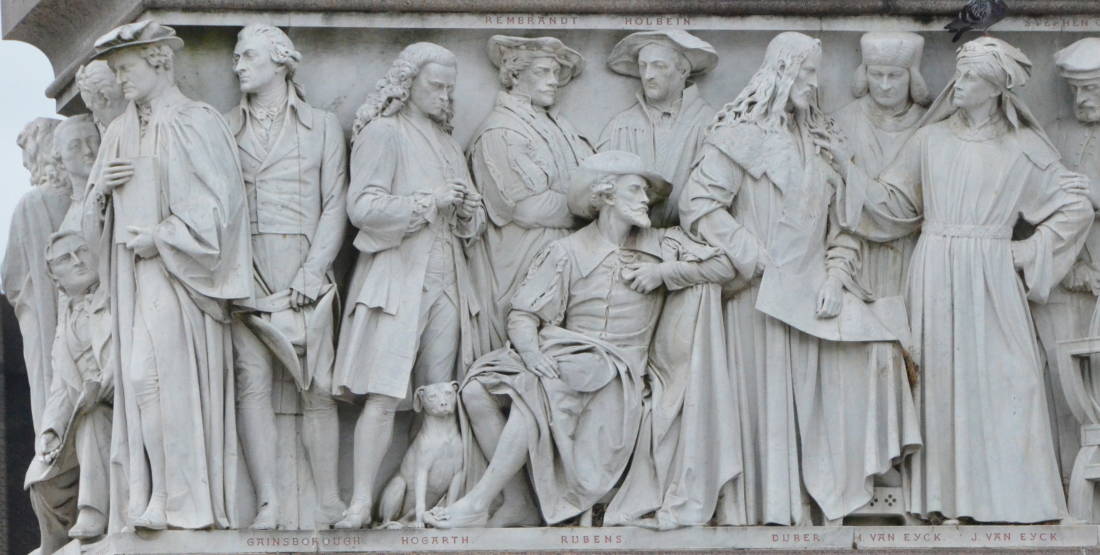
Detail from The Painters, The Frieze of Parnassus on the Albert Memorial Henry Hugh Armstead photo by George P. Landow The Victorian Web

Detail from The Painters, The Frieze of Parnassus on the Albert Memorial
Henry Hugh Armstead
photo by George P. Landow
The Victorian Web

Detail of Asia The Continents: Asia by John Henry Foley (1818-1874). Completed 1876; restored 2000. Marble. Albert Memorial photo by George P. Landow The Victorian Web

Detail of Asia
The Continents: Asia by John Henry Foley (1818-1874). Completed 1876; restored 2000. Marble. Albert Memorial
photo by George P. Landow
The Victorian Web

They walked through Hyde Park and Kensington Gardens, a little over a mile to the Albert Memorial, completed  in 1876, designed by Sir George Gilbert Scott. The monument, rising about five times higher than the top of Achilles’ head, is a compendium of Victorian sculpture. The Queen approved the artists and their designs. The walkers inspected the figures of Arts and Sciences,  169 of whom circle the memorial in the Frieze of Parnassus.  Eleanor says something about the muscular bearded manufacturer, causing Barbara to break into laughter. As they come down the steps near the group symbolizing Asia, Barbara stumbles and briefly supports herself on Jenkins’ arm, giving him a delayed emotional frisson.

The Useful Arts: Manufactures Henry Weekes Completed: 1876 (unveiled by Queen Victoria) Granite? The Albert Memorial Hyde Park, London Photograph by George P. Landow 1999 The Victorian Web

The Useful Arts: Manufactures
Henry Weekes
Completed: 1876
Granite?
The Albert Memorial
Photograph by George P. Landow 1999
The Victorian Web

Are these massive monuments mentioned just to orient us geographically? Both the Manufactures and Asia are on the southeast corner of the monument, so it is natural that the walkers should see these together.

Powell rarely misses an opportunity to let a work of art–– actual, fictional, or a composite of the two––enrich our understanding of his characters and their milieu. Here,  is he guiding us to nineteenth century associations, thoughts of Victoria and her Empire? Should we remember that the Achilles statue caused a stir as the first nude statue in London (see the cartoon from 1822 of Wilberforce using his hat to make up for a fig leaf that some thought too small.)? Should we ponder why Powell mentions the Manufacturers, rather than Commerce, Agriculture, or Engineering? Why attend to the Asian Bedouin’s “hopeless contemplation of Kensington Gardens…” while ignoring Africa, America, and Europe, even though Africa was Powell’s personal favorite (SPA….. 244)?   For now we will enjoy the  tale of young love and let others decide whether to try to read this more closely.

Posted in Uncategorized | 2 Comments

The Boyhood of Cyrus

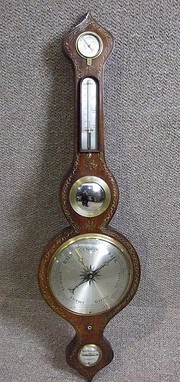
The first time that Jenkins actually sees a Deacon canvas is when he visits the Walpole-Wilson house in Eaton Square about 1928. “The canvas, comparatively small for a ‘Deacon,’ evidently not much considered by its owners, had been placed beyond the staircase above a Victorian barometer in a polished mahogany case. ” [BM 19/15]

It is amazingly easy to find a a photo to illustrate that barometer, but impossible, of course, ever to see the Deacon canvas of The Boyhood of CyrusPeter Campbell (London Review of Books 28:33 1/28/2006) writing on an exhibit at the Wallace Collection devoted to Powell, put it well:

“When both painter and paintings are fictional it is harder to imagine the pictures. The look of Edgar Deacon’s Boyhood of Cyrus must be worked out from the comparisons on offer: the Pre-Raphaelites, Simeon Solomon (whose soft-faced youths are perhaps the most suggestive parallel) and Puvis de Chavannes. It’s a mistake to match real and fictional art too quickly, just as it’s a mistake to look for the real-life originals of a novelist’s characters, but there’s no harm in identifying real elements that – like the cut-outs and bits of print Powell pasted onto screens and into scrapbooks – can be used to round an invention out.”

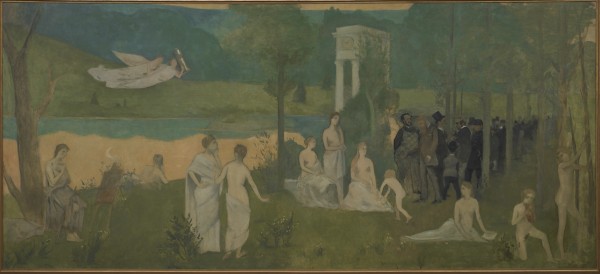
To start imagining the Boyhood of Cyrus, we looked at Puvis de Chavannes’ Ludus Pro Patria. The bucolic locale for these patriotic games, the  setting in antiquity, and the partially clad figures all fit what we know of Mr. Deacon’s style.
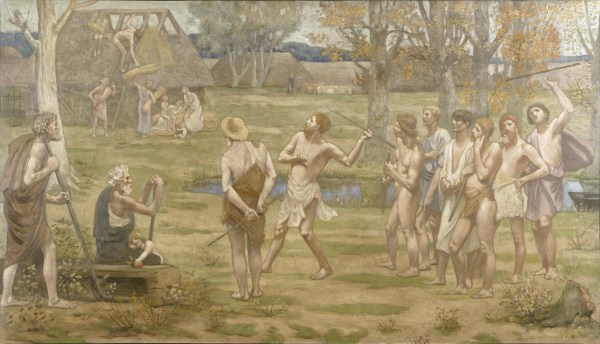
Ludus Pro Patria Pierre Puvis de Chavannes, 1883 oil on canvas H: 44 11/16 x W: 77 9/16 in. The Walters Art Museum Creative Commons Attribution-Share Alike 3.0 Unported License

Ludus Pro Patria
Pierre Puvis de Chavannes, 1883
oil on canvas
H: 44 11/16 x W: 77 9/16 in.
The Walters Art Museum
Creative Commons Attribution-Share Alike 3.0 Unported License

We then guessed that Mr. Deacon’s vision of the youth of Cyrus the Great, sixth century B.C. king of the Persian Empire, would have come from Herodotus, who related that at age ten Cyrus was “was playing on the road with other [children] of his age; and playing, the children chose him to be king over them, although he was nominally the son of a herdsman. And he appointed some of them to build a house, others to be spearmen, and of course, one of them to be ‘the Eye of the King,’ assigning tasks to each of them separately. One of these  children … did not do the task assigned by Cyrus. He therefore ordered the other children to seize him. The children obeyed and Cyrus handled the child very roughly, and whipped him. ” (Tales from Herodotus: VIII. Story of Cyrus the Great, translated at metaphrastes.wordpress.com) That this founder’s myth is of dubious truth is irrelevant to our imagination.  We looked back at Ludis Pro Patria, replacing the figures with young boys, obeying the future king.

We are not the first to alter a Puvis de Chavannes painting for a little fun.  His The Sacred Grove (Le Bois sacré cher aux arts et aux muses), visible at the Art Institute of Chicago, won a prize  at the Salon of 1884. Toulouse-Lautrec, age 20, saw the exhibition and rushed with his friends to ape the style in a large painting, thirteen feet long and six feet high, replacing the nymphs with pictures of himself and acquaintances and adding  a number of anachronisms and sight gags. This parody of Puvis de Chavannes was long little known, held in private collections; Henry Pearlman brought it to the US in 1953, but it was first loaned by the Henry and Rose Pearlman Foundation to the Princeton Art Museum in the 1970s. Powell probably did not know the parody when he wrote BM, but it is in the spirit of his humorous depiction of Mr. Deacon.

The Sacred Grove Henri de Toulouse-Lautrec, 1884 The Henry and Rose Pearlman Collection

The Sacred Grove
Henri de Toulouse-Lautrec, 1884 photo by Bruce M White
The Henry and Rose Pearlman Collection
at the Princeton University Art Museum

As for Mr. Deacon himself, the widening chasm that separated his sensibilities from those of Toulouse-Lautrec and myriad other pioneers of Modernism can be glimpsed by comparing Ludus Pro Patria with Degas’ Young Spartans Exercising, reproduced in our post called “Sketch of Antinous.” Degas’ painting is the earlier, but forward-looking in its lack of sentimentality; Puvis de Chavannes’ later treatment of a similar scene is filled with nostalgia.

448px-Frederic_Leighton_-_The_Hit

The Hit Sir Frederick Leighton, ~1893 oil on canvas, private collection, Roy Miles Gallery, photo public domain the Bridgeman Art Library via Wikimedia Commons

In Album, Lady Violet Powell shows The Hit by Sir Frederick Leighton (British, 1830-18960 when she mentions The Boyhood of Cyrus. This picture does meet the requirement of being a rather small canvas that would fit above the stairway. John Bayley (Album, p.11) says of this painting, “Wonderfully absurd it is, even though the real Leighton was a much better painter than the imaginary Deacon…”

 

Posted in Uncategorized | Tagged , , | 5 Comments

Montmarte in Whistler’s Time

Nicholas, still remembering Mr. Deacon at the Louvre in about 1919, says that Mr. Deacon bemoaned the “‘Americanisation’ of the Latin Quarter,” and said, “I sometimes think of moving up to Montmartre, like an artist of Whistler’s time.” [BM 17/ ~13]

Portrait of Whistler with a Hat James McNeill Whistler, 1857-1859 The Freer Gallery Oil on canvas H: 46.3 W: 38.1 cm

Portrait of Whistler with a Hat
James McNeill Whistler, 1857-1859
The Freer Gallery of Art and Arthus M. Sackler Gallery (with permission)
Oil on canvas
H: 46.3 W: 38.1 cm

James McNeill Whistler (1834-1903) was born in America, spent part of his  childhood in Russia, attended West Point, and did his best known painting in Britain; however, he did live and study in Paris from 1855 until about 1859 and later returned there from time to time.  His method of study included copying paintings at the Louvre; this self portrait from his Parisian student days strongly reflects the influence of the Rembrandts that he studied in the Louvre.  He lived at this time in the Latin Quarter and was often penurious, selling few paintings. In 1859 he moved to London . 

Montmartre developed as a hillside village of farms and windmills, north of central Paris.   The village became urbanized in the second half of the nineteenth century and began to attract artist’s studios.  Whistler, returning to Paris in 1861, rented a studio there. However, the heyday of Montmartre, vying with the Latin Quarter as the artistic center of Paris, was really in the 1880’s and 90’s when artists like Toulouse-Lautrec, Van Gogh, Degas, and Renoir painted there. (Myers, Nicole. “The Lure of Montmartre, 1880–1900”. In Heilbrunn Timeline of Art History. New York: The Metropolitan Museum of Art, 2000). We suspect that Deacon was not yearning for the flamboyant Montmartre of Toulouse-Lautrec but, rather, knew this history of Whistler’s time and was nostalgic for the 1860s before bohemian became chic. As for Whistler, when he moved back to Paris in 1892, he settled in the more aristocratic Faubourg St. Germain.

Posted in Uncategorized | Tagged , , | 3 Comments