Masaccio to Matisse

On at least four occasions, different characters in Dance use alliterative contradictory pairings of artists’ names to emphasize ignorance of art. While this name dropping or name dissing may not be as important as other artistic references for understanding the text, we will join Powell’s fun by providing visual examples of the contradictions.

Touring Stourwater, Jenkins “felt certain that Sir Magnus was secure in the exact market price of every object” there. This reminded Jenkins of Barnby’s description of “a chartered accountant, scarcely aware of how pictures are produced, who could at the same time enter any gallery and pick out the most expensive work there ‘from Masaccio to Matisse’…” [BM 211/201]

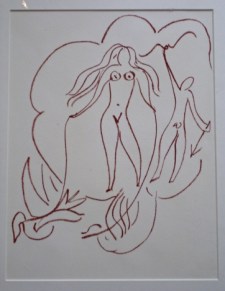
Masaccio (1401-1428) was the first great painter of the Quattrocento in Florence; Henri Matisse (1869-1954) helped lead the great changes in modern art in France in the first half of the twentieth century. To compare their styles on the same subject, we have taken some chronological liberty; the Matisse Adam and Eve was done about twenty years after the scene at Stourwater, but before Powell wrote BM. While the Masaccio is priceless and unavailable, today the chartered accountant could buy the Matisse lithograph (from an edition of 320) from Caroline Wiseman Modern and Contemporary for £1000 (accessed 12/1/13).

Expulsion of Adam and Eve from the Garden of Eden Masaccio ~1425 fresco from the walls walls of the Brancacci Chapel in the church of Santa Maria del Carmine in Florence,  photo public domain from Wikimedia Commons

Expulsion of Adam and Eve from the Garden of Eden
Masaccio ~1425
fresco from the walls walls of the Brancacci Chapel in the church of Santa Maria del Carmine in Florence,
photo public domain from Wikimedia Commons

Adam and Eve, Florilege des Amours de Ronsard Henri Matisse, 1948 16 by 13 inches Original lithograph in sanguine on Arches paper. Inspired by the love poetry of Ronsard; Printed at L'Atelier Mourlot; Published by Alberta Skira in an edition of 320

Adam and Eve, Florilege des Amours de Ronsard
Henri Matisse, 1948
16 by 13 inches
Original lithograph in sanguine on Arches paper.
Inspired by the love poetry of Ronsard; Printed at L’Atelier Mourlot; Published by Alberta Skira in an edition of 320

Posted in Uncategorized | 2 Comments

Gainsborough’s Mrs. Siddons

Mrs. Sarah Siddons Thomas Gainsborough, 1785 oil on canvas, 50 x 39 inches The National Gallery, London photo public domain from Wikimedia Commons

Mrs. Sarah Siddons
Thomas Gainsborough, 1785
oil on canvas, 50 x 39 inches
The National Gallery, London
photo public domain from Wikimedia Commons

During the portentous luncheon at Stourwater, Nick is struck by Lady Huntercombe, “whose features and dress had been designed to recall Gainsborough’s Mrs. Siddons.”[BM 209/199].  Later, at Stringham’s wedding to Peggy Stepney, Nick notices Lady Huntercombe to be “arrayed more than ever like Mrs. Siddons.” [BM 236/226]

Thomas Gainsborough (1727-1788) was one of the brightest stars of English portraiture in the eighteenth century.  Gainsborough was of modest birth but was identified as a talent early in life and sent to London to study under William Hogarth. He worked first in Ipswich, then Bath, and finally London, where he became a founding member of the RoyalAcademy and a favorite of George III, though Gainsborough’s chief rival, Sir Joshua Reynolds, won the king’s preference for court painter.

Like most other portraitists of genius, Gainsborough’s heart lay elsewhere—in this case with landscape painting––but wealthy sitters paid the bills. The wealthy sitter in question here was Sarah Siddons (1755-1831), a renowned actress of the day and a stunningly fashionable figure.  Gainsborough’s dashing portrait of Mrs. Siddons from 1785 was a prized exhibit in the National Gallery, where it resides still, so Nick and his luncheon companions would readily recognize Lady Huntercombe’s emulation of it.  Her choice to dress at the Stourwater luncheon in fashions that were popular in the mid eighteenth century says something of Lady Huntercombe’s notion of her own station.  What Nick implies about the design of Lady Huntercombe’s “features” can only be guessed.  Perhaps a clue is to be found in a remark Gainsborough is reputed to have made while working on Mrs. Siddons: “Confound the nose, there’s no end to it!”

Posted in Uncategorized | 1 Comment

Luxuria

The Triumph of Lust  From a seven-piece Seven Deadly Sins Design by Pieter Coecke van Aelst, ca. 1532–33 Woven in Brussels, ca. 1542–44 Wool, silk, and gilt metal-wrapped thread; 15 ft. 3/4 in. x 27 ft. 3 1/2 in. (459 x 832 cm) Mark of Brussels (bottom left selvage) and an unidentified weaver's mark (bottom right selvage) Patrimonio Nacional, Palacio Real de Madrid

The Triumph of Lust
From a seven-piece Seven Deadly Sins
Design by Pieter Coecke van Aelst, ca. 1532–33
Woven in Brussels, ca. 1542–44
Wool, silk, and gilt metal-wrapped thread; 15 ft. 3/4 in. x 27 ft. 3 1/2 in.
Patrimonio Nacional, Palacio Real de Madrid

Nick’s momentous first visit to Stourwater, the redoubt of Sir Magnus Donners, is occasioned by his inclusion in a luncheon party there in the company of  the Walpole-Wilsons.  “The dining room was hung with sixteenth century tapestries.  I supposed that they might be Gobelins from their general appearance, blue and crimson tints set against lemon yellow.  They illustrated the Seven Deadly Sins.  I found myself seated opposite Luxuria, a failing principally portrayed in terms of a winged and horned female figure, crowned with roses, holding between finger thumb one of her plump, naked breasts, while she gazed into a looking-glass, supported on one side by Cupid and on the other by a goat of unreliable aspect.  The four-footed beast of the Apocalypse with his seven dragon-heads dragged her triumphal car, which was of great splendour.  Hercules, bearing his clubs, stood by, somewhat gloomily watching this procession, his mind filled, no doubt, with disquieting recollections.  In the background, the open doors of a pillared house revealed a four-poster bed, with hangings rising to an apex, under the canopy of which a coupe lay clenched in a priapic grapple.  Among trees, to the right of the composition, further couples and groups, three or four of them at least, were similarly occupied in smaller houses and Oriental tents; or, in one case, simply on the ground.” [BM 199/190]

This richly symbolic art work is an invention of Powell’s, but one clearly based on actual models, if imperfectly so.  Gobelin tapestries did not come into production until the seventeenth century, but Belgian tapestries were in full production in the sixteenth, when Nick supposes the Stourwater set originated.  We believe that Cardinal Wolsey commissioned a set of Belgian tapestries depicting the Seven Deadly Sins for his residence at Hampton Court, but we have been unable to find an image of any of these, if indeed any survive.  Because Wolsey’s palace became a possession of the Crown at his death, and has remained so since, it is possible that Powell viewed Wolsey’s tapestries as a visitor to Hampton Court Palace.

A tantalizing alternative is suggested by Cassidy Carpenter, a high-school-aged scholar at Andover in 2008, whose teacher posted his students’ essays on Dance in an online compendium. Carpenter argues that Powell’s Luxuria is modeled on The Triumph of Lust, a Belgian tapestry completed  in 1533, based on a design by the Flemish  painter Pieter Coecke van Aelst (1502-1550),  himself the son of a tapestry weaver.   Van Aelst’s tapestry does not match Nick’s description of Luxuria, but Carpenter makes a credible claim for its role as Powell’s inspiration.

Van Aelst was the mentor and father-in-law of Pieter Breugel the Elder. More information about the family is available on the DeMeijer family website, which reports that the Luxuria displayed in Madrid is “one of four surviving tapestries from a set purchased by Mary of Hungary in 1544.” The photos available of the tapestry provide little detail because of its size, but Carpenter has guided us to a more detailed reproduction in a Metropolitan Museum of Art exhibition catalogue (Campbell Tapestry in the Renaissance: Art and Magnificence Yale University Press 2002, p 412-3); she points out that the tapestry which Powell describes is much more risque that the Van Aelst version of Lust. We show only thumbnails below because the book is copyrighted; follow the link to the book to see more detail.

lust-leftlust-right
In Album, Lady Violet Powell leads our search for Luxuria away from tapestries to a painted table often attributed to Hieronymous Bosch (1450-1516) that includes images of the Seven Sins


Jheronimus_Bosch_Table_of_the_Mortal_Sins_(Luxuria)

Luxuria, detail from Table of the Mortal Sins, Hieronymous Bosch, 1505-1510, oil on panel, full table size 47 x 59 in, The Prado, image in public domain from Wikimedia Commons https://upload.wikimedia.org/wikipedia/commons/6/6f/Jheronimus_Bosch_Table_of_the_Mortal_Sins_%28Luxuria%29.jpg

Incidentally, the Seven Deadly Sins in question are not a universally constant set, but since medieval times are typically identified as gluttony, sloth, greed, envy, wrath, pride, and lust. Luxuria is the Latin formulation for that last and most fascinating trait. All the others do star turns in Dance, but Luxuria certainly gets top billing.

Posted in Uncategorized | 4 Comments

The Walpole-Wilson Portraits

Powell was a Trustee of the National Portrait Gallery for many years. In Dance, he returns again and again to portraits, which not only show a family’s history, status, and taste, but also provide a glimpse at the history of British art.

The pictures in the Walpole-Wilson house are mostly ancestral portraits, like an Admiral attributed to Zoffany. [BM 186/177]

Portrait of Major George Maule, acting chief engineer of Madras (1751-1793).  Johann Zoffany Oil on canvas. 24 ¼ x 18 ¾ in, Photo originally from Art Loss Register

Portrait of Major George Maule, acting chief engineer of Madras (1751-1793).
Johann Zoffany
Oil on canvas. 24 ¼ x 18 ¾ in,
Photo originally from Art Loss Register

Johan Zoffany (German 1733-1810) painted in Britain after 1760 and helped found the Royal Academy. He was known for his theatrical scenes, ‘conversations,’ and views of eighteenth century British life.  In 2012 the Royal Academy collaborated with the Yale Center for British Art in an exhibition, Johan Zoffany RA: Society Observed , which emphasized Zoffany’s talent as an observer and interpreter of society.

Zoffany’s portrait subjects included King George III, so his portrayal of a Walpole-Wilson ancestor illustrates the prestige of the family.  We have not been able to find an Admiral, but this Major is the type of portrait that the Walpole-Wilson’s might have displayed. In 2009 this work was offered for auction from the collection of Gianni Versace; however, the family of Major Maule reclaimed it as a stolen family heirloom.

The collection is brought into the twentieth century by  a portrait of Lady Walpole-Wilson’s father by Isbister.  We already know Powell’s creation, Horace Isbister, R.A. from his portrait of Templer’s father. Earlier in BM [94/87], Widmerpool, whose ignorance of art is prodigous, praised Isbister’s portrait of Cardinal Whelan, while popular opinion favored his portrait of the wife of the Solicitor General.

Herbert Hardy Cozens-Hardy, 1st Baron Cozens-Hardy (1838-1920) Master of the Rolls
Reginald Grenville Eves 1911
Oil on canvas
Height: 27″, width: 20″
London, Government Art Collection

The invention of photography in the mid nineteenth century changed portrait painting; there was less demand for representational portraits, leading to a proliferation of more experimental portrait strategies in the twentieth century. Isbister managed to avoid the change. His painting conveyed “the impression that at any moment Lord Aberavon, depicted in peer’s robes, would step from the frame and join the company below him in the room.” (This is the same Lord Aberavon, whose taste in art led him to purchase Mr. Deacon’s Boyhood of Cyrus.)  As an approximation of the imaginary portrait, we offer this early twentieth century painting by another Academician, Reginald Eves (1876-1941), of another peer in robes to convey Isbister’s dedication to a realism that many Modern portraitists would abandon.

Posted in Uncategorized | 1 Comment

Mr. Deacon’s Shop

Burr Walnut Cradled Trumpet Work Table  available from David Wolfeneden Antiques, November , 2013 http://www.antiques-atlas.com/antique/antique_burr_walnut__cradled__trumpet_work_table/as224a269

Burr Walnut Cradled Trumpet Work Table
available from David Wolfeneden Antiques, November , 2013

Victorian Papier Mache Tray available from Graham Smith Antiques, November, 2013

Victorian Papier Mache Tray
available from Graham Smith Antiques, November, 2013

Stafforshire Figures Pugs became popular figures after Queen Victoria received a live pug as a gift.

Stafforshire Figures
Pugs became popular figures after Queen Victoria received a live pug as a gift. Shown by Elinor Penna on the web, November, 2013

When Nick first visted Mr. Deacon’s shop, it was closed. “Through the plate glass, obscured in watery depths, dark green like the interior of an aquarium’s compartments, a Victorian work table, papier mache trays, Staffordshire figures, and a varnished scrap screen — upon the sombrely coloured montage of which could faintly be discerned shiny versions of Bubbles and For He Had Spoken Lightly of a Woman’s Name … [BM 172/163 ]”

Bubbles John Everett Millais oil on canvas The Lady Lever Gallery photo public domain from Wikimedia Commons

Bubbles
John Everett Millais
oil on canvas
The Lady Lever Gallery
photo public domain from Wikimedia Commons

Bubbles, a picture of innocent childhood, is by John Everett Millais, whom we have already introduced as the painter of The Boyhood of Raleigh.  Millais sold reproduction rights to Bubbles to the A.F. Pears Soap Company, which made it into a massively distributed advertising image, adding a bar of soap to the picture. When Tate Britain presented a Millais exhibit in 2007, the headline of a review in The Guardian summarized the effect on Millais’ status: “Tate sets out to rescue reputation of artist tarnished by Bubbles.” (The Guardian review, for those interested, also revisits Millais’ scandalous romantic life.)  When Lever Brothers acquired A.F. Pears Company, it also acquired the original oil, which it now displays in the Lady Lever Gallery. We will bet that the image in Mr. Deacon’s window showed the bar of soap.

For He Had Spoken Lightly of a Woman's Name John Arthur Lomax

For He Had Spoken Lightly of a Woman’s Name
John Arthur Lomax

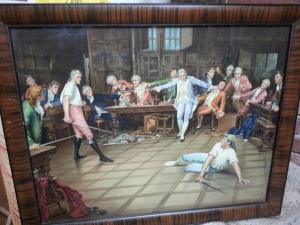
John Arthur Lomax (1857 – 1923) is a British artist, who is nearly forgotten today. He does not even have a Wikipedia entry (accessed 11/16/13), the ultimate sign of disrespect in the Internet Age.  For He Had Spoken Lightly of a Woman’s Name  is more an illustration for  a boys’ adventure story than a remembered work of art. Jenkins shows that Mr. Deacon’s store was a repository of popular culture rather than of high art, but tastes change, and today similar items, perhaps more polished than Mr. Deacon’s examples, are sold for hundreds of dollars,  as illustrated by the three images at the beginning of the post.

One of our readers has provided a photo of a colored reproduction of the Lomax work.

For He Had Spoken Lightly of a Woman’s Name John Arrthur Lomax, 1905 photo courtesy of Marty Mulder Tetloff, Metro Tacoma Fencing Club

For He Had Spoken Lightly of a Woman’s Name
John Arrthur Lomax, 1905
photo courtesy of Marty Mulder Tetloff, Metro Tacoma Fencing Club

Posted in Uncategorized | 4 Comments

Canaletto, et al.

After Mrs. Andriadis’ party and an exhaustingly long night out, Nick returns to the neighborhood of his shabby flat in Shepherd Market, gentrified today but then a precinct of “seedy glory” in his eyes.  In reality, the walk through Mayfair is only a few minutes, but Powell makes it seem like a journey through time. In a sweeping passage evoking the romantic beauty of sunrise over this ruinous quarter, Powell invokes no fewer than four eighteenth-century artists to help paint the scene:

“Now, touched almost mystically, like another Stonehenge, by the first rays of the morning sun, the spot seemed one of those clusters of tumble-down dwellings depicted by Canaletto or Piranesi, habitations from amongst which arches, obelisks and viaducts, ruined and overgrown with ivy, arise from the mean houses huddled together below them .  . . . As I penetrated farther into the heart of that rookery, in the direction of my own door, there even stood, as if waiting to greet a friend, one of those indeterminate figures that occur so frequently in the pictures of the kind suggested—Hubert Robert or Pannini––in which the architectural subject predominates.”  [BM 161-2/153-4]

Canaletto is the name by which we now know the Venetian painter Giovanni Antonio Canal (1697-1768), famous for his majestic depictions of Venice, at once panoramic and filled with local incident and detail.  Powell alludes to the way in which Canaletto’s admiration for Venice’s architectural splendors blends seamlessly with his attention to the squalor of everyday life in La Serenissima.  Canaletto’s paintings were highly prized by English visitors to Italy, and many Canalettos found their way into the great British collections.  Late in his career Canaletto moved to England, where he painted many scenes of London and the great houses in the surrounding countryside, but his genius seems not as well suited to this terrain as to his native city, and the English paintings are not among his most highly regarded.

The Stonemason’s Yard, reproduced here, gives a sense of Canaletto’s proto-Romantic pairing of the humble and the sublime that so moves Nick as he approaches Shepherd Market.
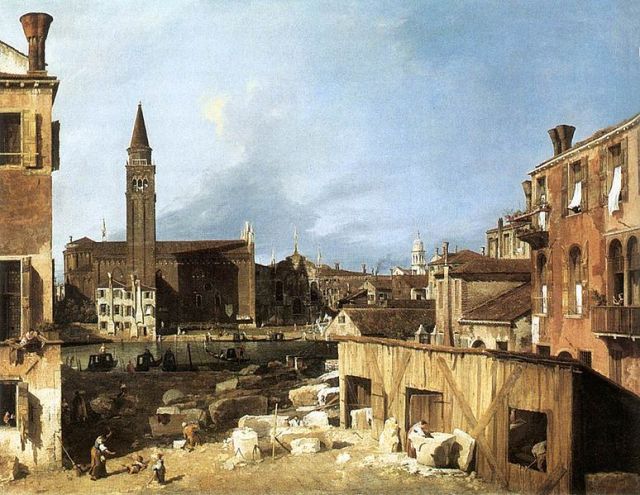
The Stonemason's Yard Giovanni Antonio Canaletto 1726-30 oil on canvas 49" x 64" National Gallery, London public domain from Wikimedia Commons

The Stonemason’s Yard
Giovanni Antonio Canaletto 1726-30
oil on canvas 49″ x 64″
National Gallery, London
public domain from Wikimedia Commons

Giovanni Battista Piranesi (1720-1778), accomplished for the glories of Rome what Canaletto had begun a generation earlier for Venice, though with a difference.  The apex of Venetian hegemony over the eastern Mediterranean had only recently passed, and perhaps that passing was not even fully apparent to Venetians of Canaletto’s generation.  In Canaletto’s Venetian panoramas the contrast is between public splendor and private humility.  In Piranesi’s work the architectural wonders of Imperial Rome are artifacts of an Arcadian past, almost invisible to medieval Romans, and now an occasion for archeology and nostalgia.

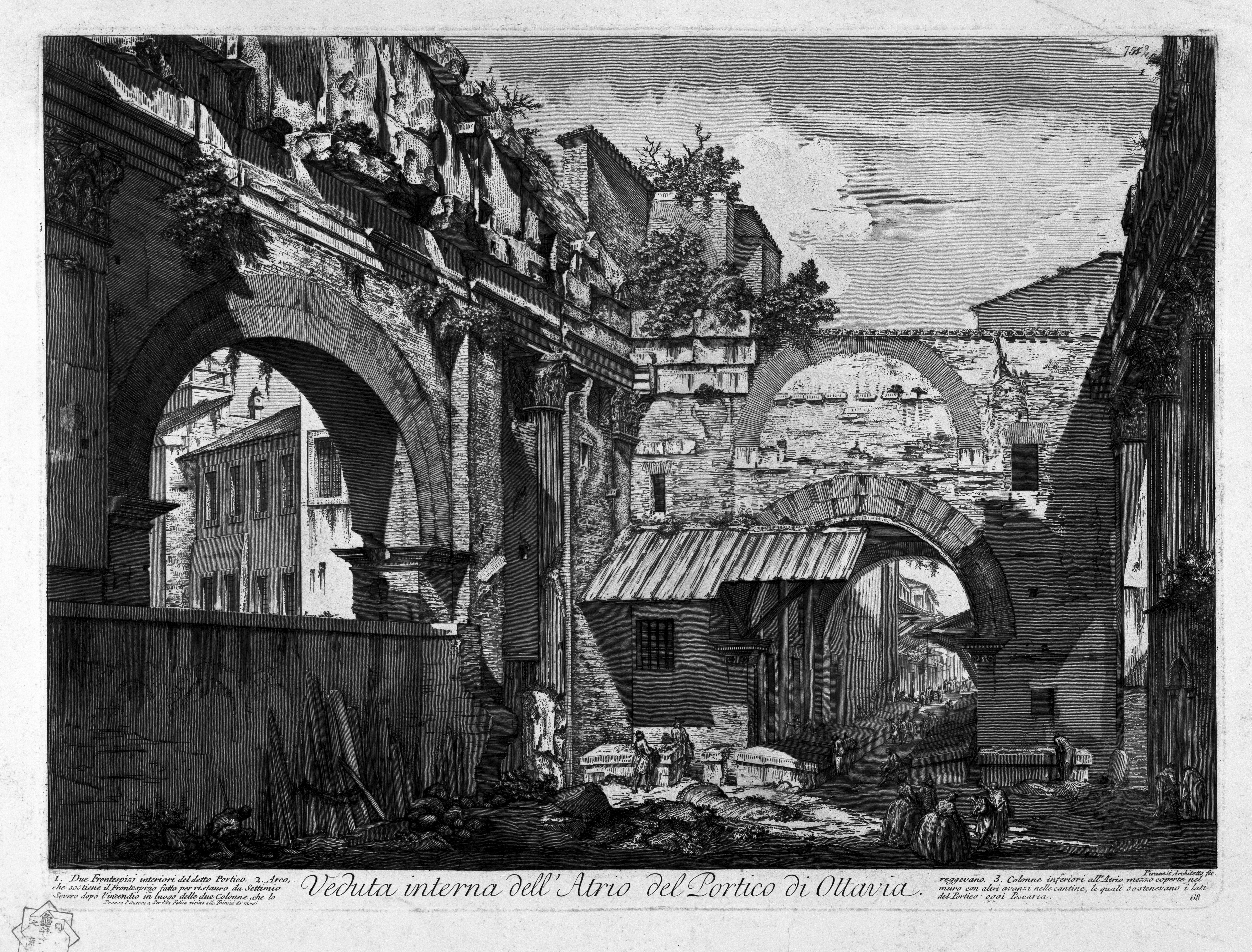
Piranesi studied as an architect and draughtsman in Venice, where his uncanny mastery of linear perspective became apparent.  He moved to Rome in 1740 and studied etching and engraving, and at the same time furthered his architectural studies by measuring meticulously the ancient ruins that underlay the 18th century city.  These experiences combined to inform his lifelong magnum opus, a series of etched drawings of vedute, or views, of Rome, in which the ruins of its ancient monuments survive cheek by jowl with the litter of their successors through the centuries.  In many cases, Piranesi’s views are examples of visual archeology, because he used his architectural knowledge and measurement data to “restore” ancient buildings in his drawings as they would come to be restored literally by future generations.  In addition, Piranesi’s mastery of perspective allowed him to alter the scales of monuments, convincingly, to accentuate a sense of romantic nostalgia for a lost classical past.  Piranesi was enormously successful in publishing and selling his etchings during his lifetime, and a huge industry persists to this day in the trade of his original prints, posthumous prints of his original plates, restrikes made from those plates, and lithographic posters printed from photographs of his original work.
Veduta interna dell' Atrio del Portico di Ottavia. Giovanni Piranesi, 1748-1774 etching, frontispiece form Vedute di Roma. Tomo I, tav. 68 // Opere di Giovanni Battista Piranesi, Francesco Piranesi e d'altri. Firmin Didot Freres, Paris, 1835-1839. Tomo 16. Public domain from Wikimedia Commons

Veduta interna dell’ Atrio del Portico di Ottavia.
Giovanni Piranesi, 1748-1774
etching, frontispiece form Vedute di Roma. Tomo I, tav. 68 // Opere di Giovanni Battista Piranesi, Francesco Piranesi e d’altri. Firmin Didot Freres, Paris, 1835-1839. Tomo 16.
Public domain from Wikimedia Commons

 Reproduced here is Piranesi’s View of the Inside of the Atrium of the Porta di Ottavia, in which contemporary Romans seem to toil almost oblivious of their noble surroundings.

Hubert Robert (1733-1808) and Giovanni Paolo Panini (1692-1765) are the two additional view painters whom Nick invokes to suggest the insignificance, in comparison to its architectural surroundings, of the figure lurking in his doorway (soon to be identified as the all too significant Uncle Giles).  Robert was a Parisian, Panini from Piacenza in northern Italy, and both found their way to Rome as a result of renewed Europe-wide interest in the excavation of classical ruins.  Panini was the elder artist and employed Robert in his workshop; both associated with Piranesi and with Robert’s French contemporary, Jean-Honore Fragonard.  While neither Robert nor Panini are very popular with contemporary general audiences, their reputations among scholars has not diminished noticeably, and both painters were enormously successful in their time, especially among wealthy tourists on the Grand Tour who could afford to take home a really grand souvenir of Rome.  
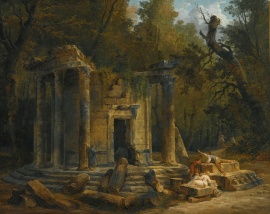
Temple of Philosophy at Ermenonville Hubert Robert oil on canvas 37" x 46" offered for auction by Southby's, 2013 photo public domain from Wikimedia Commns

Temple of Philosophy at Ermenonville
Hubert Robert
oil on canvas 37″ x 46″
offered for auction by Southby’s, 2013
photo public domain from Wikimedia Commns
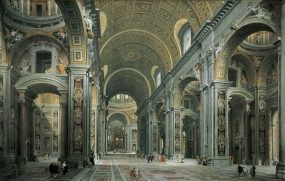
The Interior of St. Peter's, Rome Giovanni Paolo Panini, 1731 oil on canvas 57" X 90" St. Louis Museum of Art photo in public domain from Wikimedia Commns

The Interior of St. Peter’s, Rome
Giovanni Paolo Panini, 1731
oil on canvas 57″ X 90″
St. Louis Museum of Art
photo in public domain from Wikimedia Commns

Both Robert and Panini were fond of architectural fantasies and dreams of a classical past, as in Robert’s Temple of Philosophy at Ermenonville, but both were also masters of documentary exactitude, as the Panini Interior View of St. Peter’s, Rome, suggests exquisitely.

photo of Shepherd's Market, 1938 http://www.shepherdmarket.co.uk/history.htm

photo of Shepherd’s Market, 1938
http://www.shepherdmarket.co.uk/history.htm

We will finish with a photo of Shepherd’s Market, taken a few years later in 1938, to show how much morning light, mood, and imagingation romanticized Jenkins’ perception.

Posted in Uncategorized | 2 Comments

Adam and Eve Leaving the Garden of Eden

Adam and Eve Driven from Paradise James Tissot www.jamestissot.org

Adam and Eve Driven from Paradise
James Tissot
http://www.jamestissot.org
Gouache on board, 8 7/8 x 12 7/16 in. (22.6 x 31.7 cm)
The Jewish Museum, New York

When Sir Magnus and Baby Wentworth enter the room together, Jenkins is struck by the appearance of this usually beautiful woman: she had an ‘almost hang-dog air;’ her ‘features had lost all gaiety and animation;’ she appeared ‘sulky,’ ‘almost awkward.’ [BM 147/] She reminds Jenkins of an painting of Adam and Eve leaving Eden.

Adam and Eve have been painted many times and are familiar to all; the scene is cinematically vivid in Powell’s witty prose, so why should we bother to blog about paintings that Powell was not describing? First, Jenkins is reminded of modern Biblical paintings, so this gives us an opportunity to learn more about other artists whose work Powell must have known. Second, we welcome the opportunity to ponder the end of the paragraph:  “I almost expected them to be followed through the door by a well-tailored angel, pointing in their direction a flaming sword.”

Jenkins was imaging a modern painting, not one ‘in Mr. Deacon’s vernacular.’ He clearly was not thinking of the work above by James Tissot. We show it because, like Baby Wentworth, this Eve is small with dark curly hair and a face expressing her dismay.

Tissot (1834-1902) was born in Nantes and started painting in France, but anglicized his name from Jacques-Joseph to James. He built a career as a society painter. Proust says that Tissot’s  La Cercle de la Rue Royale (1868), showing members of the Paris Jockey Club, includes his friend Swann (Karpeles, p237).  Tissot spent his later career in Britain. When his beloved mistress Kathleen Newton died, he became more devoutly Catholic and often painted religious themes. A contemporary and friend of Alma-Tadema, Degas, and Whistler, Tissot was most akin stylistically to the first of these.

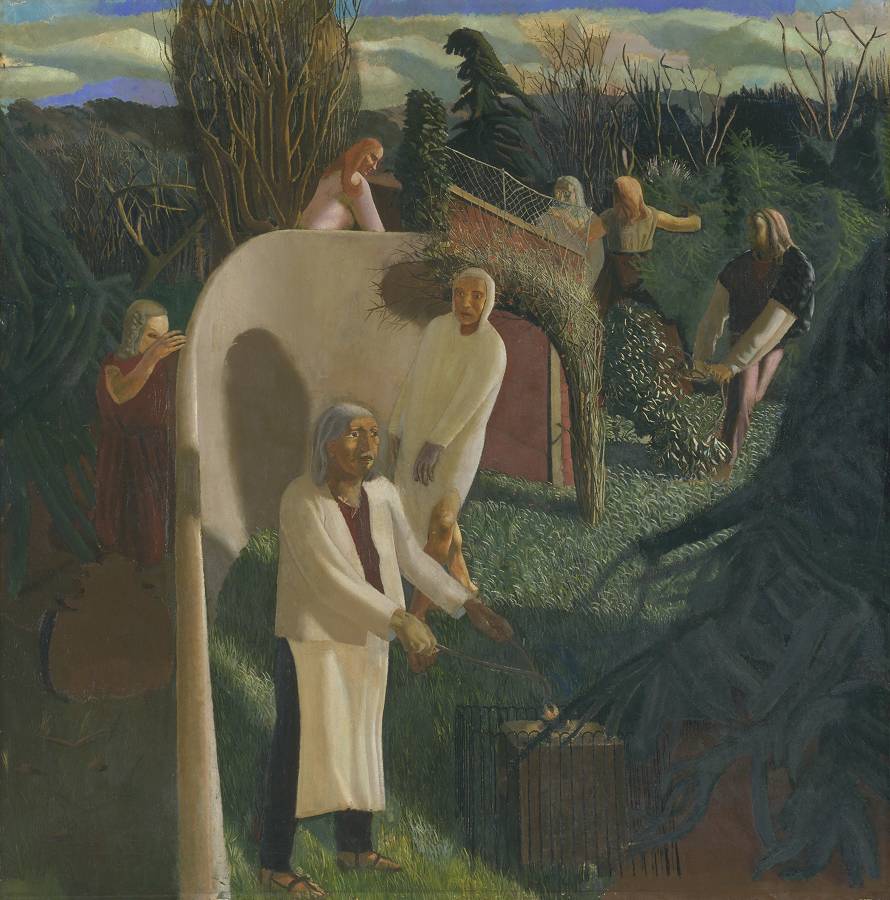
Zacharias and Elizabeth Sir Stanley Spencer, 1913-4 oil and graphite on canvas Tate Britain Full screen  © Estate of Stanley Spencer. All Rights Reserved, DACS 2002
Zacharias and Elizabeth
Stanley Spencer, 1913-4
oil and graphite on canvas
Tate Britain
© Estate of Stanley Spencer. All Rights Reserved, DACS 2002

One painter from Jenkin’s era who showed Biblical figures in modern settings is Sir Stanley Spencer (1891-1959). In the Zacharias and Elizabeth, he shows Archangel Gabriel telling Zacharias that his wife will bear a child from God.  Spencer typically set his twentieth century versions of biblical scenes in his native village of Cookham, along the Thames. However,  neither Spencer nor other modern biblical painters whom we have sampled, like Chagall, Rouault, or Joseph Epstein, depict their angels with quite the well-tailored look that Jenkins imagined.

Could Powell, by referring to that anachronisitic angel, be offering a sly reductio ad absurdum critique of those who would translocate the Bible to the twentieth century? Clearly not; Powell knew that artists for millenia have been transposing Biblical scenes into their local settings. Even Tissot, who went to the Holy Land so that he could paint the Bible authentically, reportedly paid homage to Kathleen Newton with Eve’s face  and mistakenly modelled his Biblical headresses on Greek busts.

We are left to wonder whether Jenkins fantasizes that the avenging angel, dressed for the party,  is there only for Sir Magnus and his mistress or is surveying the whole exotic crowd of men in white tie with their beautiful bejeweled women.

Posted in Uncategorized | Leave a comment

An Unsatisfying Derain

At Mrs. Andriadis’ party, Jenkins sees Sir Magnus Donners standing “beneath an unsatisfying picture in the manner of Derain [BM 144/136 ]”

Andre Derain (1880-1954) was a French artist, present at the birth of Fauvism, friendly with Picasso and Matisse, inventive in his London cityscapes, but later reverting to neoclassicism. Which of these manners of Derain would be displayed to Jenkins dissatisfaction? As usual, we do not even know if Powell is thinking of a specific painting, imagining a fictious painting, or simply inducing us to think about the evolution of Modernism.

Derain’s reputation has waxed and waned. “Of all the major figures in the Ecole de Paris, André Derain’s reputation has sunk into the deepest trough. It is doubtful if it will ever again stand as high as it did between the two World Wars. (Edward Lucie-Smith, Lives of the Great 20-th Century Artists)”

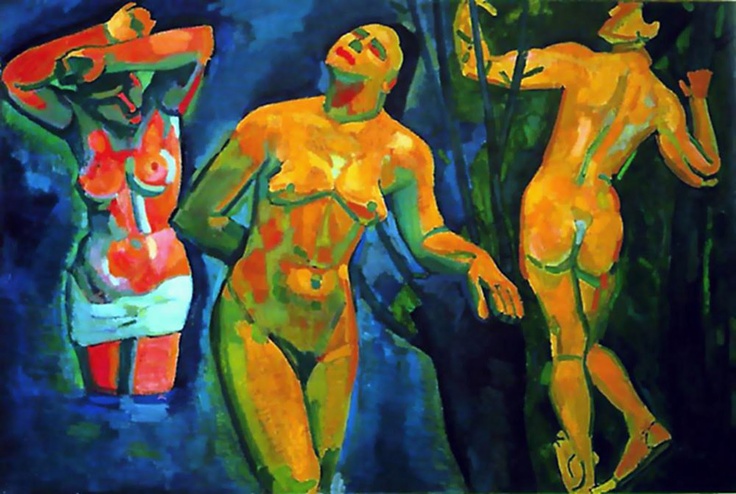
The Bathers Andre  Derain, 1907 picture from Pinterest in collection of Museum of Modern Art, NY

The Bathers
Andre Derain, 1907
picture from Pinterest
in collection of Museum of Modern Art, NY

Derain painted The Bathers in 1907.  Derain and Matisse are credited with leading the Fauvist movement, named in a review of the Salon d’Automne exhibit in 1905. The Bathers has characteristically Fauvist wild brush strokes and dissonnant colors.

Charing Cross Bridge Andre Derain, 1906 National Gallery of Art, Washington photo in US public domain from Wikipedia; copyrighted in France until 2025

Charing Cross Bridge
Andre Derain, 1906
National Gallery of Art, Washington
photo in US public domain from Wikipedia; copyrighted in France until 2025

In 1906 the Parisian art dealer Ambroise Vollard sent Derain to London to paint views of the city. Charing Cross Bridge is just one of the 30 canvases in this series; these are some of his most appreciated works (see for example the exhibit Andre Derain: The London Paintings, 2005-6, The Courtauld Institute). He continued his Fauvist brush work but used welcoming energetic colors, producing a lighter, more vibrant view of London than in earlier famous cityscapes, like those of Monet and Whistler.

Derain served in World War I. After the war, his painting was more convservative.  He went to Italy in 1921 for the Raphael centenary, and in both his writing and his painting paid homage to classical artists. He still won awards; his first solo exhibit in London was at the Lefevre Gallery in 1928, where the painting might have been acquired.

Harlequin and Pierrot Andre Derain 1924 Musee de L'Orangerie, Paris photo from Wikipaintings by fair use work copyrighted in France
Harlequin and Pierrot
Andre Derain 1924
Musee de L’Orangerie, Paris
photo from Wikipaintings by fair use
work copyrighted in France

Derain’s later work had a mixed critical reception; for example, in 1931 Jacques-Emile Blanche wrote of this part of Derain’s career: “Youth has departed: what remains is a highly cerebral and rather mechanical art.” (from Andre Derain: Pour ou Contre quoted in “Derain, André” The Oxford Dictionary of Art and Artists. Ed Ian Chilvers. Oxford University Press 2009 Oxford Reference Online. ) For example, his Harlequin and Pierrot (1924) shows a nostalgic sentimentality. By this time, Derain’s friend Picasso had become much less representational and more adventuresome in his series of Harlequins. We welcome our readers’ speculations about which style of Derain would have dissatisfied Jenkins.

Derain died in 1954, so his works are still under copyright in France; therefore, we show only thumbnails and encourage our readers to follow the links to better reproductions of the works.

Posted in Uncategorized | Leave a comment

Peter the Hermit

Preparing to part from Nick in Grosvenor Place,  Widmerpool clumsily backs into an angry young woman––our first introduction to the redoubtable Gypsy Jones––and an elderly male companion, whom Nick gradually recognizes as Mr. Deacon.  “He looked much the same, except that there was now something wilder––even a trifle sinister––in his aspect: a representation of Lear on the heath, or Peter the Hermit, in some nineteenth-century historical picture, preaching a crusade.”  [BM 91/84]

Peter the Hermit is the historical epithet given to Peter of Amiens, a French monk of the eleventh century AD who was reputed to have lived for a time as a hermit.  Legends identify Peter the Hermit as the instigator of the First Crusade against the infidels in the Holy Land, but reliable accounts assign that role to Pope Urban II.  Peter was, nevertheless, an uncommonly charismatic preacher, and when he was moved to join the crusaders against the Turks, he gathered with him a huge following of peasants as he marched across Europe toward Jerusalem in 1096.  His fortunes in battle were no match for his stirring rhetoric, however, and he was lucky to return alive to Liege (in present-day Belgium), where he founded a monastery at Neufmoutier and died in 1115.

Peter the Hermit and followers

Peter the Hermit and Followers
from S. G. Goodrich Lights and Shadows of European History (Boston: Bradbury, Soden, & Co., 1844) 211
ClipArt ETC, FCIT

If Peter the Hermit’s story is muddled by legendary accounts, his actual appearance is even more obscure; he is represented quite variously in visual lore through the ages.  Nick’s memory is likely drawn to something like the image represented here, which is reprinted from a nineteenth century history text and provides a bit of the wild and hoary aspect Nick senses in Mr. Deacon’s appearance.

Posted in Uncategorized | Leave a comment

The Quadriga’s Horses

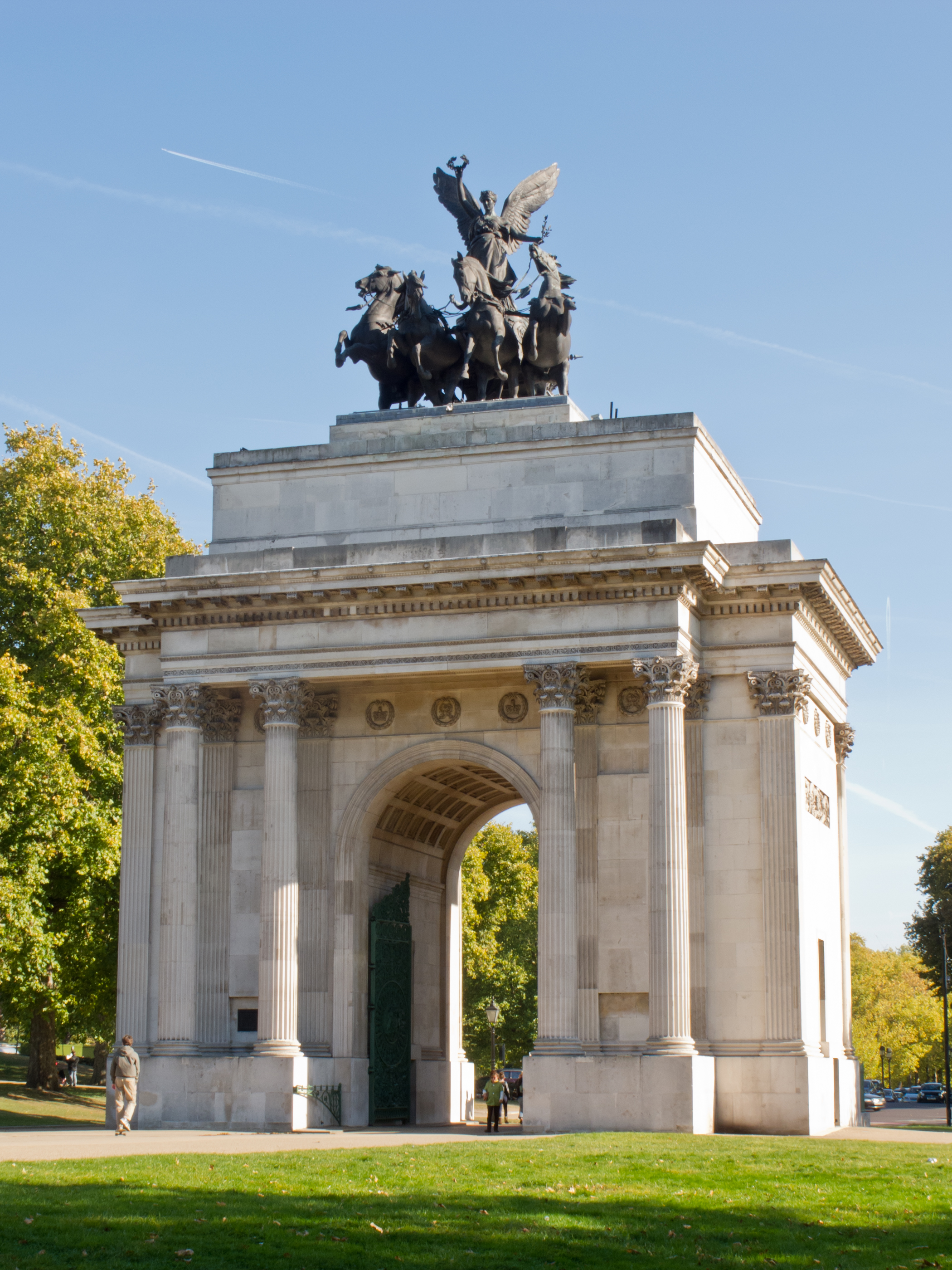
Wellington_Arch_-_01

The Quadriga atop the Wellington Arch
Hyde Park Corner
London, U.K.
photo from Wikimedia Commons

The final punctuation of Jenkins infatuation with Barbara Goring occurs near another monument, a few hundred yards from the Achilles statute where it began.  Walking with Widmerpool, who is describing his own feelings for Barbara to Nick’s dismay,  they arrive at Grosvenor Place, “in sight of the triumphal arch, across the summit of which, like a vast paper-weight or capital ornament of an Empire clock, the Quadriga’s horses, against a sky of indigo and silver, pranced desperately towards the abyss.” [BM 89/82]

Empire Clock, ormulu, showing Minerva driving the chariot of Diomedes, ~1810
Empire Clock, ormulu, showing Minerva driving the chariot of Diomedes, ~1810,
photo from Gavin Douglas Fine Antiques Ltd.

Empire clocks, which orginated during the reign of Napoleon, are mantel clocks incorporating elaborate sculptures, often of ormulu bronze. “Pendules au char” are a variety of Empire clocks with chariot sculptures. In October, 2013, we found one for sale on eBay with an elegant clock face forming the wheel of the chariot.

Nick identified the Empire-clock-type ornament as a quadriga or chariot pulled by four horses, a traditional symbol of victory. Examples are numerou,s including sculptures topping the Bradenburg Gate in Berlin (1793), the Arc de Triomphe in Paris (1815), others in St. Petersburg, Moscow, Rome, Munich, Brussels, and so on. The quadriga sculpture at Hyde Park Corner sits atop the Wellington Arch, completed in 1827 to commemorate Wellington’s victory over Napoleon. This Quadriga, reputedly the largest bronze sculpture in Europe, was designed by Adrian Jones in 1912, and shows the Angel of Peace driving the Quadriga of War, which is led by a small boy.

Posted in Uncategorized | Leave a comment