
Lansdowne Antinous. Marble, Roman Imperial artwork, ca. 130-140 AD.
Found at Hadrian’s Villa, 1769
The crown, nostrils, lips and torso have been restored. Fitzwilliam Museum, Cambridge,
photo public domain from Wikimedia Commons

Two Sketches on Antinous
John Singer Sargent (1856-1925)
After the Antique
sketchbook page, 1869
The Fogg Museum of Art
A typical patron of Mr. Deacon was “a big iron man” from the Midlands who after visiting Deacon in London would return to Lancashire with “an oil sketch of Antinous, or a sheaf of charcoal studies of Spartan youth at exercise.” [BM 8/~4]
Antinous is sometimes called “the gay god.” He was a beautiful young Bithynian Greek boy, beloved by the Roman emperor Hadrian. When Antinous drowned in the Nile in 130, Hadrian gave him the extraordinary honor of deification. As a result there were many sculptures of his beautiful body, available for sketching by an Englishman on his Italian tour. By the late nineteenth century his homoerotic beauty was a passing metaphor in three of Oscar Wilde’s works and JA Symonds devoted a chapter to him in his Sketches And Studies In Italy and Greece (1879). Symonds quotes Shelley, who in his The Colliseum, A Fragment of a Romance, written about 1819, described statutes of Antinous as showing “eager and impassioned tenderness” and “effeminate sullenness of the eye.”

Study of a Figure for Hell
John Singer Sargeant, c. 1900
Charcoal and stump on beige-laid paper, 18 7/8 x 24 1/2 in.,
Corcoran Gallery of Art, Washington, D.C.
public domain from Wikimedia Commons
We show here a charcoal nude by John Singer Sergeant, quite a bit more sophisticated than his teenage doodle of Antinous; however, we have not found charcoal sketches of Spartan youth from Mr. Deacon’s era, and he would not have approved of Degas, at least not of his later work, but this painting of the Spartan girls urging the Spartan boys to wrestle illustrates an implication about Mr. Deacon’s patrons: we think the big iron man came to London for more than just art.
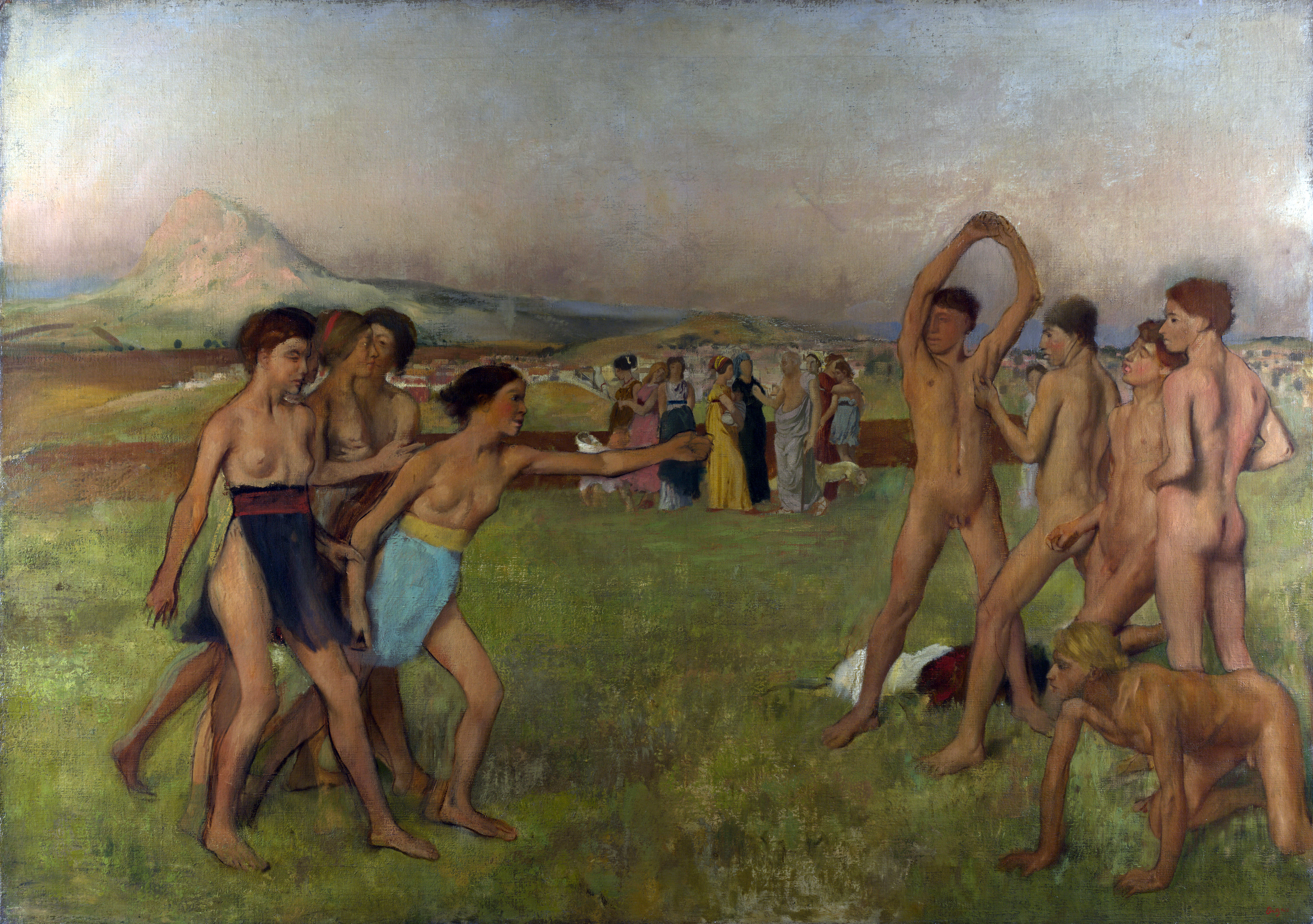
Young Spartans Exercising
Edgar Degas, 1860
National Gallery, London
photo in public domain fromWikimedia Commons


 Pictures in Powell
Thank you so much for all these picturesinpowell. They help me enormously. I think Anthony Powell was a genius at delineating character and human nature but seeing all the pictures and portraits he refers to with such ease really helps bring everyone into focus. I’m re-reading the books at the moment – just finished The Valley of Bones. Thanks again. – Virginia
Pingback: Huge Pictures of the Olympian Gods | picturesinpowell
Pingback: The Boyhood of Cyrus | picturesinpowell